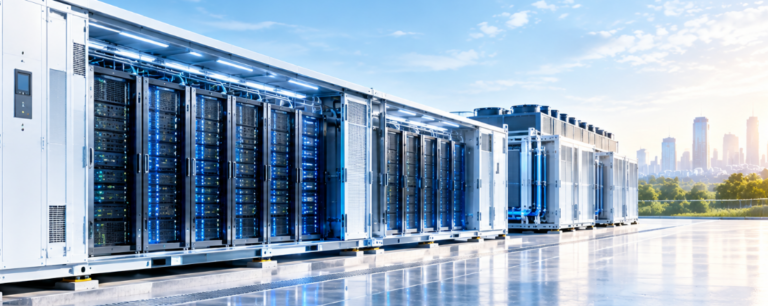


Direct-to-chip liquid cooling is the only data center cooling solution that can carry AI racks above 50 kW, and the economics trigger the switch at far lower densities than most operators expect. TrendForce reports liquid cooling penetration in AI data centers jumped from 14% in 2024 to 33% in 2025 as NVIDIA GB200 NVL72 racks reached 130-140 kW per rack, a density that forces operators to rethink their data center cooling solutions.
Direct-to-chip data center cooling solutions hold PUE near 1.10 at any density, while air-based designs climb from 1.5 toward 1.7-2.0 above 60 kW. The decision is financial, not technical.
What Is Direct-to-Chip Cooling and Why Is It Reshaping Data Center Cooling Solutions?
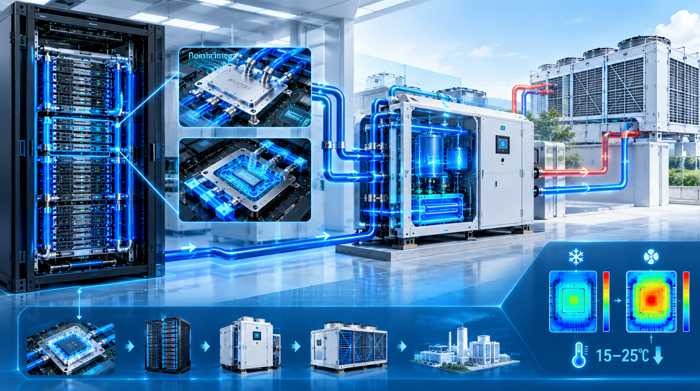
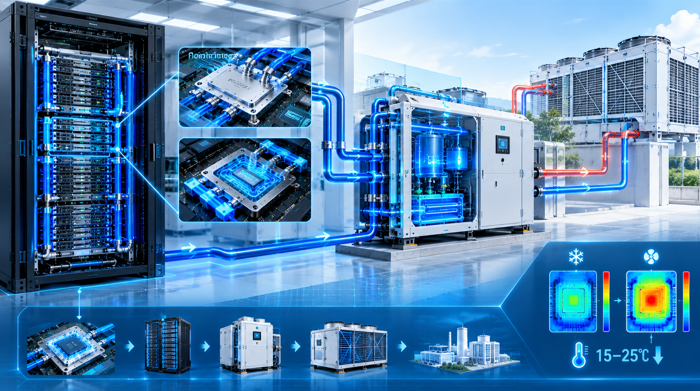
Direct-to-chip (DTC) cooling is the fastest-growing data center cooling solution for AI fleets, mounting precision cold plates directly on GPUs and CPUs and circulating coolant through microchannels to capture heat at the source. A coolant distribution unit (CDU) transfers that heat to a facility water loop or dry cooler. ResearchIntelo estimates DTC represented 38.4% of liquid cooling spend in 2025, while DC Market Insights places direct-to-chip at 71.4% of the wider liquid cooling market.
This architecture explains why DTC is the preferred data center cooling solution for GPU fleets. Junction temperatures run 15-25°C lower than air cooling at equivalent power, according to ResearchIntelo, which extends performance headroom and protects accelerator investment. NVIDIA ships the GB200 NVL family with native cold plate interfaces, and virtually every major server OEM now offers DTC-ready GPU platforms. The transition is mainstream, not experimental.
How Much Rack Density Do Air-Based Data Center Cooling Solutions Actually Support?
Air cooling hits a hard physical ceiling near 25-30 kW per rack, which is why modern data center cooling solutions have moved to liquid. American Compute documents that a 10 kW rack air-cooled at PUE 1.5 degrades toward 1.7-2.0 as load reaches 60 kW.
Water carries roughly 3,500 times the volumetric heat capacity of air, so once GPU thermal design power crosses 1,000 watts, fans and cold aisles run out of headroom no matter how much airflow is applied.
NVIDIA’s roadmap quantifies the shift: A100 at 300W in 2020, H100 at 700W in 2023, GB200 modules above 1,000W in 2025. A rack of eight such GPUs demands 80-120+ kW, which no air-based data center cooling solution can remove. The ceiling is physical, not a matter of fan count.
GYGO’s 2026 architecture guide states that rear-door heat exchangers cap near 40-50 kW and cannot scale to Blackwell densities. Removing 100 kW through airflow alone would require moving roughly 35,000 cubic feet of air per minute, which makes structured cabling and maintenance nearly impossible.
What Does Retrofitting Cost Compared with Building Liquid-Ready Data Center Cooling Solutions?
Direct-to-chip data center cooling solutions carry a capital cost of about $5,000-15,000 per rack plus CDU, piping, and external heat rejection, according to Rax 2026 data. Payback depends on density. ToneCooling reports that new high-density deployments above 40 kW per rack recover investment in under one year, while retrofits take 1.5-3 years. Dell claims direct liquid cooling cuts data center energy costs by up to 45%, with payback possible within 1.3 years.
Axis Intelligence puts the annual prize in dollars: moving one 132 kW GB200 NVL72 rack from air PUE 1.56 to liquid PUE 1.10 saves $53,191-79,786 per year at electricity prices of $0.10-0.15 per kWh. That compounds to $531,907-797,861 across a ten-year infrastructure cycle.
Supermicro adds that its DLC-2 platform reduces data center power consumption by up to 40% and lowers total cost of ownership by 20%. These savings make liquid-ready data center cooling solutions a capex decision, not an opex risk. The price of waiting compounds with every GPU generation.
Which Components Matter Most in a Reliable Direct-to-Chip Data Center Cooling Solution?
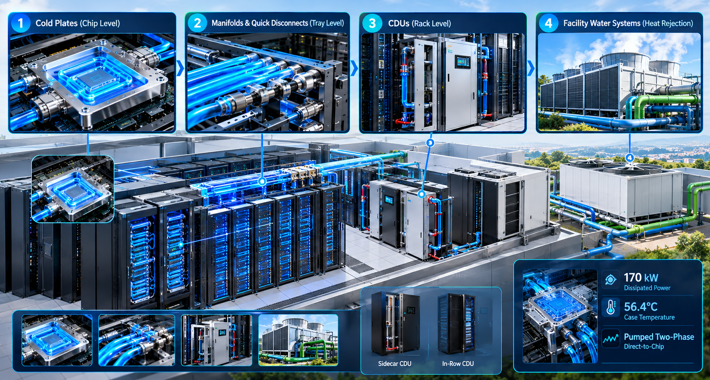
Four layers decide reliability in any direct-to-chip data center cooling solution: cold plates at chip level, manifolds and quick disconnects at tray level, CDUs at rack level, and facility water systems for heat rejection. Sidecar CDUs dominate today, with in-row units gaining ground for dense AI racks. Vertiv testing showed pumped two-phase direct-to-chip dissipated 170 kW while holding case temperature at 56.4°C. Component choice determines whether that capacity holds under sustained load.
Supermicro reports its in-rack CDU removes 250 kW per rack and captures up to 98% of rack heat. Quick disconnects deserve special scrutiny because their sealing integrity determines whether a leak ever reaches compute. In every direct-to-chip data center cooling solution, operators must treat the fluid loop as infrastructure, with redundancy, filtration, and chemistry monitoring designed in from the start. A single starved cold plate silently throttles an entire GPU tray.
How Do You Validate a Data Center Cooling Solution Before You Commit?
Run a structured pilot before scale-out, because commissioning failures wreck most data center cooling solution budgets. NVIDIA GB200 NVL72 expects supply water at 25-45°C with strict chemistry, and the rack needs over 700 liters per minute at the manifold. Any deviation found in validation should halt the rollout. Verify each item on this checklist before signing off:
- Size the CDU for peak rack power plus 20% headroom; under-sizing is the most common field failure.
- Deploy leak sensors at every cold plate connection and manifold joint, not only at the CDU.
- Verify water quality and conductivity targets against the OEM specification sheet.
- Simulate flow distribution with CFD across all cold plates; one starved GPU nullifies the rack.
- Train operations staff on fluid handling, pressure checks, and quick-disconnect procedures before go-live.
- Monitor coolant flow per module and log pressure deltas weekly during the first quarter of operation.
What Are the Real-World Refit Timelines for Data Center Cooling Solutions?
A full air-to-liquid retrofit follows a predictable sequence: thermal survey, rack relocation for plumbing access, CDU installation, manifold wiring, and staged cutover. American Compute suggests 12-18 months for a 2 MW facility when density targets exceed 40 kW per rack. New builds with liquid-first design compress that to 6-9 months because floor slab, water supply, and heat rejection are planned from day one.
The wildcard is the facility water system. Direct-to-chip data center cooling solutions need clean, conditioned water loops, and older buildings often lack the pressure, redundancy, and filtration required. Vendors like Vertiv and Supermicro now offer packaged CDU skids that bolt in with minimal civil work. Budget 20% of project time for water quality validation and permits, because that is where schedules slip.
What Mistakes Silently Destroy Data Center Cooling Solutions Payback?
The first mistake is treating PUE as the only KPI when comparing data center cooling solutions. Goldman Sachs now advises measuring Power Compute Effectiveness, because a 1.10 PUE says nothing about whether a facility delivers 50 or 500 TFLOPS per square foot. The second mistake is ignoring water efficiency. NVIDIA’s 45°C direct-to-chip architecture can cut facility cooling water from roughly 2.6 million gallons per MW per year to near zero in favorable climates.
The third mistake is retrofit denial. Rear-door heat exchangers cap near 40-50 kW and cannot scale to Blackwell densities, so any migration built on them stalls at the next GPU generation. The fourth is deferring fluid chemistry until failures appear; corrosion and biofouling quietly raise pressure drop until a CDU trips. Each error compounds, turning a sound data center cooling solution into a cost center. Operators rarely recover the lost quarters.
How Do Operators Run a Liquid-Cooled Facility Without Downtime?
Direct-to-chip data center cooling solutions have run in production hyperscale data centers since 2018, with ToneCooling reporting MTBF figures exceeding 100,000 hours. Downtime risk concentrates in fluid handling, not hardware. Operators should schedule quarterly pressure tests, monthly conductivity checks, and redundant pump paths for every CDU zone. The NVL72’s 700-plus-liter-per-minute flow turns any unplanned valve shutdown into a thermal event within minutes.
Spare quick disconnects and cold plates belong on site before the first rack powers on. Commissioning records should map each rack to its CDU, manifold, and sensor set so operators can trace a pressure anomaly quickly. NVIDIA’s reference designs treat the liquid loop as a fifth critical system alongside power, network, storage, and compute. Runbook drills prevent the panic restarts that cause most secondary failures.

When Should Operators Upgrade Their Data Center Cooling Solutions Strategy?
Set your upgrade trigger by density, not by calendar. Below 30 kW per rack, optimized air cooling remains cost-effective. Between 30 and 80 kW, direct-to-chip becomes the practical default for data center cooling solutions; above 80 kW, it is the only option. Regulation reinforces the timeline. The EU mandates PUE below 1.3 for new data centers by 2030, and Singapore requires below 1.2. The density bands are tightening faster than most roadmaps assume.
Future hardware makes the trigger irreversible. NVIDIA’s Vera Rubin NVL144 targets roughly 600 kW per rack, and Deloitte estimates next-generation AI racks could reach 370 kW even in 2026. Facilities that deploy liquid-first now will host those systems; facilities that wait compete for shrinking retrofit windows and escalating water-loop costs. Choosing the right data center cooling solutions belongs on the board agenda this quarter, alongside power procurement.
The choice of data center cooling solutions now determines whether a facility hosts 2027-generation GPUs or becomes a stranded asset. Direct-to-chip delivers 80-120+ kW per rack at PUE 1.05-1.15, recovers cost within 1-3 years, and keeps junction temperatures 15-25°C lower than air. It is the strongest infrastructure upgrade a facility can make this year.
TrendForce expects penetration to climb beyond 33% as liquid-to-liquid architectures accelerate after 2027. Operators who set trigger thresholds, validate with pilots, and protect water chemistry capture the density economics of modern data center cooling solutions. The rest will pay triple to catch up.