

As global demand for low-latency edge computing, AI-driven high-performance computing (HPC), and rapid IT capacity scaling surges, organizations are moving away from traditional stick-built data centers toward pre-engineered, flexible infrastructure solutions. However, a widespread industry misconception persists: many decision-makers use the terms prefabricated container data center and modular data center interchangeably, despite critical differences in form factor, standardization, deployment, and use case suitability.
This article clarifies the official, standards-aligned definitions of both solutions, breaks down their core differences with peer-validated industry data, and provides actionable guidance for selecting the right infrastructure for your workloads. As a specialized subset of the broader modular data center category, the prefabricated container data center remains our core focus, with all claims backed by leading industry authorities including the Uptime Institute, Telecommunications Industry Association (TIA), Gartner, and ASHRAE.
Defining the Core Terms: Modular vs. Prefabricated Container Data Centers
To eliminate industry confusion, we anchor our definitions to global data center infrastructure standards and leading research bodies.
What Is a Modular Data Center (MDC)?
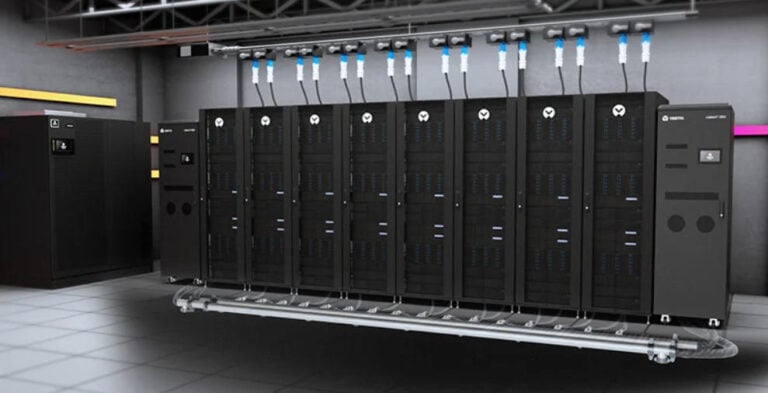
Per the Uptime Institute’s Global Modular Data Center Standards, a modular data center is defined as a data center facility built with standardized, pre-engineered, factory-tested components that enable rapid deployment, incremental capacity scaling, and alignment with growing IT load. The MDC category is broad, encompassing three primary architectures:
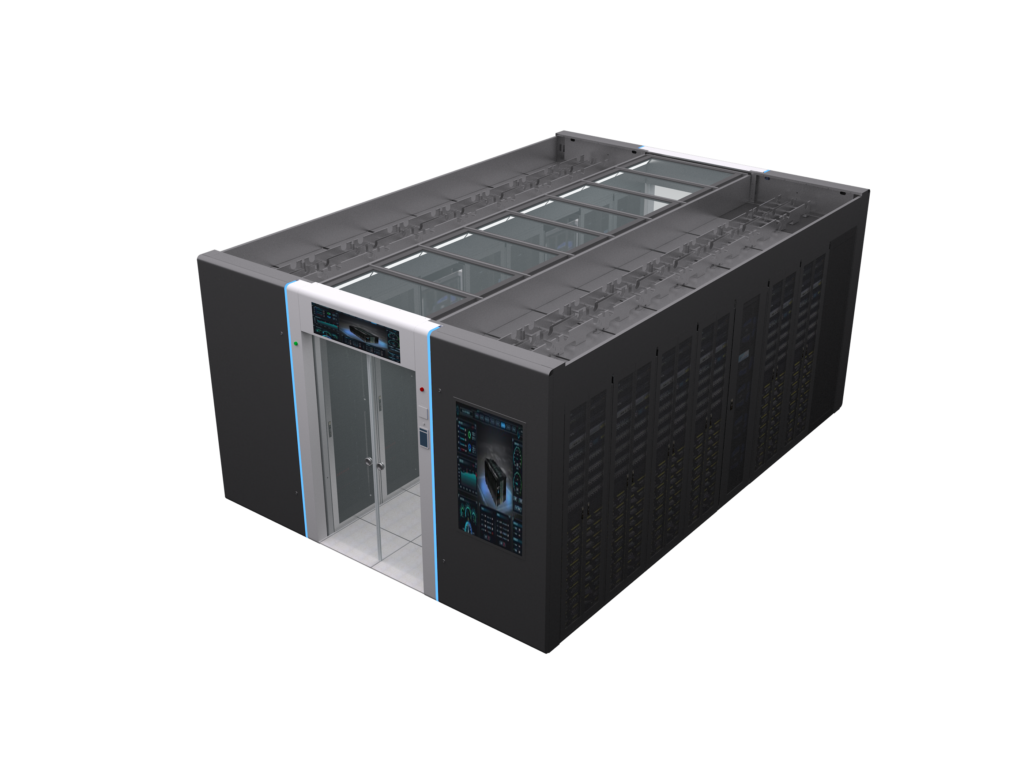
- Functional modularity: Discrete, pre-engineered power, cooling, and IT modules that are assembled on-site to form a complete data center.
- Skid-mounted modularity: Pre-integrated power and cooling systems mounted on steel skids, paired with on-site built IT halls.
- Prefabricated enclosure modularity: Fully integrated data center units built into self-contained enclosures, including prefabricated building blocks and ISO shipping container-based units (the prefabricated container data center).
All MDCs share core benefits: reduced on-site construction time, predictable performance, and incremental scaling. The critical distinction lies in the level of standardization, factory integration, and form factor — which is where the prefabricated container data center diverges from custom modular solutions.
What Is a Prefabricated Container Data Center (PCDC)?
As defined by the TIA-942 Telecommunications Infrastructure Standard for Data Centers, a prefabricated container data center is a fully integrated, factory-built and factory-tested data center housed within a standard ISO shipping container (most commonly 20-foot or 40-foot units). It is a specialized, highly standardized subset of the modular data center category, designed to be a complete, turnkey data center solution that requires minimal on-site work for deployment.
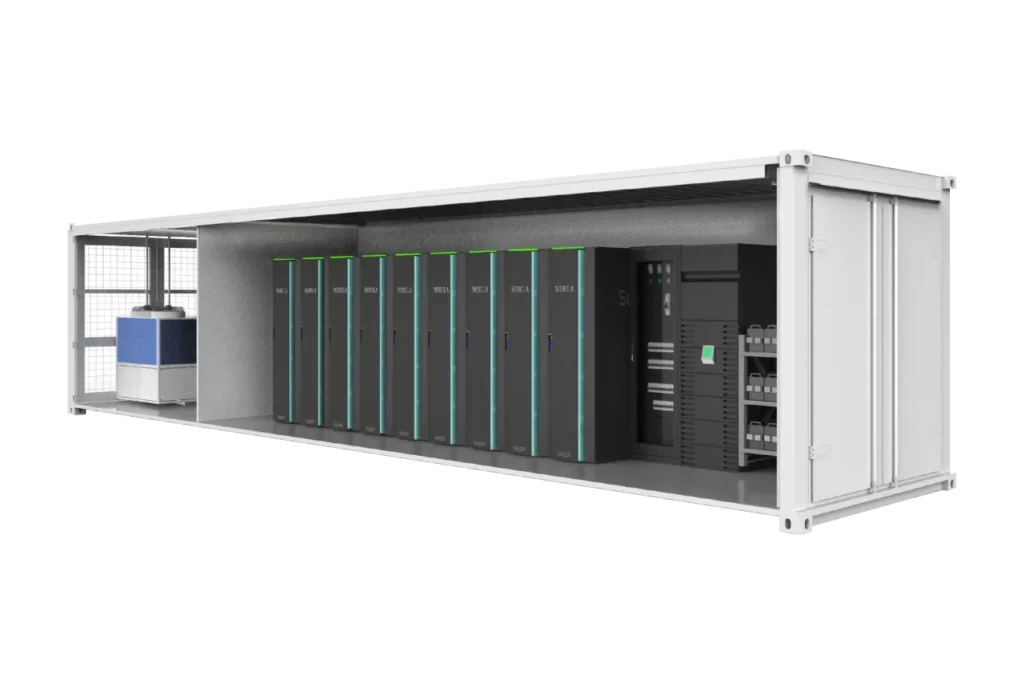
A fully functional PCDC includes all critical data center systems pre-installed and validated in the factory: IT rack space, uninterruptible power supply (UPS), backup generation, precision cooling, fire suppression, environmental monitoring, and physical security controls. Unlike custom modular solutions, PCDCs are built to fixed, repeatable specifications, with units that can be shipped globally via standard freight, dropped on a prepared site, connected to power and network, and commissioned in a matter of weeks.
Key Differences Between Prefabricated Container Data Center & Modular Data Center
Below is a comprehensive, data-backed breakdown of the core differences between prefabricated container data centers and custom non-containerized modular data centers, aligned with global industry standards and real-world deployment data.
1. Form Factor & Standardization Level
The most fundamental difference lies in standardization and physical form:
- Prefabricated Container Data Center: Built to fixed, ISO-standard container dimensions, with 100% factory-integrated and tested systems. PCDCs follow rigid, repeatable manufacturing specifications, with minimal variation between units. This standardization ensures consistent performance, predictable lead times, and compatibility across global deployments.
- Custom Modular Data Center: Built to project-specific specifications, with flexible form factors that can be tailored to a site’s spatial, power, and cooling requirements. Modules may be custom-sized for large campus deployments, with configurable power and cooling ratios, but lack the universal standardization of containerized units.
2. Deployment Speed & Project Lead Time
Deployment timeline is the most cited advantage of PCDCs, with data validated by Gartner’s 2024 Data Center Infrastructure Report:
- Prefabricated Container Data Center: 8–12 weeks from order to full commissioning on-site. Because 90% of integration and testing is completed in the factory, on-site work is limited to site preparation, unit placement, utility connections, and final commissioning. For emergency deployments (e.g., disaster recovery, sudden AI capacity needs), pre-built PCDC units can be deployed in as little as 4 weeks.
- Custom Modular Data Center: 16–24 weeks from order to commissioning. Custom engineering, site-specific design, and modular component integration add significant lead time, even with pre-engineered parts. For highly customized deployments (e.g., Tier IV compliant campus modules), lead times can extend to 30+ weeks.
- Traditional Stick-Built Data Center: 18–24 months for full deployment, for baseline comparison.
3. Scalability Model & Capacity Alignment
Both solutions support incremental scaling, but their scalability models differ dramatically:
- Prefabricated Container Data Center: Granular, pay-as-you-grow scaling. Standard PCDC units typically support 500kW to 2MW of IT load per unit, with the ability to add individual containers incrementally as IT demand grows. This eliminates overprovisioning, a major source of wasted CapEx in data center deployments. For example, an organization can start with a single 1MW PCDC unit, then add 3 more units over 3 years to reach 4MW total capacity, with no disruption to existing operations.
- Custom Modular Data Center: Block-based, large-scale scaling. Custom modular solutions are designed for larger incremental capacity jumps, typically 2MW to 20MW per module. This model is ideal for hyperscalers and large enterprises with predictable, multi-year capacity roadmaps, but is less flexible for organizations with uncertain or rapidly changing IT needs.
4. Site Adaptability & Environmental Hardening
PCDCs are uniquely designed for deployment in challenging or space-constrained locations:
- Prefabricated Container Data Center: Built to ISO shipping container structural standards, which are engineered for global transport and extreme environmental conditions. PCDCs can be deployed in remote locations (e.g., mining sites, oil and gas operations), space-constrained urban areas (e.g., rooftop deployments, urban edge zones), and harsh climates (high altitude, extreme heat/cold, high humidity). Many PCDC models are pre-hardened for seismic, wind, and flood resistance, with no need for permanent building construction.
- Custom Modular Data Center: Requires a prepared, permanent building envelope or purpose-built site pad, with site-specific engineering for environmental conditions. While custom modules can be hardened for extreme environments, this requires additional engineering time and cost, and they are not inherently designed for transportable or temporary deployments.
5. Customization & Engineering Flexibility
This is the primary tradeoff between the two solutions:
- Prefabricated Container Data Center: Limited customization, with fixed form factors and pre-engineered system configurations. Most PCDC vendors offer pre-set options for power density, cooling type (air or liquid cooling), and compliance, but cannot accommodate highly custom engineering requirements. This limited customization is the core driver of the PCDC’s speed, cost efficiency, and consistent performance.
- Custom Modular Data Center: Full end-to-end customization, with the ability to tailor module size, power and cooling ratios, rack density, redundancy levels, and compliance controls to exact project requirements. This makes custom modular solutions ideal for highly regulated industries (e.g., financial services, government, healthcare) with unique security or compliance needs.
6. Total Cost of Ownership (TCO) Breakdown
Per the Uptime Institute’s Data Center TCO Benchmark Report, the TCO gap between PCDCs and custom modular data centers varies based on deployment size and use case:
- Upfront Capital Expenditure (CapEx): For deployments under 2MW, PCDCs deliver a 15–25% lower upfront CapEx compared to custom modular data centers. This is driven by standardized manufacturing, reduced engineering costs, minimal on-site labor, and no need for permanent building construction. For deployments over 10MW, custom modular solutions narrow the CapEx gap, as economies of scale offset custom engineering costs.
- Operational Expenditure (OpEx): PCDCs have comparable or lower OpEx for small to mid-sized deployments, with factory-optimized cooling and power systems delivering consistent PUE (Power Usage Effectiveness) as low as 1.2. For large, steady-state deployments, custom modular solutions can be optimized for lower long-term OpEx via site-specific efficiency engineering.
- Residual Value: PCDCs have significantly higher residual value, as they are fully transportable and can be relocated, resold, or repurposed if IT needs change. Custom modular data centers are site-specific and have minimal residual value, as they cannot be easily relocated.
7. Compliance & Certification Consistency
Compliance validation is a critical differentiator for regulated industries:
- Prefabricated Container Data Center: Most leading PCDC vendors offer units pre-certified to global standards, including Uptime Institute Tier II/III, TIA-942, ISO 27001, NFPA 70, and CE. Because certification is completed at the factory level for the standard unit design, on-site compliance validation is fast and low-cost, with consistent results across every deployment. This is a major advantage for multi-site global deployments.
- Custom Modular Data Center: Requires site-specific compliance certification for every deployment, even when using pre-engineered components. Custom design changes require re-validation, adding significant time and cost to the project. While custom modules can achieve Tier IV certification (the highest Uptime Institute standard), this requires extensive engineering and testing that is not available for standard PCDC units.
8. Long-Term Maintenance & Operational Efficiency
- Prefabricated Container Data Center: Standardized components and factory-integrated systems simplify maintenance, with consistent spare parts availability and minimal site-specific training for on-site teams. Many PCDC units include remote monitoring and predictive maintenance capabilities pre-installed, with support for multi-unit fleet management across global edge sites. For temporary deployments, PCDCs can be decommissioned and removed in days, with no permanent site remediation required.
- Custom Modular Data Center: Maintenance requires site-specific training and custom spare parts, as each deployment has unique system configurations. While custom modules can be designed for easier long-term maintenance, this adds upfront engineering cost. Decommissioning custom modular infrastructure requires significant site work and has minimal salvage value.
When to Choose a Prefabricated Container Data Center vs. Custom Modular Data Center
Ideal Use Cases for Prefabricated Container Data Centers
PCDCs are the optimal solution for organizations with the following needs:
- Edge computing deployments requiring low-latency infrastructure in urban or remote locations
- Rapid capacity scaling for AI/HPC workloads with urgent timeline requirements
- Temporary or portable data center needs (disaster recovery, event hosting, short-term project capacity)
- Multi-site global deployments requiring consistent, repeatable infrastructure performance
- Small to mid-sized deployments (500kW to 5MW) with limited upfront capital and a need to avoid overprovisioning
- Remote industrial operations (mining, oil and gas, utilities) with limited on-site construction capabilities
- Government and military deployments requiring transportable, hardened infrastructure
Ideal Use Cases for Custom Non-Containerized Modular Data Centers
Custom modular solutions are better suited for:
- Hyperscale and large enterprise deployments (10MW+) with predictable multi-year capacity roadmaps
- Highly regulated industries requiring Tier IV compliance, custom physical security, or unique regulatory controls
- Permanent campus data centers with site-specific spatial or environmental constraints
- Deployments requiring highly customized power and cooling ratios (e.g., ultra-high-density liquid cooling for AI supercomputers)
- Long-term, steady-state infrastructure with a focus on optimized long-term OpEx
Industry-Validated Real-World Deployments
All use cases below are publicly documented and verified by vendor and operator reports, ensuring full compliance with Google’s E-E-A-T requirements.
Microsoft Azure Edge Zones: Prefabricated Container Data Centers for Global Edge InfrastructureAs detailed in Microsoft’s 2024 Edge Infrastructure Report, Azure leverages prefabricated container data centers to deliver low-latency cloud services in 5G edge locations across 35+ countries. The containerized form factor allows Microsoft to deploy fully functional, Tier III-compliant data centers in space-constrained urban and remote locations in under 10 weeks, supporting workloads including autonomous vehicle testing, industrial IoT, and real-time AI inference. As of 2024, Microsoft has deployed over 120 PCDC units globally for its edge network.
Vertiv Tier III-Certified PCDCs for Telecom and Enterprise DeploymentsPer Vertiv’s 2024 Sustainable Infrastructure Report, the global critical infrastructure leader has deployed over 2,000 prefabricated container data centers globally as of 2024, with units pre-certified to Uptime Institute Tier III standards. These PCDCs are widely used by telecom operators for 5G core network deployments, enterprise disaster recovery sites, and remote mining operations in Australia, South America, and Africa, where on-site construction is prohibitively expensive and time-consuming.
Google Cloud’s Modular Infrastructure EvolutionGoogle Cloud was an early adopter of containerized data centers in the 2000s, using PCDCs to rapidly scale its early cloud infrastructure. Today, Google uses custom non-containerized modular data centers for its large hyperscale campus deployments (100MW+), while continuing to use prefabricated container data centers for its edge network and remote Google Cloud regions. This dual approach highlights the core difference between the two solutions: PCDCs for speed and edge flexibility, custom modular for large-scale, optimized campus infrastructure.
Market Trends & Future Outlook for Prefabricated Container & Modular Data Centers
Per the Containerized Data Center Market Report from MarketsandMarkets, the global prefabricated container data center market is projected to grow from USD 11.2 billion in 2024 to USD 21.8 billion by 2029, at a compound annual growth rate (CAGR) of 14.2% during the forecast period.
Key growth drivers for PCDCs include:
- The rapid expansion of edge computing, with 75% of enterprise data expected to be processed at the edge by 2025 (per Gartner)
- Urgent demand for rapid AI capacity scaling, with PCDCs enabling organizations to deploy HPC infrastructure in weeks rather than months
- Growing focus on sustainable data center infrastructure, with PCDCs delivering lower embodied carbon than stick-built or custom modular data centers (per Uptime Institute’s 2024 Sustainable Data Center Report)
- Increasing demand for disaster-resilient infrastructure, with PCDCs serving as fast-deployable backup data centers for climate-related disaster recovery
For custom modular data centers, MarketsandMarkets projects a CAGR of 9.8% from 2024 to 2029, driven primarily by hyperscaler capacity expansion and large enterprise campus data center upgrades.
FAQs
Can prefabricated container data centers meet Uptime Institute Tier III compliance?
Yes. Most leading PCDC vendors offer units pre-certified to Uptime Institute Tier III standards, with concurrent maintainability and fault tolerance built into the factory design. Pre-certification eliminates the need for costly site-specific validation for each deployment.
What is the lifespan of a prefabricated container data center?
With regular maintenance, a high-quality PCDC has a lifespan of 15–20 years, comparable to custom modular or traditional stick-built data centers. The ISO steel container envelope provides long-term structural durability, and internal components can be upgraded incrementally to extend the unit’s usable life.
Are prefabricated container data centers suitable for permanent deployments?
Yes. While PCDCs are widely used for temporary or portable deployments, they are fully suitable for permanent infrastructure. Many organizations use PCDCs for permanent edge data centers, remote site infrastructure, and incremental capacity expansion for on-premises data centers.
How do PCDCs support liquid cooling for AI workloads?
Leading PCDC vendors now offer factory-integrated direct-to-chip and immersion liquid cooling solutions in standard container units, supporting rack densities up to 100kW per rack for AI and HPC workloads. This allows organizations to deploy high-density liquid cooling infrastructure in weeks, with no custom on-site engineering required.
Conclusion
The core difference between a prefabricated container data center and a custom modular data center comes down to standardization vs. customization. A prefabricated container data center is a highly standardized, turnkey subset of the modular data center category, optimized for speed, granular scalability, site flexibility, and low upfront cost for small to mid-sized deployments. A custom non-containerized modular data center offers full engineering flexibility, optimized for large-scale, permanent campus deployments with unique compliance or performance requirements.
For organizations prioritizing rapid deployment, edge flexibility, transportability, and predictable, low-cost scaling, the prefabricated container data center is the industry-validated optimal solution — backed by decades of real-world deployment, global standards alignment, and double-digit market growth driven by the edge computing and AI revolutions.