

Liquid cooling for data centers is not a one-size-fits-all solution; it’s a spectrum of liquid cooling technology tailored to different power densities, budgets, and infrastructure needs. A high-performance liquid cooling system is becoming increasingly essential as data centers grapple with the rising heat loads from AI, HPC, and high-density computing hardware.
The Uptime Institute’s 2024 Cooling Systems Survey found water-cooled cold plates to be the most widely adopted direct liquid cooling technology, but immersion and two-phase systems are rapidly gaining traction for ultra-high-density AI and HPC deployments—proving that the right liquid cooling system can redefine efficiency and scalability. Below is a comprehensive breakdown of the most impactful liquid cooling technologies, their engineering principles, ideal use cases, and how they integrate into a robust liquid cooling system.
1. Cold Plate Liquid Cooling
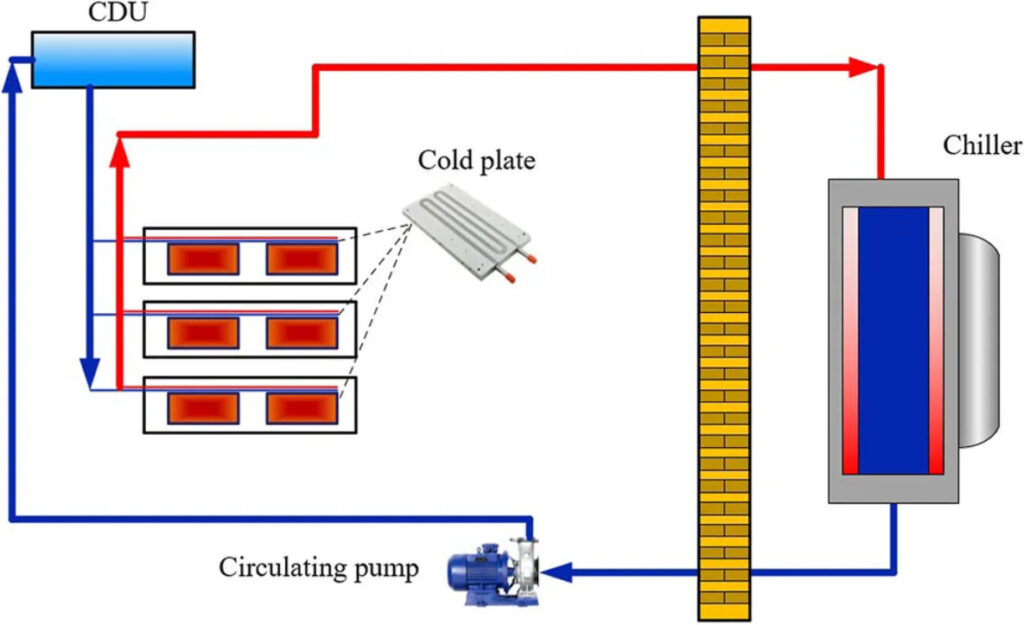
As one of the most practical and widely deployed liquid cooling technologies, Cold Plate Liquid Cooling serves as the foundational direct liquid cooling solution for modern data center liquid cooling systems. It targets heat-generating components (CPUs, GPUs, HBM memory) with custom cold plates—metal heat exchangers mounted directly onto chips with a thermal interface material (TIM) to minimize heat resistance. Coolant (typically deionized water or glycol mixtures) flows through microchannels in the cold plate, absorbing heat and carrying it to a centralized heat exchanger (CDU: Coolant Distribution Unit) for cooling and recirculation—creating a closed-loop liquid cooling system that balances performance and cost for diverse data center deployments.
Key Advancements in Cold Plate Liquid Cooling System
- Vertical Power Delivery: A game-changing design that mounts power modules directly above/below processors, minimizing power delivery network (PDN) losses and complementing Cold Plate Liquid Cooling’s low-profile cold plate structures. VPD eliminates the lateral DC/DC converter placement required for air cooling, unlocking more flexible board designs and higher component density—all while enhancing the overall efficiency and adaptability of the liquid cooling system.
- Microconvective Cooling: Replaces traditional microchannel cold plates with arrays of small fluid jets that precisely target chip hotspots. This advanced liquid cooling technology delivers lower thermal resistance than conventional microchannel designs, avoids pressure drop issues, and is far more effective for high-power AI chips (e.g., NVIDIA GB200/GB300) with heat flux densities exceeding 500W/cm²—making it a critical upgrade for high-performance liquid cooling system setups in AI-centric data centers.
- Two-Phase Cold Plate Cooling: For ultra-high-power components, fluorocarbon-based coolants enable two-phase Cold Plate Liquid Cooling, a cutting-edge liquid cooling technology that leverages the latent heat of evaporation to absorb 100x more heat than single-phase water cooling. While more expensive upfront, fluorocarbon coolants are non-conductive and less damaging in case of leaks, making them ideal for mission-critical AI clusters and resilient liquid cooling system deployments.
Ideal For:
Mid-to-high density data centers, AI training clusters, and retrofits of existing air-cooled infrastructure—Cold Plate Liquid Cooling technology requires minimal hardware modification and balances performance with cost-effectiveness, making it a versatile and widely adopted choice for most liquid cooling system configurations.
2. Immersion Liquid Cooling
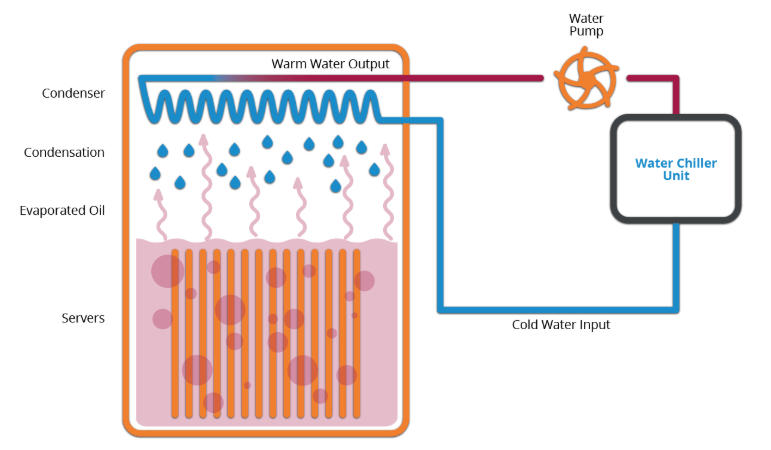
Immersion cooling is an innovative liquid cooling technology that takes the liquid cooling system to a new level by fully submerging entire server racks or components in a non-conductive dielectric fluid, eliminating the need for cold plates, fans, or heatsinks entirely. Heat is transferred directly from every component to the fluid, which is then cooled via a heat exchanger or condenser—delivering near-perfect thermal uniformity and the lowest possible PUE scores for a liquid cooling system. This liquid cooling technology is redefining sustainability and performance for the most demanding data center environments, especially ultra-high-density AI and HPC facilities.
Immersion cooling is split into two categories, each suited for different liquid cooling system needs:
- Single-phase immersion: Dielectric fluid (mineral oil, silicon-based coolant) circulates through the tank without phase change, offering high efficiency and low maintenance. It’s the most widely adopted immersion liquid cooling technology, with widespread deployments in hyperscale and edge data centers, where a reliable, low-cost liquid cooling system is a top priority.
- Two-phase immersion: Low-boiling fluorocarbon coolants boil at 40–50°C, absorbing massive amounts of heat via latent heat of vaporization. Vapor rises to a condenser, condenses back to liquid, and falls back into the tank—creating a passive, pump-free cycle for maximum efficiency in a liquid cooling system. This liquid cooling technology is ideal for ultra-high-density setups where every watt of energy efficiency directly impacts operational costs and sustainability goals.
Key Considerations for Immersion Liquid Cooling System
While immersion cooling delivers unrivaled efficiency as a liquid cooling technology, it requires dedicated infrastructure (sealed tanks) and addresses valid concerns around fluid leakage, environmental impact, and stray capacitance (from high-dielectric fluids) that can affect high-frequency signals. New silicon-based dielectric fluids are solving these issues: they’re non-toxic, low-cost, and have minimal impact on electrical performance—with commercial deployments achieving 210kW per rack in AI data centers, solidifying immersion cooling as a leading liquid cooling system solution for next-generation green computing.
Ideal For:
Ultra-high-density AI/HPC clusters (85–210kW per rack), supercomputing centers, and net-zero emission-focused green data centers—immersion cooling is the gold standard liquid cooling technology for sustainability and peak performance, making it the ideal liquid cooling system for future-proof, high-power data center infrastructures.
3. Hybrid Liquid to Air Cooling
For data centers with mixed power densities (e.g., low-power storage servers alongside high-power AI compute), hybrid liquid-air cooling combines Cold Plate Liquid Cooling technology for hot components (CPUs/GPUs) with air cooling for low-heat hardware (storage, networking). This approach balances efficiency and cost, avoiding the upfront investment of a full liquid cooling system while eliminating the hotspots and energy waste of pure air cooling—making it a practical and flexible liquid cooling technology for diverse and mixed-use data center environments.
Hybrid systems are particularly popular for colocation facilities, where tenants have varying cooling needs—they allow operators to offer tiered cooling solutions without full infrastructure overhauls. By integrating Cold Plate Liquid Cooling technology only where heat loads demand it, hybrid setups create a customized liquid cooling system that adapts to changing workloads, power densities, and budget constraints, optimizing both performance and operational expenses.
Why Choose the Liquid Cooling System?
As data centers evolve to meet the demands of AI, HPC, and cloud computing, liquid cooling technology and liquid cooling system solutions will continue to be the backbone of efficient, reliable data center operations.
From Cold Plate Liquid Cooling’s practical versatility to immersion cooling’s unmatched efficiency and hybrid systems’ adaptive flexibility, each liquid cooling technology offers a unique approach to managing heat loads—ensuring data centers can scale seamlessly, reduce energy consumption, and maintain optimal performance.
Investing in a tailored liquid cooling system, aligned with specific power densities and infrastructure requirements, is the key to building sustainable, high-performance data centers that thrive in the era of next-generation computing.