

Driven by the explosive growth of AI, machine learning, high-performance computing (HPC), and cloud infrastructure, traditional air cooling is quickly reaching its physical and economic limits. Liquid cooling for data centers has emerged as a transformative solution, yet many operators and decision-makers remain hesitant due to widespread misunderstandings.
Despite its proven benefits for efficiency, performance, and sustainability, liquid cooling is still clouded by outdated assumptions. In this article, we debunk the most common myths about liquid cooling for data centers and reveal the facts that can help you future-proof your facility.
Myth 1: Liquid cooling system is too expensive to deploy
Many teams reject liquid cooling out of hand because they believe upfront costs are prohibitively high. It’s common to hear that liquid cooling requires major infrastructure overhauls and delivers little financial return.
Fact: Liquid cooling provides fast, predictable ROI
While upfront capital expenses for liquid cooling are typically 15–20% higher than air cooling, the total cost of ownership (TCO) drops dramatically over time. Most facilities see full return on investment within just 2–3 years through:
- Significant reductions in cooling energy consumption
- Longer hardware lifespan and fewer unexpected replacements
- Higher compute density in the same physical space
- Improved PUE (Power Usage Effectiveness) and lower utility costs
For AI and HPC data centers, ROI is even faster. Liquid cooling can improve performance by up to 30% while drastically cutting cooling energy use, creating both economic and technical advantages.
Myth 2: Liquid cooling system is risky
Fear of leakage is the single greatest barrier to adoption. The idea of fluid near sensitive electronics leads many to assume that liquid cooling is inherently dangerous.
Fact: Modern systems are engineered to prevent and withstand leaks
Today’s liquid cooling for data centers uses multiple safety layers:
- Non-conductive dielectric fluids and fluorocarbons that do not cause electrical shorts
- Real-time leak detection sensors
- Low-pressure coolant loops
- Secure quick-disconnect fittings in direct-to-chip (D2C) systems
- Industry-certified tubing and connectors
Even in the rare case of a leak, modern coolants do not damage electronics. Liquid cooling is often more reliable than air cooling, which suffers from fan failures, dust buildup, and hotspots.
Myth 3: Liquid cooling system is hard to maintain
Another persistent myth is that liquid cooling requires constant, specialized maintenance, increasing labor and downtime.
Fact: Liquid cooling reduces maintenance compared to air cooling
Liquid cooling actually simplifies long-term operations:
- No fans to clean or replace
- No air filters to change monthly or quarterly
- No bulky heatsinks to reapply or inspect
- Immersion cooling typically requires only annual fluid checks
- Direct-to-chip systems need minimal periodic CDU maintenance
For large-scale and hyperscale data centers, this can reduce operational and maintenance (O&M) costs by nearly 50%.
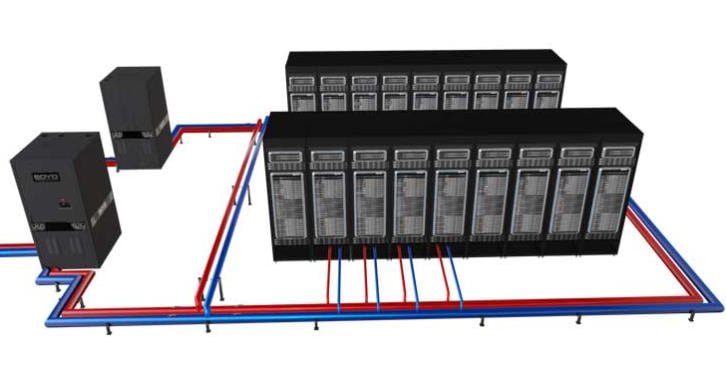
Myth 4: Liquid cooling is only for AI/HPC
Many small, edge, and colocation operators believe liquid cooling is only for supercomputers and hyperscale clouds.
Fact: Liquid cooling scales to every size of data center
Liquid cooling for data centers is highly adaptable:
- Small and edge data centers use compact D2C systems to lower energy costs
- Colocation providers offer liquid cooling as a premium service for AI tenants
- Even standard racks at 10kW per rack see meaningful savings
As power densities rise across the industry, liquid cooling is becoming a practical upgrade for almost any facility.
Myth 5: Liquid cooling is bad for sustainability
Some operators avoid liquid cooling because they assume it wastes massive amounts of water and harms environmental goals.
Fact: Liquid cooling improves water efficiency and sustainability
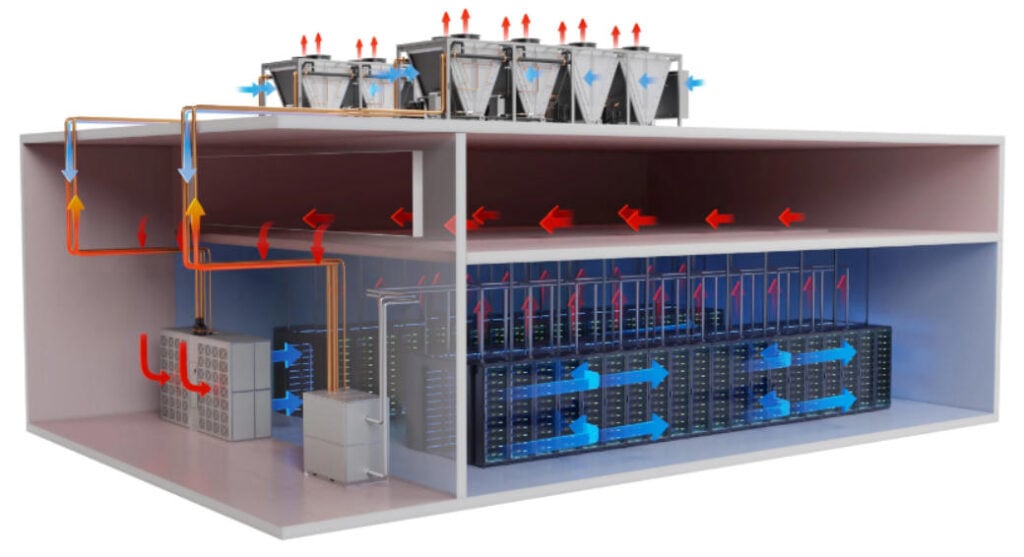
Many liquid cooling systems, especially direct-to-chip and rear-door heat exchangers, use closed-loop circuits that consume little to no additional water. When paired with dry coolers or free cooling, water usage can drop significantly compared to traditional evaporative cooling systems. Liquid cooling also lowers overall energy consumption, reducing carbon emissions — a critical win for green data center initiatives.
Myth 6: Liquid cooling requires full facility rip-and-replace
A common misconception is that adopting liquid cooling means shutting down operations and rebuilding the entire data center.
Fact: Liquid cooling can be deployed incrementally
Modern liquid cooling supports phased rollouts:
- Rear-door heat exchangers work with existing racks
- Direct-to-chip can be deployed row-by-row
- Immersion cooling can be implemented in dedicated zones
- Retrofits often do not require full facility shutdown
This makes it possible to adopt liquid cooling for data centers without disrupting business operations.
Myth 7: Liquid cooling is too unproven for mission-critical loads
Some teams believe liquid cooling is an emerging, high-risk technology not suitable for critical infrastructure.
Fact: Liquid cooling is mature and widely deployed
Liquid cooling has been used in supercomputing, servers, and data centers for decades. Today’s systems are tested, certified, and supported by major hardware and cooling vendors. Hyperscalers, cloud providers, and financial institutions already rely on liquid cooling for their most mission-critical, high-availability workloads.
Myth 8: Hardware aren’t compatible with liquid cooling
IT teams often worry that existing or new servers cannot support liquid cooling.
Fact: Most modern hardware supports liquid-ready designs
Major server OEMs offer:
- Direct-to-chip cold-plate support
- Liquid-ready motherboards and chassis
- Immersion-compatible components
- Standardized cooling interfaces
Many systems can be upgraded or ordered with liquid cooling from the factory, eliminating compatibility concerns.
Myth 9: Liquid cooling increases data center complexity
Operators often assume liquid cooling introduces more points of failure and longer maintenance windows.
Fact: Liquid cooling reduces downtime from overheating and hardware failure
Liquid cooling eliminates hotspots, stabilizes temperatures, and reduces strain on fans and power supplies. This results in:
- Fewer server crashes
- Less thermal throttling
- Longer component lifespan
- More predictable uptime
When maintenance is needed, modern designs support quick, tool-free access.
Final Thoughts
Liquid cooling for data centers is not a risky, expensive, or overly complex experiment — it’s a mature, practical solution for modern computing demands. Whether you run a small edge site, colocation space, enterprise data center, or large AI facility, understanding the truth behind these myths will help you unlock better efficiency, lower costs, and stronger performance.