

Even single-phase liquid immersion cooling, while a step up from air cooling, still relies on energy-draining pumps and external heat exchangers to circulate coolant, adding complexity and limiting overall efficiency.
For organizations looking to scale high-density infrastructure without sacrificing energy efficiency or hardware reliability, the two-phase liquid immersion cooling system emerges as the only solution that addresses both critical pain points, delivering unmatched heat dissipation and operational simplicity for modern data centers
What Is Two-Phase Liquid Immersion Cooling System?
A two-phase liquid immersion cooling system is a precision thermal management method specifically engineered for high-density computing hardware. It works by fully submerging servers—including CPUs, GPUs, motherboards, and storage devices—in a non-conductive dielectric refrigerant fluid, which absorbs heat through a controlled liquid-vapor phase change.
Unlike conventional cooling approaches that rely solely on convective heat transfer, this phase change cooling technology leverages the latent heat of vaporization—the massive amount of energy required to convert liquid to vapor—to capture and remove heat far more efficiently. This design ensures stable, consistent temperatures across all critical hardware, preventing overheating and optimizing performance in high-load environments.
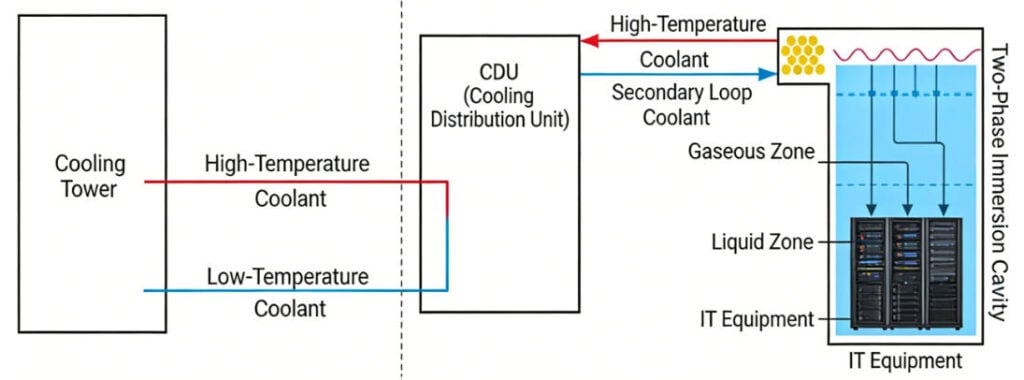
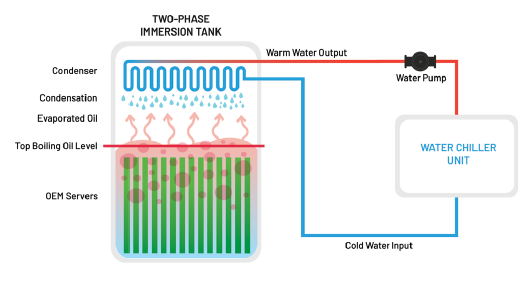
The closed-loop working cycle of a two-phase liquid immersion cooling system is both simple and highly efficient, often operating without energy-consuming pumps. Here’s a step-by-step breakdown:
- Servers and all their critical components are fully submerged in a sealed tank filled with non-conductive dielectric fluid, ensuring direct contact between heat-generating hardware and the cooling medium.
- As servers operate under high load, CPUs and GPUs generate intense heat, which is immediately transferred to the surrounding dielectric fluid; once the fluid reaches its low boiling point (40–50°C), it begins to boil.
- The liquid dielectric fluid transitions into a vapor state, absorbing massive amounts of thermal energy through the latent heat of vaporization—this is the key step that makes the system far more efficient than air or single-phase cooling.
- The warm vapor, being less dense than the liquid fluid, naturally rises to the condenser coil installed at the top of the tank.
- The condenser cools the vapor back into its liquid state, either by circulating ambient air or a warm-water loop .
- The condensed liquid dielectric fluid then falls back down into the main tank by gravity, returning to the server components to repeat the cycle, creating a self-sustaining closed loop.
Why Two-Phase Liquid Immersion Cooling Is So Efficient?
The two-phase liquid immersion cooling system’s exceptional efficiency stems from four fundamental physics principles that set it apart from air and single-phase cooling technologies.
First, latent heat of vaporization allows the dielectric fluid to absorb massive amounts of heat without a significant rise in temperature—far more than air or single-phase coolants, which only absorb sensible heat.
Second, its heat transfer coefficient is 50–100 times higher than forced-air cooling, as the liquid-vapor transition creates turbulent fluid movement that eliminates the stagnant thermal boundary layer limiting heat transfer in other systems.
Third, temperature self-stabilization is built into the system: the dielectric fluid boils at a fixed, low temperature, ensuring server components stay within their optimal operating range without active temperature control.
Finally, this self-stabilization delivers near-isothermal cooling, maintaining a consistent temperature across all submerged hardware and eliminating hotspots that degrade performance and shorten hardware lifespan.
Two-Phase vs. Single-Phase liquid Immersion Cooling
The core distinction between two-phase and single-phase immersion cooling lies in their heat transfer mechanisms—a difference that directly impacts efficiency, complexity, and suitability for high-density applications.
Single-phase immersion cooling relies solely on sensible heat transfer: the dielectric fluid absorbs heat without changing phase, requiring pumps to circulate the warmed fluid to an external heat exchanger for cooling. This limits its heat flux capacity and adds ongoing energy costs from pump operation.
In contrast, two-phase immersion cooling leverages both latent heat (from phase change) and sensible heat, enabling it to handle heat fluxes that are 5–10 times higher than single-phase systems—critical for supporting 50+ kW/rack densities. Additionally, two-phase systems can operate without pumps, relying on natural convection and gravity for fluid circulation, while single-phase systems cannot function without active pumping.
Most importantly, two-phase cooling delivers far more stable temperatures: the fixed boiling point of the dielectric fluid ensures near-isothermal operation, while single-phase systems experience temperature gradients that can create potential hotspots.
Why Two-Phase Liquid Immersion Cooling Is Perfect for AI
Two-phase liquid immersion cooling system is uniquely suited for AI and HPC environments, where high density, continuous load, and energy efficiency are non-negotiable.
First, it supports 50–200+ kW per rack—a 5–10x increase over air cooling and 2–4x over single-phase liquid cooling—enabling organizations to pack more GPUs and CPUs into smaller footprints, reducing data center space requirements and associated costs.
Second, it delivers an industry-leading PUE of 1.05–1.08, meaning cooling accounts for just 5–8% of total data center energy use (compared to 30–50% for air cooling), translating to massive long-term energy savings.
Third, it eliminates the need for server fans, resulting in near-zero fan power consumption and a quieter data center environment (noise levels below 45dB). Fourth, the near-isothermal cooling and absence of hotspots extends GPU and CPU lifespan by 20–30%, reducing hardware replacement costs and minimizing downtime. Finally, it excels at continuous high-load operations—critical for AI training clusters and supercomputers that run at maximum capacity 24/7.
Conclusion
The two-phase liquid immersion cooling system is more than just a cooling technology—it’s the foundation of next-generation high-density data centers. As AI and HPC continue to evolve, demanding more power and higher density, traditional cooling solutions will only become more inefficient and limiting.
Two-phase immersion cooling solves these challenges by delivering unmatched efficiency, scalability, and reliability, while reducing energy use and carbon footprints. For organizations looking to future-proof their data centers and unlock the full potential of high-performance computing, it’s not just an option—it’s a necessity.