


Entras en tu sala de datos y notas que el rack n.º 14 está funcionando a 42°C de temperatura de entrada — otra vez. Tus unidades CRAC perimetrales operan a plena capacidad, pero los puntos calientes no desaparecen. Si esto te resulta familiar, tu arquitectura de aire acondicionado para centros de datos ha chocado contra el muro de la densidad. La brecha entre la refrigeración tradicional a nivel de sala y los racks modernos de alta densidad es donde vive el tiempo de inactividad, y tu estrategia de enfriamiento de precisión por filas es el único puente para cruzarla.
Cuando el enfriamiento perimetral falla en tu centro de datos
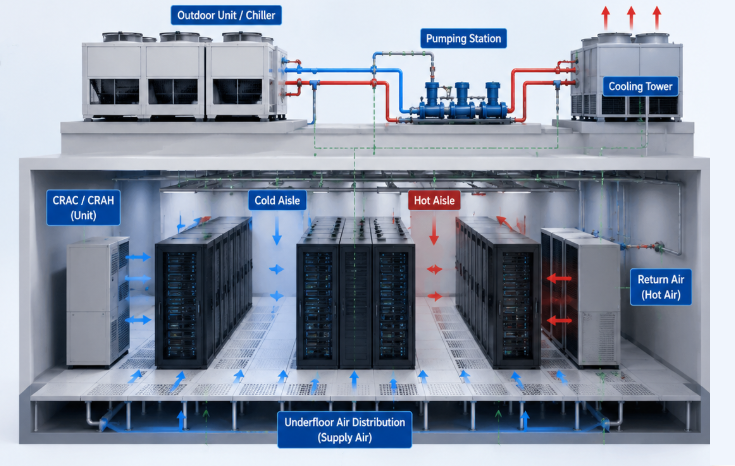
La CRAC perimetral — acondicionadores de aire para salas de computadoras colocados a lo largo de las paredes, que soplan aire frío a través de un suelo elevado — ha sido el método de aire acondicionado para centros de datos por defecto durante décadas. Funciona. Hasta que deja de hacerlo.
Según los datos de campo recopilados por CRAC.services, la eficiencia del enfriamiento perimetral se desploma cuando la densidad de los racks supera los 10 kW por gabinete. La física es sencilla: el recorrido del aire desde una unidad montada en la pared hasta un rack situado a 15 metros es demasiado largo. El aire frío se mezcla con el aire caliente de escape antes de llegar a las tomas de los servidores. La presión de tu pleno de suelo no puede escalar lo suficiente sin que las placas salgan volando de su posición.
Ahora añade los clústeres de entrenamiento de IA que empujan 30–100 kW por rack. Según el informe Vertiv Data Center 2025, el 41% de los profesionales del sector espera que el modelo híbrido de gestión térmica aire-líquido se convierta en el nuevo estándar. Tu configuración perimetral heredada nunca fue diseñada para esta realidad. Esto no es un problema incremental — es un desajuste arquitectónico completo.
Entender la arquitectura del enfriamiento de precisión por filas
El enfriamiento de precisión por filas coloca unidades de refrigeración estrechas directamente dentro de la fila de servidores, entre tus racks. En lugar de empujar el aire 15 metros a través de la sala, el recorrido del aire se reduce a aproximadamente 30–50 cm desde la unidad de refrigeración hasta la toma del rack. Cada unidad en fila entrega una capacidad de refrigeración de 10–50 kW según el modelo — siendo la Vertiv Liebert CRV el diseño de referencia más desplegado en este segmento.
Tu pasillo caliente se convierte en la vía de retorno. El aire frío entra por el frontal del rack, absorbe el calor de los servidores, se expulsa al pasillo caliente confinado y regresa directamente a la toma de la unidad en fila. El bucle es cerrado. La recirculación — el principal enemigo del aire acondicionado perimetral en centros de datos — prácticamente desaparece.
Esta arquitectura también resuelve el dilema de la modernización. Si tienes una sala de datos heredada donde el 80% de los racks funcionan a 5 kW pero dos filas de servidores GPU necesitan 35 kW cada una, instalas unidades en fila en esas dos filas y dejas que tu CRAC perimetral se encargue del resto. No estás arrancando tu infraestructura existente; estás añadiendo capacidad de forma quirúrgica donde tu densidad lo exige.
Cálculo de carga del aire acondicionado del centro de datos
Los errores en el cálculo de carga son la causa raíz de la mayoría de los fallos del enfriamiento de precisión. Una investigación de la industria de Airventec China muestra que el 85% de las salas de computadoras fijan puntos de consigna de temperatura más bajos de lo necesario — consumiendo entre un 15 y un 25% más de energía del compresor mientras siguen sin eliminar los puntos calientes. La solución comienza con un cálculo de carga preciso.
Primero, calcula tu carga de TI según el consumo real, no según la placa de características. Los servidores rara vez consumen el 100% de su potencia nominal. Un factor de carga realista es del 60–80% de la placa. Para un rack con 10 servidores nominales de 1,200 W cada uno, tu carga real se acerca más a 7.2–9.6 kW, no a 12 kW. Sobredimensionar tu aire acondicionado de centro de datos basándote en los valores de placa desperdicia capital y obliga a tus compresores a ciclos de carga parcial ineficientes.
Segundo, ten en cuenta el calor de las pérdidas de los UPS, la iluminación y el personal — normalmente un 5–10% de la carga de TI. Tercero, aplica directamente las guías térmicas ASHRAE TC 9.9: la temperatura de entrada de tus servidores debe situarse entre 18–27°C, con una humedad relativa mantenida entre un punto de rocío mínimo de 5.5°C y un máximo de 60% RH. Si mantienes tu pasillo frío a 18°C cuando ASHRAE permite 25°C, cada grado de refrigeración innecesaria te cuesta aproximadamente un 3–5% de energía anual, según los mismos datos del sector.
Confinamiento del pasillo caliente y reglas de gestión del flujo de aire
El enfriamiento de precisión en fila sin confinamiento del pasillo caliente es tirar el dinero. Ambos son inseparables. Cuando instalas unidades en fila pero dejas los pasillos caliente y frío abiertos, el aire frío de suministro evita por completo las tomas de los servidores — regresando en cortocircuito a la entrada de la unidad de refrigeración sin haber hecho ningún trabajo útil.
El confinamiento total del pasillo caliente — con paneles rígidos, puertas y una barrera en el techo — obliga a que cada metro cúbico de aire caliente de escape regrese a través de tus unidades en fila. El confinamiento del pasillo frío es la alternativa: encierras el pasillo frío y dejas que el resto de la sala se convierta en el pleno de retorno caliente. La elección depende de la distribución de tus instalaciones. En cualquier caso, el confinamiento no es negociable. Los datos del análisis técnico de 51cps.net muestran que un confinamiento del pasillo caliente correctamente sellado reduce por sí solo el consumo energético de refrigeración entre un 20 y un 30%, independientemente de las actualizaciones de equipos.
También debes cubrir cada ranura U no utilizada del rack con paneles ciegos. Un único hueco de 1U en el frontal del rack permite que el aire frío evite por completo los servidores, creando un atajo de baja resistencia que degrada la refrigeración de todos los racks posteriores. Tu cobertura de paneles ciegos debe superar el 95%.
Cómo elegir tu enfriamiento de precisión
Tus unidades de refrigeración en fila vienen en dos variantes principales: expansión directa (DX) y agua fría (CW). Cada una tiene un perfil operativo bien definido.
Las unidades DX contienen su propio circuito de refrigerante y compresor. Son autónomas — no requieren un circuito de agua fría en la instalación. Esto convierte a la DX en la opción por defecto para salas de servidores pequeñas, sitios de borde y modernizaciones donde llevar tuberías de agua fría hasta una fila concreta resulta prohibitivo en coste. La contrapartida: la eficiencia a carga parcial cae más rápido que con agua fría, y tu capacidad máxima por unidad suele limitarse a unos 30 kW.
Las unidades en fila de agua fría se conectan a la planta central de enfriadoras de tu edificio. Escalan de forma eficiente — el COP a carga parcial se mantiene alto porque los compresores de tu planta central gestionan una carga mayor y más estable. Para despliegues de más de 30 kW por rack o instalaciones de varias filas, el agua fría es casi siempre el camino de menor coste total de propiedad. Si te cuesta mantener la estabilidad de temperatura durante las variaciones de carga, usar una herramienta de monitorización puede ayudarte a rastrear la variación de temperatura de entrada en tiempo real en todos los racks e identificar qué filas necesitan reequilibrar su capacidad antes de que los puntos calientes se conviertan en interrupciones.
Modernización del aire acondicionado del centro de datos
Modernizar una sala de datos activa con refrigeración de alta densidad suena caro — y puede serlo, si eliges el enfoque equivocado. Los intercambiadores de calor de puerta trasera (RDHx) ofrecen la vía de modernización con menor fricción. Un intercambiador de calor aleteado se atornilla a la parte trasera de tu rack existente, se conecta al suministro de agua fría y elimina entre el 80 y el 90% del calor del rack en la puerta, antes de que entre siquiera en la sala. Tu CRAC perimetral solo se encarga del 10–20% residual. Sin reconfiguración de toda la instalación. Sin cambios en la distribución de las filas.
Las modernizaciones con refrigeración en fila requieren algo más de planificación — necesitas reservar 30–60 cm de espacio de fila por unidad de refrigeración — pero la ganancia de capacidad es proporcionalmente mayor. Para racks que funcionan entre 20 y 50 kW, la configuración en fila es el punto óptimo práctico.
Las cifras cuadran cuando tienes en cuenta el tiempo de inactividad evitado. Una única interrupción no planificada por sobrecarga térmica cuesta a un operador de colocation típico entre $500,000 y $1 millón en penalizaciones de SLA y pérdida de clientes, según los datos de costes de interrupciones del Uptime Institute. Tu modernización de enfriamiento de precisión se paga por sí sola la primera vez que evita un apagado térmico.
Cómo evitar los 5 errores más comunes en el enfriamiento de precisión
Fijar la temperatura demasiado baja
Cada grado por debajo de la banda recomendada por ASHRAE te cuesta un 3–5% en energía sin ningún beneficio de fiabilidad.
Ignorar el control de la humedad
El aire acondicionado del centro de datos debe gestionar tanto la carga sensible como la latente. Un punto de rocío por debajo de 5.5°C provoca descargas electrostáticas — invisibles para ti hasta que un DIMM falla misteriosamente. Por encima del 60% RH, aumenta el riesgo de condensación. Tus unidades de precisión necesitan humidificación y deshumidificación operativas, no sensores puenteados.
Usar compresores de velocidad fija
El estudio de Airventec descubrió que el 44% de los centros de datos todavía utilizan refrigeración de velocidad constante. Los variadores de frecuencia adaptan la velocidad del compresor a la carga en tiempo real, reduciendo el consumo energético entre un 30 y un 50%. Si tus compresores se encienden y apagan cada pocos minutos, estás gastando dinero para crear oscilaciones de temperatura.
Desplegar confinamiento sin modelado CFD
La simulación de dinámica de fluidos computacional cuesta unos pocos miles de dólares y tarda una semana. Te muestra exactamente dónde están tus zonas muertas, bucles de recirculación y desequilibrios de presión antes de que instales un solo panel. Omitir el CFD es la forma más rápida de gastar seis cifras en un confinamiento que rinde por debajo de lo esperado.
Descuidar tu programa de mantenimiento
Los filtros en fila se obstruyen. Las baterías de agua fría se ensucian. La carga de refrigerante se fuga lentamente a lo largo de meses. Cada uno de estos factores degrada silenciosamente la capacidad de tu aire acondicionado de centro de datos hasta que la próxima ola de calor te empuja más allá del punto de inflexión.
Tu cadencia de mantenimiento del aire acondicionado del centro de datos
Necesitas un programa de mantenimiento por escrito y de cumplimiento obligatorio. Filtros de aire en fila: inspección mensual, sustitución trimestral — con más frecuencia si tus instalaciones están cerca de obras o en una zona de mucho polvo. Baterías de agua fría: limpieza química anual. Carga de refrigerante DX: prueba de presión cada seis meses. Bandejas de drenaje y líneas de condensado: inspección trimestral para evitar daños por agua en los racks entre los que se sitúan tus unidades en fila.
Los sensores de temperatura de cada entrada de rack deben calibrarse anualmente contra una sonda de referencia. Un sensor que lee 2°C por debajo significa que tu temperatura real de entrada es 2°C superior a la que muestra tu panel DCIM — y 2°C es la diferencia entre una operación estable y el estrangulamiento térmico en las CPUs modernas.
Se proyecta que el mercado del aire acondicionado para centros de datos crecerá de 2.1 mil millones de dólares en 2024 a 5.8 mil millones para 2030, según DataString Consulting — una CAGR del 18.3% impulsada casi por completo por el cambio de la refrigeración a nivel de sala hacia la gestión térmica de precisión a nivel de fila. Tus decisiones de infraestructura de hoy determinan si tus instalaciones cabalgan esa curva de crecimiento o se quedan dando servicio a racks de 5 kW mientras la industria avanza hacia los 50.