

You are standing in front of a rack drawing 130 kilowatts. The fans are screaming. The PUE monitor on your dashboard reads 1.7. And you realize: the air cooling system you installed three years ago was never designed for this workload.
That moment is arriving faster than most operators expect. AI workloads are rewriting thermal management rules, and if you are still relying on air cooling for GPU-dense racks, you are burning money and leaving performance on the table. This article gives you a concrete framework for evaluating whether your infrastructure needs to shift to AI data center cooling with liquid-based solutions — and exactly how you should start.
Why Your AI Rack Density Is Outpacing Air Cooling
Air cooling hits a hard ceiling around 20 kilowatts per rack. For years that was adequate, because your standard server rack pulled 5 to 8 kW. But NVIDIA’s GB200 NVL72 systems now push single-rack thermal design power to 130 to 140 kW, according to TrendForce. If you are deploying these GPUs inside traditional air-cooled facilities, you are risking thermal throttling that silently degrades your AI training throughput.
The physics are unforgiving, and they affect you directly. When your rack densities cross 30 kW, the volume of air you need to move becomes mechanically impractical. You end up with wider aisles, larger ductwork, higher fan energy consumption, and PUE values between 1.5 and 1.9.
By 2028, NVIDIA’s Feynman architecture will push thermal design power to 4,400 watts per processor, according to Tom’s Hardware. When you reach that level of density, AI data center cooling becomes your baseline infrastructure requirement.
The Real Power Numbers Driving AI Data Center Cooling
You need to understand the scale of what is happening. According to the International Energy Agency, data centers will consume roughly 4% of global electricity by 2030. Within that, your AI-accelerated servers are growing electricity consumption at roughly 30% annually — nearly three times the 9% rate of traditional servers, per China Economic News Network.
Goldman Sachs projects that liquid cooling penetration in AI training servers will jump from 15% in 2024 to 80% by 2027. If you are still running air cooling in two years, you will be in the minority. TrendForce separately estimates that AI data center cooling adoption rose from 14% to 33% in 2025. These are not incremental shifts — they signal a structural transition you cannot afford to ignore.
The AI data center cooling market reached $6.6 billion in 2025, according to MarketIntelo, and your industry is on track for $61.8 billion by 2034 at 28.7% CAGR. By 2024, liquid-based systems had already captured 46% of the broader cooling market, per Mordor Intelligence — and you can see that trajectory accelerating. If you are managing capacity planning or infrastructure budgets, these numbers should be shaping your purchasing decisions right now.
Liquid Cooling Technologies You Need to Evaluate
When you start evaluating AI data center cooling options, three architectures should be on your radar.
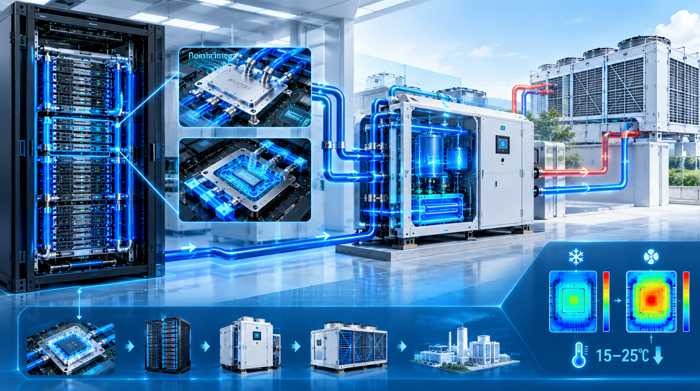
Cold plate cooling attaches metal plates directly to your CPUs and GPUs, with coolant circulating through them to pull heat away. You can deploy this as a retrofit — it coexists with your existing air handling infrastructure. CoolIT demonstrated a single-phase coldplate capable of cooling up to 4,000 watts at nearly 200 W/cm², while Accelsius claims its two-phase approach reaches 300 W/cm², as reported by Tom’s Hardware.
Immersion cooling submerges your entire server in a dielectric fluid. If you choose single-phase, the fluid stays liquid and you benefit from lower cost — this category holds 80.9% of the immersion market, according to MGrid. If you need extreme-density AI data center cooling, two-phase systems let the fluid boil at low temperature, capturing heat through phase change while your racks exceed 200 kW. Your PUE can drop as low as 1.02.
Embedded cooling etches microfluidic channels directly into your chip package, with TSMC targeting commercial deployment around 2027. Your choice among these three AI data center cooling architectures depends on whether you are retrofitting brownfield capacity or building greenfield clusters from scratch.
Matching Your AI Cooling Strategy
If your racks run between 30 and 80 kW, direct-to-chip cold plates are your most practical AI data center cooling option. You get 30% to 46% cooling energy reduction versus air, with PUE between 1.1 and 1.3. You keep your existing rack layout and avoid major structural changes.
If your racks push past 100 kW — and if you are training frontier AI models, they likely will — immersion cooling becomes your baseline. A two-phase immersion system can give you PUE of 1.02 to 1.05, meaning less than 5% of your total power goes to cooling overhead. Compare that to the industry average PUE of 1.56 from the Uptime Institute, and the financial logic becomes unavoidable for your operation.
Consider a real deployment: LiquidStack built a 40-megawatt immersion-cooled hyperscale facility that achieved 92.6% cooling energy savings and required 90% less floor space than an equivalent air-cooled build. If you are paying commercial real estate rates, that space savings transforms your cost model.
PUE and the Financial Case for AI Data Center Cooling
You cannot talk about AI data center cooling without looking at PUE, and the gap between air and liquid is stark. With air cooling, your facility sits between 1.4 and 1.8. Direct-to-chip brings you down to 1.1 to 1.3. Two-phase immersion pushes you to 1.02 to 1.08, according to MGrid’s 2026 analysis.
Here is what those numbers mean for your operating budget. BOYD Corporation data shows when you convert 75% of cooling from air to liquid, your total power costs drop by 27% and overall energy consumption falls by 15.5%. For a 40-megawatt facility paying $0.08 per kilowatt-hour, your cooling energy savings of 40% to 50% translate to $1.4 million to $1.75 million in annual operating cost reductions.
Huawei benchmarks show a 50,000-server data center using immersion liquid cooling saves roughly $16.5 million in electricity per year. That is margin you are leaving on the table with air cooling.
What Hyperscalers Are Doing About AI Data Center Cooling
You are not alone in this transition. Google, Microsoft, Meta, and AWS have all publicly committed to liquid cooling roadmaps, according to MarketIntelo. You can look at Microsoft as a benchmark — it has been running liquid cooling pilots across the U.S. Midwest and Asia, planning to make liquid the standard for new deployments in 2025, per TrendForce. If the largest cloud providers are betting on AI data center cooling with liquid, your hesitation comes with a competitive cost.
In India, Submer Technologies signed an agreement with Madhya Pradesh in mid-2025 to develop up to 1 gigawatt of liquid-cooled AI data center capacity. You should also note KDDI in Japan, which recorded PUE values approaching 1.05 after deploying containerized single-phase immersion rigs for edge AI. These are production deployments you should be studying as reference cases.
Regulatory pressure is accelerating your timeline. The EU Energy Efficiency Directive now mandates that you report PUE and water usage effectiveness starting in 2026. Several U.S. states — including California, Michigan, and Iowa — have passed quarterly disclosure laws you must comply with. If your facility runs air-cooled infrastructure above 20 kW per rack, you are facing a regulatory liability, not just an efficiency gap.
Your AI Data Center Cooling Roadmap
You do not need to rip out every air handler tomorrow. But you do need a phased plan.
Start by auditing your current rack densities. If any cluster consistently exceeds 30 kW per rack, mark it for liquid cooling evaluation within 12 months. Next, assess your water infrastructure. Direct-to-chip and immersion systems use closed-loop designs that reduce your direct water consumption by 70% to 90% compared to evaporative cooling towers — critical if you operate in water-stressed regions.
Third, pilot a small cluster. A single immersion tank or a rack of direct-to-chip servers gives you real operational data without committing to a full retrofit. Your costs run roughly $2 to $3 million per megawatt, so you want validation before scaling.
Finally, build liquid cooling compatibility into every new facility specification starting now. Hyperscalers plan to invest $650 billion in AI infrastructure in 2026 alone, and facilities coming online in 2027 and 2028 will be liquid-cooled by default. If your new builds are still designed around air, you are locking in a cost disadvantage before the concrete is poured.
The transition to liquid-based AI data center cooling is not a question of if for your operation. It is a question of when your rack density crosses the threshold where air stops working. For most operators running AI workloads, that threshold has already arrived.