

You have likely noticed the conversation around data center cooling trends shifting dramatically over the past two years. The reason is simple: artificial intelligence is pushing rack power densities to levels that traditional cooling architectures were never designed to handle. If you manage or plan data center infrastructure, understanding these data center cooling trends is no longer optional — it is essential for keeping your operations running, efficient, and compliant.
The global data center cooling market reached $187.8 billion in 2025 and is projected to hit $541.8 billion by 2034, registering a CAGR of 12.6 percent, according to Fortune Business Insights. Behind that headline number is a structural transformation driven by one dominant force: AI compute density.
The Heat Crisis Driving Data Center Cooling Trends
To grasp why data center cooling trends are shifting so rapidly, you need to look at what is happening inside a single rack. NVIDIA’s GB200 NVL72 system, for example, generates a thermal design power (TDP) of 130 to 140 kilowatts per rack, according to TrendForce. To put that in perspective, a traditional enterprise server rack typically runs at 5 to 10 kilowatts. You are looking at a 10x to 20x increase in heat density within the same physical footprint.
This is not a future scenario — it is happening now. Cloud service providers are deploying these high-density racks in 2025 and 2026. The Uptime Institute’s 2024 cooling survey found that more than one in five data centers already use direct liquid cooling, and another 61 percent say they are considering it. These data center cooling trends reflect a market that is actively pivoting away from legacy approaches.
Cooling systems currently account for 30 to 40 percent of total data center energy consumption, according to the U.S. Department of Energy. If you rely on traditional air-based cooling, you are facing rising electricity costs and potential thermal hotspots that can cause server throttling or downtime. The urgency behind current data center cooling trends is rooted in this heat crisis.
Why Traditional Air Cooling Falls Short in Modern Data Centers
If your facility still depends on computer room air conditioning (CRAC) units and raised-floor air distribution, you are not alone. Room-based cooling commanded 44.7 percent of the market in 2025, according to IMARC Group. However, this approach has a fundamental limitation: air has poor thermal conductivity compared to liquids.
When rack densities exceed 20 to 30 kilowatts, traditional air cooling struggles to remove heat efficiently. You end up over-provisioning airflow, running fans at maximum speed, and still seeing hot spots. The average Power Usage Effectiveness (PUE) of data centers has improved from 1.58 in 2020 to 1.28 in 2025, according to GEP Research, but the remaining gap to the ideal 1.0 is increasingly difficult to close with air alone.
This is where the latest data center cooling trends come into play. The industry is moving toward solutions that can handle high-density loads while reducing energy waste. If you are planning a new facility or retrofitting an existing one, you need to evaluate alternatives before the heat load outgrows your cooling capacity.
The Liquid Cooling Revolution in Data Center Cooling Trends
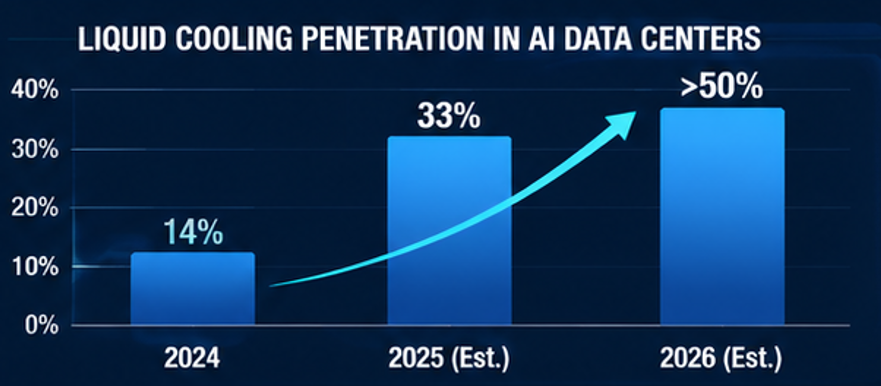
Liquid cooling is the most significant shift in data center cooling trends today. TrendForce reports that liquid cooling penetration in AI data centers surged from 14 percent in 2024 to an estimated 33 percent in 2025. By 2026, liquid is expected to surpass traditional air cooling as the preferred architecture for new hyperscale projects.
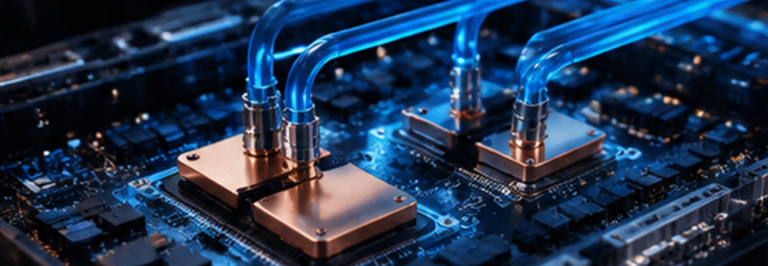
You have two primary liquid cooling paths to consider. The first is direct-to-chip liquid cooling, where coolant circulates through cold plates attached directly to processors and GPUs. This approach can handle 40 kilowatts and above per rack. The second is immersion cooling, where entire servers are submerged in a dielectric fluid. Studies show immersion cooling can reduce total cooling energy by up to 50 percent compared to air cooling.
Google deployed AI-optimized liquid cooling systems in its data centers and reported reducing overall cooling energy by more than 30 percent, according to Fortune Business Insights. If you are struggling with unstable thermal conditions or rising PUE, evaluating liquid-based solutions should be a priority when tracking data center cooling trends.
AI-Driven Intelligent Cooling: The Next Frontier
Beyond the hardware transition to liquid, data center cooling trends are also being shaped by artificial intelligence itself. AI-driven cooling optimization systems use machine learning algorithms to analyze temperature sensors, IT load data, and environmental conditions in real time, then dynamically adjust cooling parameters.
According to data from the China Academy of Information and Communications Technology (CAICT), data centers that adopted dynamic AI cooling optimization reduced their cooling system energy consumption by 20 to 35 percent, achieving PUE values between 1.15 and 1.25. Huawei’s iCooling@AI solution, for example, has demonstrated annual PUE reductions of 8 to 15 percent in production environments.
What does this mean for you? Even if you cannot fully transition to liquid cooling immediately, you can implement AI-based cooling optimization on your existing infrastructure. The approach uses predictive algorithms to anticipate thermal loads rather than reacting to them after they occur. This is one of the most practical data center cooling trends available today because it works with both air and hybrid cooling setups.
Free Cooling and Raising Temperature Standards
Another important trend in data center cooling trends that you may have overlooked is the gradual relaxation of operating temperature ranges. Historically, data centers kept server rooms at around 70 degrees Fahrenheit (21 degrees Celsius) or below. Today, operators are pushing temperatures higher, following ASHRAE’s expanded allowable ranges.
By raising the target temperature by just a few degrees, you can significantly extend the hours during which free cooling — using outside air or water directly without mechanical refrigeration — is viable. This is a low-cost strategy that pairs well with other advanced cooling approaches.
The shift in temperature standards is particularly valuable in cooler climates, where free cooling can cover the majority of annual cooling hours. Even in warmer regions, combining raised temperature setpoints with evaporative or adiabatic pre-cooling can reduce mechanical cooling load by 30 to 40 percent, according to industry reports.
Regional Data Center Cooling Trends: Asia Pacific Leads the Charge
If you are tracking data center cooling trends by geography, Asia Pacific deserves your close attention. The region accounted for 38.6 percent of global data center cooling revenue in 2025, according to IMARC Group, and is growing at a CAGR of approximately 14.3 percent — the fastest of any region.
China is the dominant force within Asia Pacific, driven by strong data-sovereignty regulations, the “Digital China” initiative, and aggressive expansion of domestic AI infrastructure. Local cooling technology suppliers’ domestic market share rose from 41 percent in 2020 to 67 percent in 2025, according to GEP Research. India and Southeast Asian nations are also accelerating hyperscale deployments.
In Europe, the retrofit market is growing fast. Strict EU energy efficiency regulations and carbon neutrality targets pushed the cooling system retrofit rate from 18 percent in 2024 to 29 percent in 2025, creating a $56.3 billion market. North America remains the largest single market by value at $72.8 billion in 2025, driven by AWS, Microsoft, and Google’s hyperscale expansions.
Preparing for Future Data Center Cooling Trends
Looking ahead, data center cooling trends point toward a multi-technology future. L2A (Liquid-to-Air) cooling will dominate through 2027 as an intermediate solution, while L2L (Liquid-to-Liquid) architectures are expected to accelerate from 2027 onward as next-generation data centers come online, according to TrendForce.
The global liquid cooling market is projected to be worth approximately $74.4 billion between 2025 and 2028, based on TrendForce’s analysis of 50 GW of new AI data center demand. This represents both a challenge and an opportunity for you.
If you are planning data center capacity for the next three to five years, you should start preparing your power distribution, piping infrastructure, and floor loading for liquid-based systems now. Retrofitting a facility after construction costs far more than designing for liquid from day one. The air-cooled era for high-density compute is ending.
Your immediate next step should be conducting a thermal audit of your current infrastructure to identify where your cooling gaps are. From there, evaluate whether direct-to-chip liquid cooling, immersion cooling, or an AI-driven optimization retrofit is the right path for your specific workload profile. The data center cooling trends outlined here are not predictions — they are already happening. The question is whether you are ready for them.