

High performance computing cooling has crossed a decisive threshold. AI accelerators such as NVIDIA’s H100 at 700 W and the Blackwell B200 at 1,000 W push rack densities past 100 kW, while air cooling tops out near 25 to 30 kW per rack. The industry answer is liquid cooling, a market Dell’Oro Group projects will reach about $7 billion by 2029. For HPC operators, the question is no longer whether to adopt liquid cooling, but which architecture fits the workload, budget, and facility constraints.
Why Has High Performance Computing Cooling Become the Critical Bottleneck in AI Clusters?
The physics of convective heat transfer sets a hard ceiling on air cooling; fans and heat sinks cannot break through it. Accelerator power has climbed steeply: the H100 runs at 700 W, the Blackwell B200 at 1,000 W, and next-generation Rubin is expected to climb higher, per The Cooling Report. A dense AI training cluster pushes rack densities past 100 kW, approaching 120 kW in some configurations. Next-generation designs target 200 to 250 kW per rack, which is why high performance computing cooling has moved to the top of the design agenda.
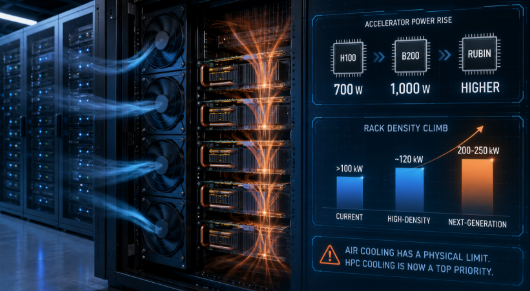
AMD’s MI300X and Intel’s Gaudi 3 also exceed the power envelopes that air cooling can handle, so this is not a single-vendor problem. Global AI workloads are expected to reach about 44 GW in 2026, overtaking non-AI workloads of roughly 38 GW. When one rack draws more power than a small office building, cooling limits compute density, energy cost, and uptime. High performance computing cooling decisions now determine whether a cluster runs at full utilization or throttles under thermal stress.
What Are the Main High Performance Computing Cooling Technologies in Use Today?
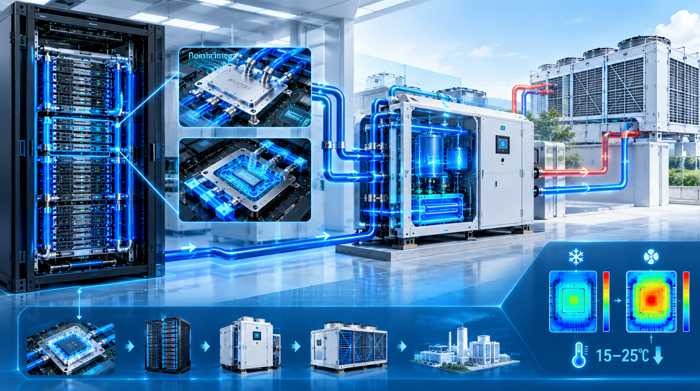
Three technology families dominate modern HPC facilities. Conventional air cooling uses computer room air handlers, fans, and heat sinks to reject heat. Direct-to-chip liquid cooling, also called cold-plate cooling, circulates coolant through metal plates mounted on CPUs, GPUs, and memory modules. Immersion cooling submerges entire servers in a dielectric fluid, in single-phase or two-phase configurations. Each family addresses a different range of high performance computing cooling requirements.
Adoption data shows how fast the landscape is shifting. Uptime Institute’s Cooling Systems Survey 2024, based on 964 respondents, found that 22 percent already use direct liquid cooling in their facilities, while 61 percent would consider it in the future. Nearly half of DLC users report that under 10 percent of their IT racks use the technology. For high performance computing cooling, the practical question is no longer which vendor to buy from, but which architecture to standardize on as densities climb.
How Much Heat Can Traditional Air-Based High Performance Computing Cooling Remove?
Air cooling has a practical ceiling of roughly 25 to 30 kW per rack, a limit that has not moved meaningfully for years. Optimization cannot break through that boundary. Any HPC cluster exceeding about 30 kW per rack requires a different heat rejection strategy. Understanding this ceiling is the first step in any high performance computing cooling strategy.
The efficiency gap is equally visible in power usage effectiveness. Traditional air-cooled data centers have long operated above 1.8 PUE, according to China Economic Net reporting. Cooling typically consumes 30 to 40 percent of total data center energy, behind only the IT equipment itself, which accounts for 45 to 60 percent. Liquid-cooled facilities can push PUE below 1.1, and China’s eight national hub nodes now average around 1.25. For high performance computing cooling, this efficiency delta translates directly into operating cost, carbon footprint, and the ability to add compute capacity inside an existing power envelope.
Direct-to-Chip or Immersion: Which High Performance Computing Cooling Architecture Should You Choose?
Direct-to-chip liquid cooling attaches cold plates to the highest-heat components and removes most heat at the source. Immersion cooling submerges the entire server in a dielectric fluid and rejects essentially all heat from every component. The choice between the two shapes the entire high performance computing cooling roadmap, so the decision deserves careful analysis.
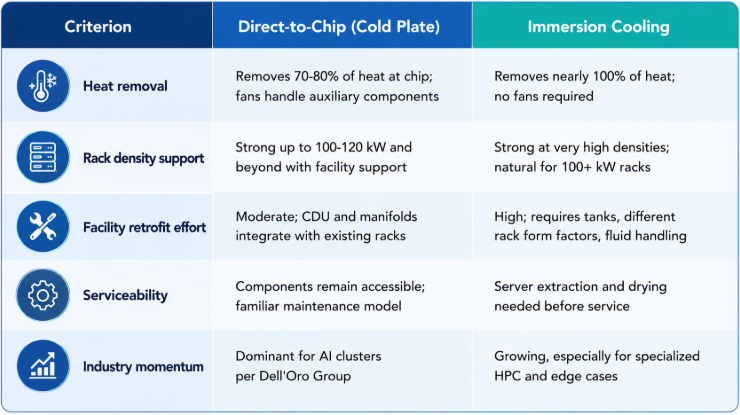
Dell’Oro Group reports that single-phase direct liquid cooling has consolidated its position as the dominant architecture for AI clusters. For most organizations, direct-to-chip delivers the fastest path to high performance computing cooling capability with the least operational disruption. Immersion remains attractive where density targets exceed retrofit support, or where operators want to eliminate air handling.
What Does a High Performance Computing Cooling Upgrade Cost, and What Does It Save?
The economics of high performance computing cooling are improving as the market scales. Dell’Oro Group projects the worldwide liquid cooling market will reach about $7 billion in manufacturer revenue by 2029. In China, the smart computing center liquid cooling market reached 18.4 billion RMB in 2024, growing 66.1 percent year over year, and could reach about 130 billion RMB by 2029, per the China Academy of Information and Communications Technology.
The savings side of high performance computing cooling is driven by PUE reduction. Moving from a PUE of 1.8 to below 1.2 can cut cooling-related energy consumption by more than half. National hub nodes now average PUE 1.2 to 1.3, and liquid-cooled designs have demonstrated PUE below 1.1. Heat reuse adds another revenue stream: warm coolant can feed district heating, turning waste heat into an asset. Over a five-year facility life, the energy savings from high performance computing cooling upgrades typically outweigh the capital cost of the equipment itself.
How Do You Migrate a High Performance Computing Cooling System Without Downtime?
Migration follows a staged pattern that protects running workloads. First, audit the actual thermal load per rack using telemetry rather than nameplate ratings. Second, pilot on one row or partition, validating coolant flow, leak detection, and temperature control under production load. Third, expand incrementally, prioritizing the densest racks where air cooling is already marginal. A phased plan keeps high performance computing cooling upgrades predictable.
A coolant distribution unit is the central integration point, isolating facility water from server coolant and controlling flow and temperature. Manifolds route coolant to each server, and quick-disconnect fittings allow service without draining the loop. Leak detection belongs at every connection, and monitoring should track coolant and chip junction temperatures. For mixed hardware generations, keep a small air-cooled zone for legacy servers. Every high performance computing cooling migration should be reversible at rack level, so a failed rollout affects one partition, not the entire cluster.
What Reliability and Performance Gains Can High Performance Computing Cooling Deliver?
Liquid cooling removes the thermal throttling that plagues air-cooled accelerators. Consistent low temperatures let GPUs run at full clock speed for sustained periods, shortening training and simulation times. Lenovo’s Neptune platform, which places cold plates directly on GPUs and memory modules, cites fewer slowdowns and longer hardware life because thermal spikes are eliminated. These gains turn high performance computing cooling into a performance lever, not just a utility.
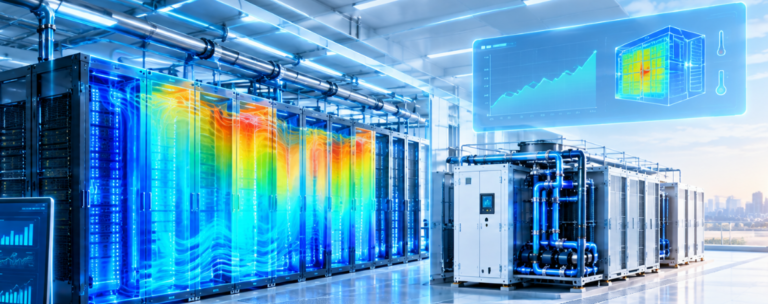
Operators are also using digital twins to tune cooling behavior. The Oak Ridge National Laboratory team behind Frontier, the exascale supercomputer, built a Digital Twin that simulates power and cooling telemetry, letting engineers test cooling water temperature and scheduling changes before applying them to the real machine. This reduces the risk of experimenting with a system too valuable to test directly. High performance computing cooling is thus evolving from a static utility into an actively managed subsystem where reliability, efficiency, and performance are optimized together.
How Will High Performance Computing Cooling Evolve Through 2030?
Three trends will define high performance computing cooling through the end of the decade. First, single-phase direct liquid cooling will remain the default for AI clusters, while two-phase and immersion approaches mature for niches. Second, rack densities will keep rising; designs targeting 200 to 250 kW per rack are already on whiteboards, pushing coolant temperatures higher and making heat reuse more attractive. Third, facility integration will deepen, with liquid cooling designed into buildings from the start and heat recovery standard in cold climates.
The strategic implication is straightforward: high performance computing cooling is now a core architectural decision, not a facility afterthought. Organizations that standardize on liquid-ready racks, trained teams, and monitoring tooling will absorb each new GPU generation without re-architecting facilities. Those that wait for air cooling to fail under load will face rushed migrations and avoidable downtime.
Conclusion
High performance computing cooling has moved from an optional efficiency measure to a mandatory requirement for AI-scale clusters. Air cooling stops at roughly 25 to 30 kW per rack, while B200-class accelerators push racks past 100 kW. Direct-to-chip liquid cooling is the dominant near-term answer. Uptime Institute data shows 22 percent of facilities already use DLC, Dell’Oro projects a $7 billion market by 2029, and liquid-cooled facilities routinely reach PUE below 1.2. The framework is practical: audit your thermal load, pilot on one partition, standardize on liquid-ready racks, and scale with monitoring. Every high performance computing cooling decision made today will determine which organizations can deploy the next generation of accelerators at full utilization.