

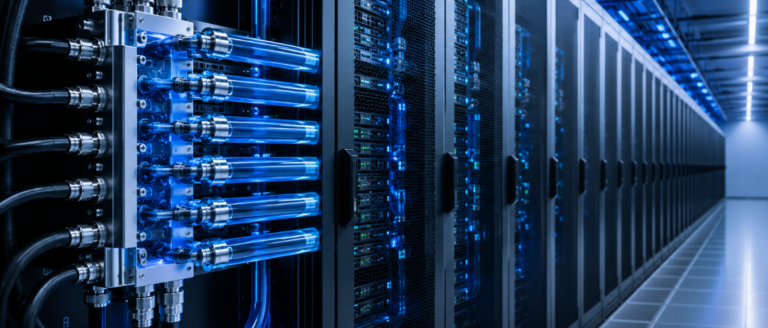
You have likely heard the term in rack liquid cooling in industry conversations, but understanding exactly what it entails is the first step toward making a sound investment decision. In rack liquid cooling refers to a thermal management architecture where coolant distribution units (CDUs) sit directly inside your server racks, circulating dielectric fluid or treated water through cold plates attached to your CPUs and GPUs. Unlike room-level systems that pump coolant from a central facility loop, in rack liquid cooling localizes heat capture at the chassis level, giving you far more precise temperature control at the source.
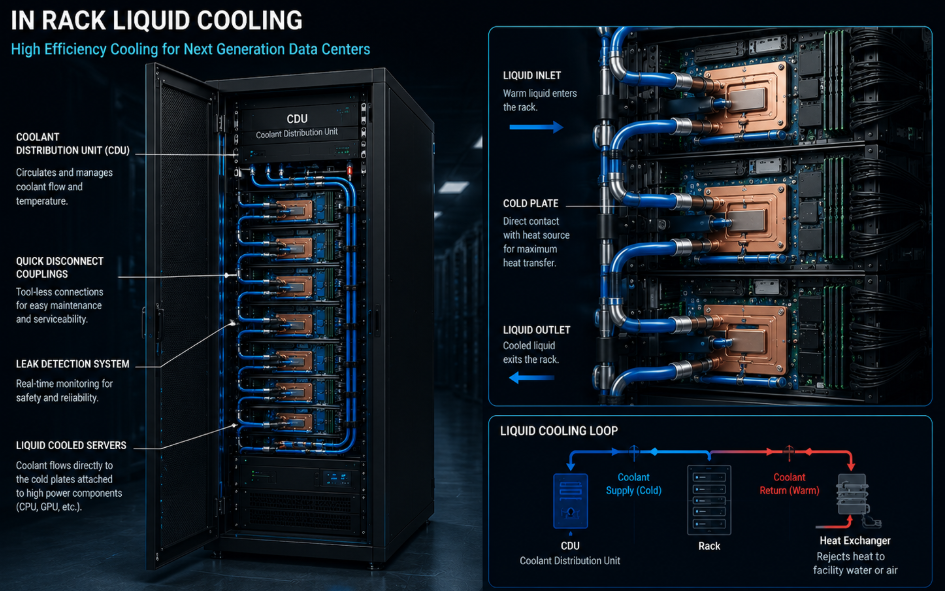
When you deploy this architecture, your rack infrastructure integrates pumps, heat exchangers, and intelligent flow control systems that maintain optimal coolant temperatures while filtering impurities from the closed loop. According to a 2025 report by IntelMarketResearch, the global in rack coolant distribution unit market reached $573 million in 2024 and is projected to hit $2.19 billion by 2032 at an 18.6% CAGR. This growth reflects the reality that traditional air cooling simply cannot handle the thermal output of modern AI and HPC hardware.
The Power Density Tipping Point
You need to know exactly when air cooling stops being viable for your operation. Air-cooled racks typically max out at 20–25 kW, with hot spots and thermal throttling becoming persistent risks beyond that threshold. In rack liquid cooling comfortably manages 30–50 kW per rack today, and next-generation CDUs like the DeepCoolAI ORV3 are now reaching 200 kW cooling capacity for AI training clusters, as reported by OpenPR in April 2025.
According to a November 2024 Deloitte Insights analysis, rack power densities in AI and cloud environments have already crossed the 50–100 kW mark in hyperscale deployments. If your workloads involve GPU clusters running large language model training or real-time inference, you are almost certainly past the air-cooling tipping point. MarketIntelo data shows that direct-to-chip liquid cooling held a 41.2% market share in 2025, confirming that operators are voting decisively with their budgets. The ASHRAE TC 9.9 guidelines give you a clear technical benchmark: air cooling supports coolant supply temperatures of 18–27°C, while liquid cooling allows up to 45°C under W4/W5 classification — a wider thermal envelope that lets you leverage free cooling for more hours per year.
Real Costs of In Rack Liquid Cooling
Now, the question you are probably asking first: what does in rack liquid cooling actually cost? A single unit ranges from $15,000 to $50,000 depending on capacity and features, according to IntelMarketResearch. A full rack-level deployment — including manifolds, CDUs, and liquid-ready chassis — typically runs $30,000 to $50,000 per rack, as detailed in SENJUN’s 2026 comparative analysis. This represents a two- to three-times premium over conventional air cooling hardware.
However, you should never evaluate this as a standalone capital expense. A joint analysis by NVIDIA and Vertiv, cited by Carbon-Z, found that transitioning to 75% liquid cooling reduced facility power consumption by 27% and slashed server fan power by up to 80%. At scale, these savings compress your payback period to 18–36 months, depending on local energy prices and rack utilization rates.
You also need to budget for ongoing maintenance. This technology introduces new protocols for leak detection, coolant quality monitoring, and specialized component servicing. Modern blind-mate dripless connectors conforming to OCP ORV3 standards have simplified cold plate maintenance, but your operations team will still require training on fluid handling and system purging — capabilities that air-cooled environments simply never demanded.
Energy Savings You Can Expect
Your energy bill is likely the largest operational line item in your data center budget. Electricity costs now represent 30–40% of total data center operating expenses. In rack liquid cooling directly addresses this by reducing cooling system energy consumption by 40–60% compared to air-based approaches, as reported by MarketIntelo.
Here is why those savings are so significant: in an air-cooled 40 kW rack, up to 30% of your power may be consumed by server fans alone. When you switch to this liquid-based approach, nearly all of that 40 kW becomes available for actual compute. The physics is straightforward — liquid has a convective heat transfer coefficient of 1,000–10,000 W/(m²·K), roughly 100 times greater than air at 10–100 W/(m²·K), according to SENJUN’s engineering analysis.
If you are running sustained high-density workloads, these savings compound quickly. The Business Research Company projects the data center liquid cooling market will grow from $5.1 billion in 2025 to $16.16 billion by 2030 at a 26% CAGR, reflecting the compelling payback operators are achieving. For your facility in a high-cost electricity region — Northern Virginia, Frankfurt, or Singapore — the economic case becomes undeniable even at moderate rack densities.
PUE Targets Driving In Rack Liquid Cooling Adoption
You cannot discuss this cooling strategy without addressing Power Usage Effectiveness. Air-cooled facilities typically operate at PUE values between 1.25 and 1.50, while in rack liquid cooling routinely delivers PUE below 1.10, with some deployments reaching 1.03–1.05 according to Deloitte’s November 2024 analysis.
Regulatory pressure is accelerating your timeline. The European Union’s Energy Efficiency Directive now requires data centers to achieve PUE below 1.3 by 2025 — a threshold nearly impossible to meet with air cooling alone at scale. Similar mandates are advancing across North America and Asia-Pacific markets, where hyperscale expansion in China and India accounts for over 35% of global in rack cooling demand, per IntelMarketResearch.
If your organization carries public sustainability commitments or ESG reporting requirements, this approach provides a measurable, auditable path toward those goals. It also reduces water consumption by approximately 90% compared to evaporative cooling systems, a critical advantage if you operate in water-stressed regions. For facilities pursuing both PUE and WUE targets, the dual environmental benefit transforms liquid cooling from an operational upgrade into a strategic imperative.
Retrofitting vs. New Build Decisions
Whether you should retrofit existing racks or wait for a new build depends on your facility’s structural readiness. SENJUN’s 2026 evaluation framework recommends assessing four criteria: silicon TDP exceeding 500W per component, sustained rack density above 30 kW, floor loading capable of supporting 350+ pounds per square foot, and sustainability mandates requiring PUE below 1.15. Meeting three of these four thresholds justifies retrofitting.
The modular, plug-and-play design of modern CDUs supports phased deployment, allowing you to convert one row at a time without disrupting production workloads. For greenfield construction, in rack liquid cooling should be part of your base design specifications. Leading cloud providers including AWS, Microsoft Azure, and Google Cloud have already deployed direct-to-chip liquid cooling at scale in new hyperscale builds. MarketIntelo data confirms that nearly 25% of all new hyperscale deployments now specify some form of liquid cooling infrastructure — triple the figure from three years ago.
Avoiding Common In Rack Liquid Cooling Pitfalls
Your deployment will succeed or fail based on attention to detail during planning. First, do not underestimate supply chain lead times. Specialized components — leak-proof quick-connect fittings, corrosion-resistant heat exchangers, and precision flow control valves — now face 6–9 month lead times in some regions, per IntelMarketResearch. Order critical components well before your target deployment date.
Second, do not neglect facility water quality. Your CDU’s heat exchanger performance depends directly on coolant chemistry. If you are using facility water rather than a closed-loop dielectric system, invest in filtration and regular testing — impurities accelerate corrosion and can void manufacturer warranties.
Third, do not skip staff training. Monitoring tools like SOETECK provide real-time telemetry on flow rates, differential pressure, and coolant temperature, but your operations team still needs hands-on experience with leak response protocols and component-level troubleshooting. Budget for at least two weeks of specialized training before commissioning your first liquid-cooled racks.
Finally, plan for dual cooling during migration. If you are retrofitting an existing air-cooled row, hybrid architectures combining rear-door heat exchangers with in rack liquid cooling loops give you a flexible pathway to adopt liquid cooling incrementally while maintaining uptime.
Conclusion: Your In Rack Liquid Cooling Decision
In rack liquid cooling has moved from niche experimentation to mainstream necessity for any data center running AI, HPC, or GPU-intensive workloads above 20 kW per rack. The economics are increasingly clear: while you face higher upfront capital costs of $15,000–$50,000 per rack, the 20–40% reduction in total facility energy consumption and the ability to achieve PUE below 1.10 deliver payback within 18–36 months at scale. Your decision should hinge on a clear-eyed assessment of your power density trajectory, facility readiness, and sustainability targets. If your roadmap includes next-generation GPU deployments, this is not a question of if — it is a question of when.