

You are staring at two proposals on your desk. One is a traditional data center build — 24 months of construction, roughly $12 million per megawatt. The other is an all-in-one data center solution: factory-integrated, shipped to your site, and operational in under six months. To you, the choice looks obvious. But if you sign that purchase order without drilling into five specific blind spots, you could end up with a deployment that costs you more per rack than the traditional build you rejected.
Here is what your vendor likely will not volunteer during the sales cycle, and exactly how you should protect your budget.
The All-in-One Data Center Market Is Exploding
You are not alone in exploring this path, and you should understand the scale. According to Pmarketresearch, your industry’s all-in-one modular data center market reached $5.23 billion in 2025 and is projected to hit $15.85 billion by 2032, a CAGR of 17.15%. Containerized all-in-one data centers captured 60.2% of market share in 2025, with IT and telecommunications driving 39.6% of demand. North America leads at $1.86 billion, followed by Asia Pacific at $1.57 billion and Europe at $1.33 billion. This is not a niche you can ignore. But the 17% CAGR also means your vendor landscape fills with new entrants every quarter, and your due diligence burden grows accordingly.
Speed vs. Customization: The Real Trade-Off
The headline every all-in-one data center vendor leads with is deployment speed, and you should know the data supports them. A 2025 McKinsey analysis found that modular data centers cut your time to first workload by roughly 50%, shrinking build timelines from 18 to 36 months down to a 3-to-6-month window. Cushman & Wakefield’s 2025 cost guide pegs traditional construction at $9.3 to $15 million per megawatt, while modular deployments range from $4.5 to $6.5 million per module. You get the appeal immediately: lower capital at risk and faster time-to-revenue.
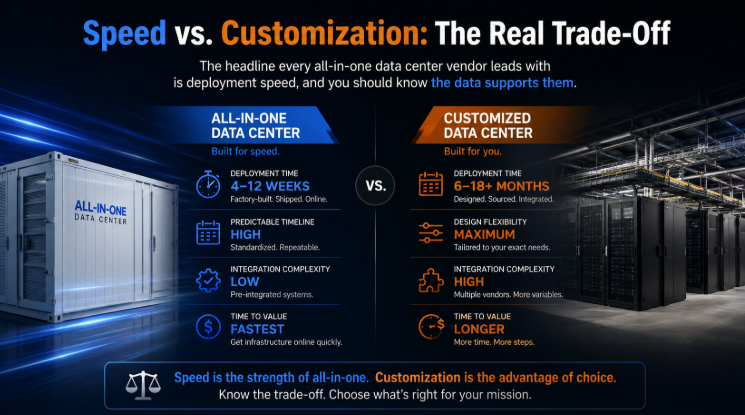
But here is what you need to watch: the speed advantage comes directly from standardization. When your vendor pre-integrates power, cooling, and racks at the factory, you are buying into their reference architecture. If your workload demands a non-standard rack depth or a specific cooling loop pressure rating, you may discover that “configurable” and “customizable” are not the same term. You should ask your vendor to show you a deployed unit matching your exact density specifications before you commit to anything.
Why Your PUE Target Keeps Getting Missed
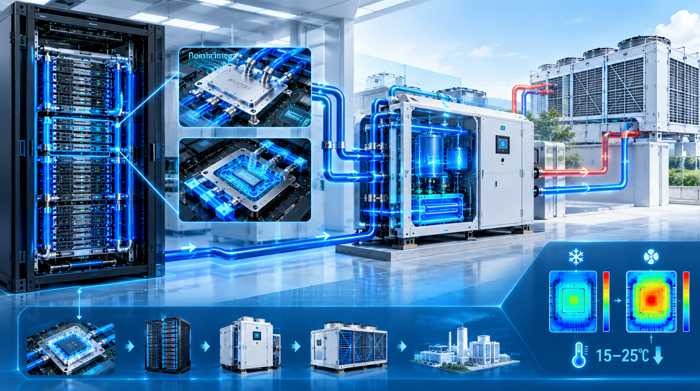
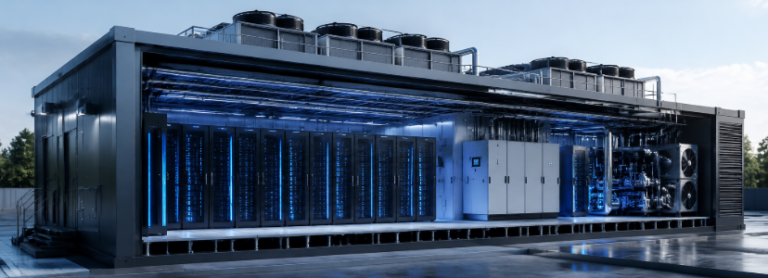
Every all-in-one data center brochure promises industry-leading Power Usage Effectiveness, and you should know the lab numbers are genuinely impressive. Huawei’s CloudPower IDS1000 integrates power, cooling, monitoring, and fire suppression into a single enclosure that you can deploy in roughly one week. ZTE’s AIDC prefabricated container, launched at MWC Shanghai 2025, achieves a PUE as low as 1.15 using chilled water and cold plate technology — a figure you would be thrilled to hit. FiberHome’s FitA series pushes PUE below 1.4 with row-level precision cooling, and you can see field data showing 30% energy reduction versus traditional builds.
Your real-world PUE, however, depends on three variables you directly control: ambient climate at your deployment site, the consistency of your IT load profile, and whether your commissioning team correctly sequences the cooling control logic during startup. If you deploy the same all-in-one data center in 35°C ambient temperatures at partial IT loads, your actual PUE can drift 0.2 to 0.3 above the specification sheet. You need a site-specific computational fluid dynamics simulation before you accept any vendor’s PUE guarantee at face value.
Cooling Integration: The Silent Budget Killer
Cooling is where all-in-one data center economics get complicated, and you need to understand why. As AI workloads push rack densities past 30 kW, the cooling subsystem becomes your dominant cost driver. Flex’s 2025 integrated platform incorporates liquid cooling and claims to accelerate deployment by up to 30%. Delta Electronics demonstrated a 1,500 kW liquid-to-liquid cooling system at COMPUTEX 2025. The trap you need to avoid is under-specifying cooling at purchase.
If your all-in-one data center ships with air cooling rated for 15 kW per rack and your AI workloads arrive six months later demanding 40 kW, retrofitting liquid cooling into a sealed enclosure is neither cheap nor fast. This is where your equipment vendor selection becomes critical. If you are evaluating integration quality across suppliers, a vendor like SOETECK can help you assess whether your target all-in-one data center supports field-upgradable cold plate connections without a full module swap-out — a detail that can save you hundreds of thousands in mid-lifecycle costs.
All-in-One Data Center Vendor Selection Checklist
When you sit down to evaluate all-in-one data center vendors, you need a framework that goes beyond the sales deck.
- First, demand a reference deployment with 12 months of operational data — PUE trends, uptime statistics, and maintenance logs.
- Second, verify that factory acceptance testing includes a full-load thermal run at your specified rack density.
- Third, confirm the power architecture supports your redundancy tier without external switchgear that defeats the all-in-one value.
- Fourth, request a bill of materials showing which subsystems the vendor manufactures versus white-labels.
- Fifth, calculate your total cost of ownership over a 7-year lifecycle — energy, labor, and component refresh — not just the upfront capital figure.
Power Density and Your Future AI Workloads
Your power density requirements are almost certainly going to double within three years, and the all-in-one data center you purchase today must accommodate that trajectory.
You should map your workload roadmap 36 months forward before you select a module size. If your current average is 8 kW per rack but your AI roadmap targets 25 kW within 24 months, buying an all-in-one data center capped at 15 kW forces you into either throttling compute performance or buying a second unit far sooner than your capital budget anticipated. You only capture the per-megawatt cost advantage — $4.5 to $6.5 million versus $9.3 to $15 million for traditional builds, per Cushman & Wakefield — if you size the unit correctly from day one.
The Supply Chain Risk You’re Ignoring
An all-in-one data center shifts integration risk onto your vendor, and you get a genuine benefit from that in normal market conditions. But you also concentrate your dependency in ways you may not have considered. If your vendor’s primary factory faces a disruption — a component shortage, a logistics bottleneck, or a quality hold — your entire deployment stalls because you cannot simply swap in an alternative chiller or power module mid-build the way you could with a traditional multi-vendor approach.
You should ask your vendor for their multi-site manufacturing contingency plan and lead-time guarantees with enforceable penalty clauses before you sign the contract. Without those protections, you are absorbing their supply chain risk without the contractual leverage you need to recover your deployment schedule.
Making Your All-in-One Data Center Pay Back Faster
The financial case for an all-in-one data center closes fastest when you factor in time-to-revenue acceleration, not just construction cost reduction. Every month your traditional build sits in the construction phase is a month your compute capacity generates zero business value for your organization. At $5 to $15 million in capital at risk per traditional build site versus $5 to $15 million per modular module, according to AMC research drawing on McKinsey and JLL data, the capital efficiency argument tilts decisively toward modular deployment — but only if you avoid the five procurement blind spots detailed above.
Your all-in-one data center strategy should treat vendor selection as a systems integration audit, not a procurement transaction. You need to test thermal performance at your actual planned density, validate supply chain resilience with contractual teeth, lock in a cooling architecture that supports your AI workload roadmap, and benchmark real-world PUE from reference sites operating in your climate zone. Do all of that, and your all-in-one data center delivers exactly what the market numbers promise: faster deployment, lower capital at risk, and a scalable foundation that grows with your compute demand.