



A modular data center build does not fail on the site. It fails in the procurement queue. Factory prefabrication removes months of field labor, yet transformers, generators, and medium-voltage switchgear still carry 42 to 100 week lead times that no amount of prefabrication compresses. Modular delivery therefore only converts into real schedule savings when long-lead equipment is released before design freeze, not after.
Why Does a Modular Data Center Build Hit Its Limit in Procurement?
Prefabrication moves work from the site into a factory, and that shift is genuine. Assembling racks, power distribution, and containment in a controlled bay cuts server-room fit-out from roughly fifteen weeks to two or three according to engineering firm Salas O’Brien. What prefabrication cannot do is manufacture a transformer faster than the grid equipment supply chain allows.
That asymmetry moves the bottleneck. On a traditional build, site sequencing often governs the calendar, so compressing field work looks like compressing the project. On a modular data center build, field work is already short, which exposes the equipment queue that was always sitting behind it. The constraint becomes visible rather than new.
JLL’s 2026 outlook puts the average data center equipment lead time at about 33 weeks across categories, and that average conceals the outliers that actually govern a schedule. Thirty-three weeks is already longer than the site-assembly window of a well-standardized modular hall, which is why a modular data center build planned purely around construction method tends to miss its energization date.
Which Long-Lead Equipment Actually Sets the Critical Path?
The spread between categories is wide, and for a modular data center build the ranking decides what must be ordered first. JLL reports 2026 transformer lead times of roughly 100 weeks in EMEA, 42 weeks in the Americas, and 20 weeks in APAC, making the transformer the single longest item in most markets. Generators follow at about 83, 50, and 40 weeks respectively.
Medium-voltage switchgear runs about 52, 42, and 28 weeks, while chillers run 48, 34, and 21. Battery and UPS systems sit near 30, 34, and 22 weeks, and rear-door or direct-to-chip cooling hardware near 30, 18, and 15. Racks, busway, and PDUs are comparatively short at 3 to 6 months, which is why they can still be adjusted late.
Regional variation matters more than most planning templates admit. A modular data center build in Frankfurt faces a transformer queue several times longer than the same design in Singapore, because European grid equipment capacity has tightened faster than demand. Copying a schedule template across regions therefore imports an error that surfaces only at commissioning, when the module is ready and the power is not.
What Do Vendor Speed Claims Actually Measure?
Published acceleration figures describe narrow scopes, and reading them as end-to-end savings is the most common planning mistake. SemiAnalysis notes that Vertiv’s headline 85 percent figure applies to overhead busway and cable management only, that a 50 percent claim measures module deployment against site construction, and that a 60 percent claim covers power and cooling modules alone.
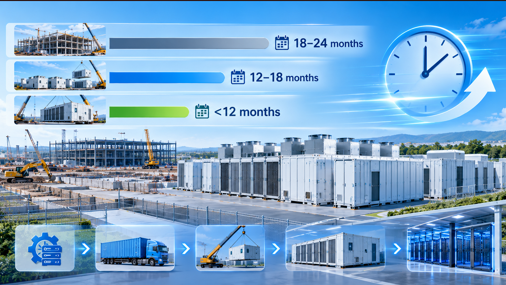
None of those scopes is dishonest, but none describes a whole modular data center build. When the same analysis models a complete 50 MW liquid-cooled hall end to end, pure site construction takes about 18 to 24 months, full modular delivery reaches 12 to 18 months, and integrated prefabricated or containerized modules can compress the window below 12 months.
That is a real gain of roughly 36 percent, and it is worth having for any modular data center build that can absorb standard configurations. It is simply smaller and differently sourced than the marketing suggests, because the remaining months are dominated by equipment arrival, utility interconnection, and commissioning rather than by erecting walls or pouring slabs.
How Early Must Procurement Release to Protect a Modular Data Center Build?
Because the module is built around its equipment, the order date governs everything downstream in a modular data center build. Freezing module dimensions before the transformer and switchgear are allocated produces a factory-built enclosure that waits in a yard, converting a supposed schedule advantage into storage cost, financing drag, and rework when the delivered unit no longer matches the design.
Leading operators treat capacity slots as a tradable asset. QTS reportedly holds roughly seven million square feet of warehouse capacity in Kansas specifically to stock long-lead equipment, and its Rapids design has been adopted by two large AI customers on that basis. Inventory becomes a schedule instrument rather than waste.
The practical rule for a modular data center build is to release transformers, generators, and switchgear at concept design, dual-source every long-lead category, and standardize each type across phases so a delayed unit can serve any building on the campus. Waiting for permit approval before ordering is what erases the modular advantage.
A release ladder makes this concrete. Transformers and utility interconnection agreements go first, because grid studies and energization dates depend on them. Generators and switchgear follow once the capacity block size is fixed. Cooling architecture locks next, and racks, busway, and PDUs come last, since at three to six months they still tolerate late change. If you invert that order and start with the most visible equipment, the invisible queue sets the date.
Where Do the Seams Between Modules Create Risk?
Modular delivery replaces one integrated design problem with many interface problems, and those interfaces are where a modular data center build quietly loses its schedule advantage. A standardized power block must coordinate fault current, protective device settings, grounding, impedance, and controls with adjacent blocks and with the utility feed. Cooling modules must hold flow, pressure, redundancy, and operating sequence against a central plant.
Physical fit is equally unforgiving. Modules must pass through doors and corridors, around structural elements, and into position with clearance for installation, operation, and later replacement. A module that fits on a drawing but cannot be rigged into place is a failed design regardless of how well it performs in the factory.
This is why the industry is developing shared interface frameworks, including IEEE P3710 work on modular data center interfaces, and why models are pushed to LOD 400 so geometry, connections, supports, and maintenance zones are resolved before fabrication. In a modular data center build, the model replaces the site as the place where errors are found.
Does a Modular Data Center Build Really Cost Less per Megawatt?
Cost claims are closer to reality than schedule claims, but the margin is thin. SemiAnalysis puts a fully modular solution near 13.5 million dollars per megawatt against roughly 14.6 million for pure site construction, an 8 percent reduction. The saving comes from moving MEP installation into a factory, worth about 600,000 dollars per megawatt in construction services and 500,000 in installation.
Modular delivery also adds cost that site builds do not carry. A module supplier margin sits on top of the equipment, oversized units can cost 15,000 to 50,000 dollars each to transport, and foundations, grading, and utility connections still require conventional work. Any deviation from a standard configuration adds both money and time.
JLL’s 2026 construction cost data shows how much location dominates these figures, ranging from about 7 million dollars per megawatt in Mumbai to 18 million in Tokyo. For a modular data center build, the honest comparison is not modular versus traditional in the abstract but modular versus traditional at that specific site, with that specific supply chain.
What Should Factory Acceptance Testing Cover Before Shipment?
Factory testing is the main quality control that modular delivery offers, and skipping it wastes the format entirely. Because defects found in a factory are cheap and defects found on site are not, acceptance on a modular data center build should cover full power-train operation, cooling loop pressure and flow, controls sequence, and a simulated failover before the module leaves.
Operators and MEP contractors have reported reliability problems in some modular offerings, and a single latent defect can erase the schedule gain that justified the purchase. A witnessed factory test with recorded data is the only credible defense, and it should be a contractual milestone tied to payment rather than a courtesy visit.
Commissioning after delivery still takes two to four months and consumes 1 to 3 percent of project cost, according to development guidance drawn from DGTL Infra and Turner & Townsend data. A modular data center build compresses this phase but does not remove it, so the schedule should carry explicit integration and load-bank time.

Is a Modular Data Center Build the Right Choice for Every Site?
Modular delivery wins where time-to-market dominates. It fits edge and remote sites with scarce skilled labor, phased campuses adding capacity incrementally, and GPU deployments waiting on facilities rather than on silicon. In those cases the premium for speed is easily repaid, at an estimated 500,000 dollars of operator value per megawatt per month of earlier operation.
It fits poorly where requirements are highly customized, geotechnical conditions demand extensive foundations, module delivery is constrained by dense urban access, or absolute lowest cost matters more than schedule. A modular data center build also inherits the module supplier’s configuration limits, which can become a constraint once rack densities rise beyond the standard design.
The defensible conclusion is that modular construction changes where the schedule risk lives rather than deleting it. Teams that plan a modular data center build around procurement slots, interface models, and witnessed factory tests capture the 8 percent cost and 36 percent schedule gains. Teams that treat prefabrication as a construction shortcut inherit the same equipment queue with less flexibility to absorb it.
There is a legitimate middle path. A modular data center build can be used as bridge capacity while a conventional hall is completed, or phased as repeatable pods tied to a central utility plant that is sized once and expanded later. Both patterns accept that power delivery, not module fabrication, sets the outer boundary of what is achievable.