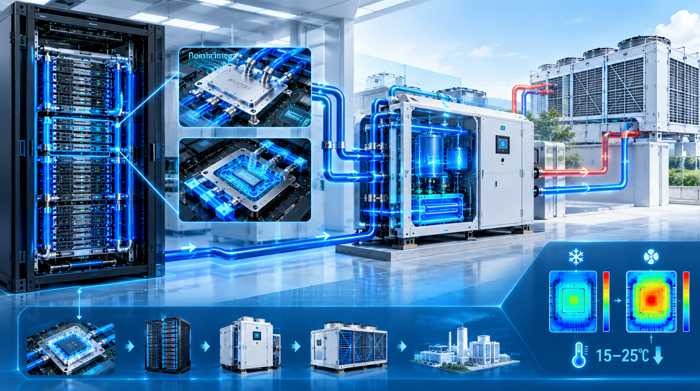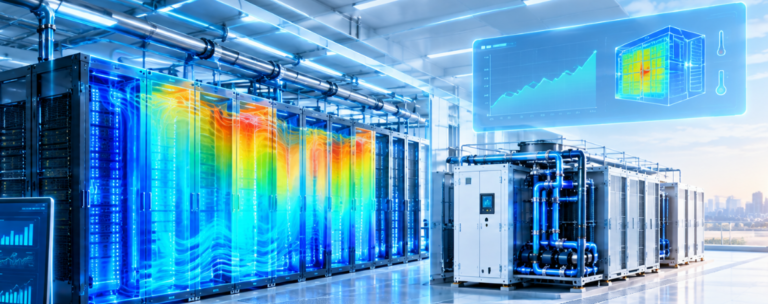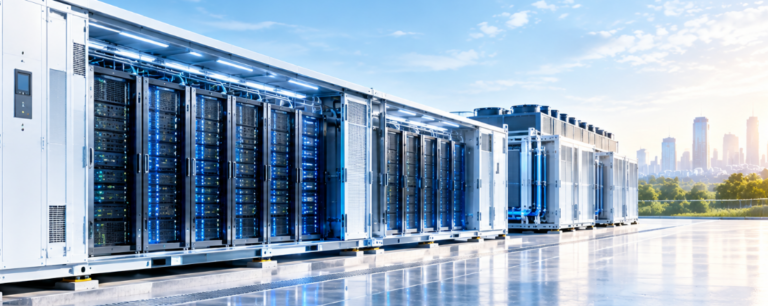


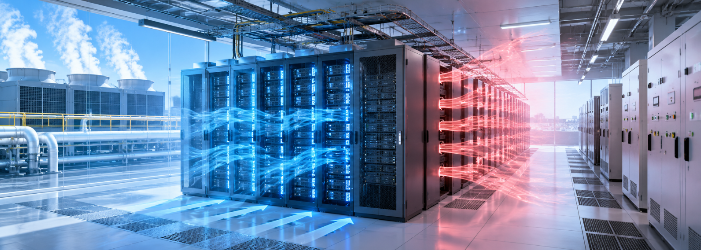
Retrofitting is now the fastest realistic answer to data center heat dissipation, because more than 70% of global data center capacity sits in buildings designed for 5–15 kW air-cooled racks. New construction takes three to five years, while GPU platforms iterate on an 18-month cycle, so waiting for greenfield means losing competitive ground. The proven path is a phased direct-to-chip retrofit: this data center heat dissipation strategy starts with an assessment, converts a pilot rack or two, expands row by row, and keeps air cooling for legacy equipment. Done in phases, a liquid retrofit costs roughly $2 million per megawatt versus $11 million for new capacity and can reach payback in 24–36 months.
Why Is Retrofitting the Real Data Center Heat Dissipation Problem?
The AI buildout is happening inside existing buildings, not in greenfield facilities operators can spec from scratch. The Cooling Report notes that over 70% of global data center capacity already exists, most of it engineered for 5–15 kW rack densities. Those buildings were never designed for 100 kW per rack, which makes brownfield data center heat dissipation the mainstream engineering challenge of this cycle. The economics reinforce the urgency: STL Partners puts a liquid cooling retrofit at about $2 million per MW, versus $11 million per MW for new liquid-cooled capacity. Tate Global adds that retrofitting cuts capital expenditure by 20–40% versus new builds and reduces embodied carbon by up to 50%. For operators with available power and grid interconnection, the retrofit converts a stranded asset into AI-ready capacity for data center heat dissipation in months rather than years.
How Much Does a Data Center Heat Dissipation Retrofit Cost vs. Building New?
Retrofit costs vary by technology choice, and the table below shows the realistic cost ranges for data center heat dissipation retrofit projects, as reported by integrators and analysts in 2025–2026. Costs are expressed per rack because density, facility conditions, and scope drive the final number, so treat each figure as a planning baseline rather than a quote:
| Rear-door heat exchanger (RDHx) | $8,000–15,000 | Adds 15–30 kW heat removal per door | Incremental upgrade, adequate chilled water |
| In-row cooling unit | $20,000–35,000 | 40–100 kW per unit | Rack space available, room-level cooling weak |
| Direct-to-chip cold plates | $5,000–80,000 | 30–100+ kW | GPU/AI racks, phased conversion |
| Immersion tank retrofit | $15,000–40,000 | 100+ kW | Greenfield or dedicated high-density zones |
TechInfraHub cautions that retrofit costs run 15–30% higher than equivalent greenfield deployment because of integration complexity and structural reinforcement. Nimble DC analysts report typical direct-to-chip retrofits between $5,000 and $20,000 per rack, while Introl’s field data for full conversion, including CDUs and manifolds, reaches $50,000–80,000 per rack at 60 kW+ density.
Floor loading is a real constraint in data center heat dissipation retrofits: cold plates add 15–25 kg per rack, so structural capacity must be confirmed before committing capital. The spread reflects scope: a single-rack pilot costs a fraction of a full row conversion, which is why phased deployment dominates.
Which Racks Should You Convert First in a Data Center Heat Dissipation Retrofit?
Start with an assessment, not a procurement; data center heat dissipation retrofits fail on infrastructure readiness more often than on cooling physics. Introl’s teams have evaluated more than 500 legacy facilities and report that sites scoring above 70 on their 100-point readiness scale succeed about 90% of the time, while scores below 50 usually point to new construction. The assessment, costing $25,000–50,000, verifies floor loading, power distribution, chilled water capacity, and fire suppression compatibility before any capital is spent.
Rack selection follows measured density, not nameplate ratings: rows below 15 kW stay on air; rows at 25–30 kW are prime direct-to-chip candidates; immersion only pays off above 60–70 kW per rack. Convert development or test workloads first: 2–3 pilot racks of non-production compute let the team learn without risking customer uptime, proving that the data center heat dissipation loop can be installed, commissioned, and operated safely in your facility.
What Does a Phased Data Center Heat Dissipation Retrofit Timeline Look Like?
A realistic data center heat dissipation retrofit runs in four phases over roughly 12–18 months, based on Introl’s field playbook. Phase 1, infrastructure preparation in months 1–3, installs CDUs in mechanical spaces, runs primary loops through accessible pathways, and upgrades power distribution, budgeting $500,000–1,500,000 for a 10-rack deployment with zero downtime if planned correctly. Phase 2, the pilot in months 4–5, converts 2–3 racks for $150,000–300,000, with 4–8 hours of downtime per rack during cutover.
Phase 3, production migration in months 6–12, converts racks in waves of 5–10 during maintenance windows at $100,000–150,000 per rack. Phase 4, optimization in months 13–18, raises chilled water temperatures and tunes flow controls as the data center heat dissipation retrofit reaches steady state. SAVRN’s roadmap compresses the same logic: 3–6 months of assessment, 6–12 months of pilot deployment on 1–2 high-density racks, then 12–24 months of scale-out.
How Do You Protect a Live Facility During Data Center Heat Dissipation Upgrades?
Converting a live facility is where retrofits earn their reputation for risk. Leviathan Systems converts one row per night during planned maintenance windows, using temporary barriers, a dedicated CDU per row, and a separate liquid loop while air cooling keeps the rest of the hall running. CIBSE Journal flags a subtler issue: older facilities were designed to keep water away from IT racks, and colocation SLAs may exclude water near equipment, so contract language may need revision first.
Leak protection is non-negotiable: dual-sealed connections, isolation valves, inline leak detection sensors under every CDU and manifold, and dry-break connectors for hot-swap server maintenance without draining the loop, all standard in successful data center heat dissipation retrofits. Fire suppression must be upgraded too, since liquid cooling adds flammable coolant near electronics; clean agent systems such as Novec 1230 and pre-action sprinklers replace legacy FM-200 where installed. Every measure protects uptime during the data center heat dissipation transition.
What Infrastructure Must Change Beyond the Cooling Loop?
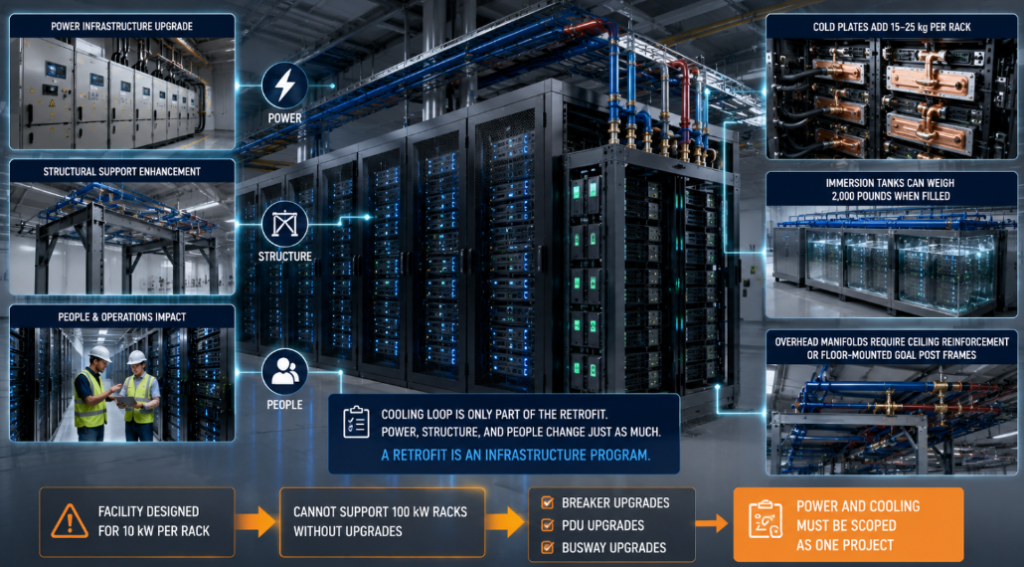
The cooling loop is only part of a retrofit; power, structure, and people change just as much, which makes a data center heat dissipation retrofit an infrastructure program. The Cooling Report warns that a facility designed for 10 kW per rack cannot support 100 kW racks without breaker, PDU, and busway upgrades that run ahead of the cooling work, so power and cooling must be scoped as one project. Cold plates add 15–25 kg per rack, immersion tanks can weigh 2,000 pounds when filled, and overhead manifolds require ceiling reinforcement or floor-mounted goal post frames.
Coolant quality demands new discipline: Leviathan specifies 30% propylene glycol and 70% deionized water with corrosion inhibitor, quarterly testing, and replacement every 3–5 years or when resistivity drops below 1 MΩ·cm. CDUs need N+1 redundancy, each supporting 200–500 kW. The least visible constraint is workforce: engineers who spent careers on chilled-water air handlers must now balance CDU flow rates and commission mixed cooling architectures, a skill set not yet available in volume.
How Do You Commission and Validate a Retrofitted Liquid Loop?
Commissioning determines whether a retrofit succeeds or fails, and rushing it is the leading cause of early failures. The process starts with pressure testing the entire loop at 1.5 times the maximum operating pressure, logging any pressure drop before a single server is connected. Cold plates are torqued to specification in a cross-pattern with calibrated tools; overtorquing cracks GPU substrates, while undertorquing leaves air gaps that create hot spots. After cutover, an infrared camera verifies that all GPU die temperatures sit within a few degrees of each other under full load.
Coolant is tested quarterly with a handheld conductivity meter and particle counter, and loops are flushed when particle counts exceed 100 per mL at 0.5 microns. Introl’s production data shows what good commissioning achieves: direct-to-chip cooling drops PUE from 1.58 to 1.15, and CoolIT demonstrated 300 H100 GPUs holding 62°C junctions with 25°C inlet water. Monitor actual versus projected PUE, temperature stability, and maintenance costs for at least one quarter before expanding the data center heat dissipation deployment.
What Is the Payback Reality for Data Center Heat Dissipation Retrofits?
The financial case for a data center heat dissipation retrofit is density and speed, with energy savings as a secondary benefit. Nimble DC analysts report most operators achieve payback in 24–30 months for direct-to-chip retrofits, driven by 20–40% reductions in cooling-related energy and 10–20% cuts in total facility operating costs. A 5 MW hall at 80% load cuts cooling energy 30–50%, about $130,000 per year at $0.10 per kWh, against a retrofit cost of $500,000–1,000,000, extending energy-only payback to 4–8 years.
The real return comes from density: early adopters gain roughly 40% higher compute density, and liquid-cooled space commands premium lease rates from AI tenants. Introl reports direct-to-chip already holds a dominant 47% share of the AI data center liquid cooling market. For operators weighing capital, data center heat dissipation retrofits are capital-efficient because they monetize existing power and space faster than any new build.
Data center heat dissipation retrofits are now a mainstream strategy, not an experimental edge case. The evidence is consistent: over 70% of capacity lives in air-cooled buildings, retrofits cost a fraction of new builds and can be delivered in months, phased direct-to-chip conversion keeps risk contained, and payback typically lands within 24–36 months when density gains are counted. The discipline that separates successful projects is sequence: assess readiness, convert development racks first, validate commissioning data, then scale row by row. Operators who execute that sequence will convert existing assets into AI-ready capacity ahead of competitors still waiting for greenfield permits.