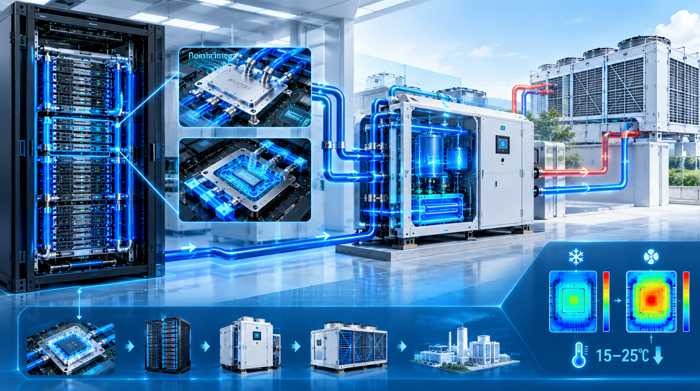



Imagine a single legacy rack in an older colo hall, air-cooled at 8 kW, and a plan to turn it into a 40 kW direct-liquid-cooled rack holding four NVIDIA H100 servers. One rack is the smallest unit of infrastructure, but upgrading it touches everything around it.
This article follows one arithmetic chain, from the heat a 40 kW rack produces to the gallons of water, amps of current, kilograms of floor load, and network ports it demands. Each answer feeds the next, and every one decides whether that rack can claim to be part of an AI ready data center. Only after the full chain does a label like AI ready data center mean anything measurable. The exercise is deliberately small, one rack and four servers, yet it resolves a question about the whole building.
Why Does a 40 kW Upgrade Start with Heat, Not Power?
Power and heat are the same number, because every watt a server consumes must be removed as heat. A 40 kW rack produces 136,500 BTU/h, since each kilowatt equals roughly 3,412 BTU/h, about 11.4 refrigeration tons. An 8 kW air-cooled rack, by contrast, produces only 27,300 BTU/h, or 2.3 tons. The fivefold jump drives the size of every pipe, circuit, and slab that follows.
No later calculation makes sense until this number is fixed, which is why the first audit step of a rack-boundary AI ready data center upgrade is a heat ledger, not a power budget. In short, an AI ready data center is first a thermal statement, and every engineering decision sits downstream of it. The math holds whether the rack holds four H100s or eight smaller GPUs; only the heat ledger changes.
How Much Coolant Flow Does an AI Ready Data Center Rack Need?
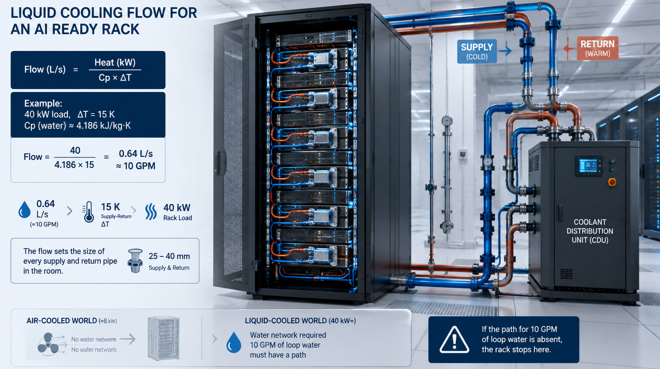
Liquid cooling exists because air cannot move 40 kW of heat out of a small space. The flow follows a simple equation: heat divided by the water’s heat capacity and its temperature rise. With a common 15 K supply-return spread, a 40 kW load needs about 0.64 liters per second of flow, roughly 10 gallons per minute. That volume moves through a 25 to 40 mm supply and return pipe to a coolant distribution unit. The numbers look small, but they set the diameter of every supply and return pipe in the room, which is the plumbing definition of an AI ready data center.
In an 8 kW air-cooled world there is no water network at all, so the question most sites miss is whether those pipes exist and where they can run. If the path for 10 GPM of loop water is absent, the rack stops at this step, no matter how much power the room claims on paper. This is why a real AI ready data center begins at the pipe, not at the server.
How Large an Electrical Circuit Does an AI Ready Data Center Rack Demand?
The heat number now converts into a current draw that most legacy panels cannot serve. On a 415V three-phase feed with 0.9 power factor, a 40 kW rack draws about 62 amps. On the 208V three-phase systems common in older buildings, the same rack draws about 123 amps, which needs a dedicated feeder and larger breakers. Those two numbers, 62 and 123 amps, are the electrical fingerprint of an AI ready data center rack at either voltage.
The Ethernet Alliance’s 2026 white paper states plainly that 415V to the rack is now essential for new AI builds and that most 208V-limited plants cannot house AI equipment. Traditional racks ran two PDUs at 60 or 63 amps; an AI rack instead needs multiple PDUs at 100 amps and beyond. Upstream transformers and switchgear share the same arithmetic, so most 208V buildings quietly stop being an AI ready data center at exactly this junction.
Can Your Floor Carry the Weight of an AI Ready Data Center Rack?
A 40 kW rack is not just hot; it is heavy. Four H100 servers weigh about 560 kg on their own, and once the rack, cabling, and coolant hardware are added, a liquid-cooled unit lands near 800 to 900 kg. Over a standard 0.6 by 1.2 meter footprint, that is roughly 1,100 kg per square meter. Traditional raised-floor designs are often rated for 450 to 600 kg per square meter, with point loads far below what a dense GPU rack applies. Structure, not servers, is often the binding constraint of an AI ready data center retrofit.
Operators choosing to retrofit frequently discover that structural reinforcement cost more than the cooling system. This is the first step in the chain that is financial rather than physical, and it commonly kills an upgrade that passed the water and electricity checks. A floor that fails here disqualifies the rack from any AI ready data center claim.
Does One AI Ready Data Center Rack Threaten the Racks Around It?
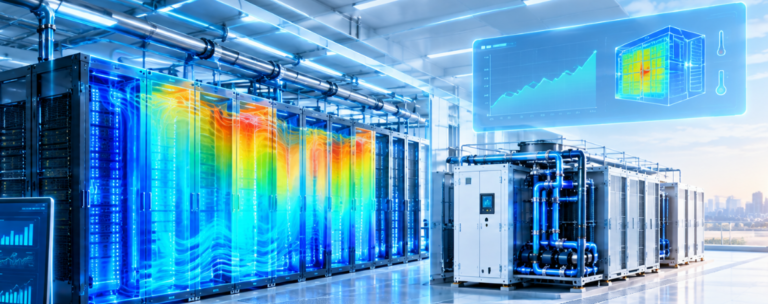
A liquid-cooled rack still rejects heat, just through water instead of room air, and that heat must land somewhere. If the coolant distribution unit rejects 30 to 40 kW into the same hall where neighboring air-cooled racks ingest air, adjacent servers see warmer intake and throttle.
AFCOM’s 2025 report found that only 17% of data centers have adopted liquid cooling while another 32% plan to within 12 to 24 months, so mixed halls are the norm, not the exception. That waste heat is real, since at 80% coolant-to-air efficiency roughly 8 kW still leaks into the hall.
The engineering answer is zoning: liquid-cooled rows must be isolated from air-cooled rows with hot-aisle containment and separate airflow. A single-rack pilot inside a fully air-cooled hall is therefore not just an electrical project, because it quietly degrades every rack that shares its aisle. Row-level zoning is what an AI ready data center means in practice, because the label is a whole-building claim.
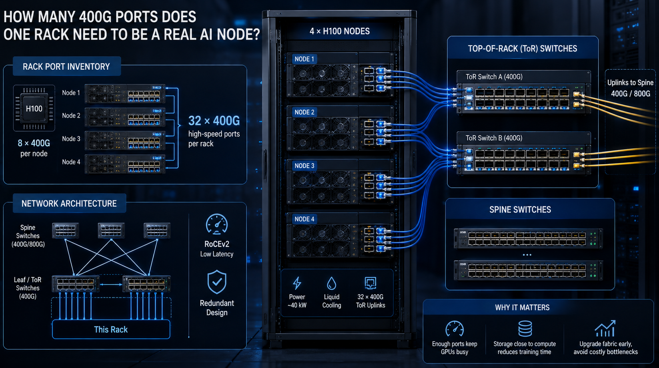
How Many 400G Ports Does One Rack Need to Be a Real AI Node?
The four H100 nodes in the rack each carry eight 400 Gb/s ports, so the rack exposes 32 high-speed ports. Those must land on 400G top-of-rack switches, typically two in a redundant pair, with 400G or 800G uplinks above. Cisco’s AI infrastructure guidance describes exactly this pattern: high-radix leaf-spine topologies and RoCEv2 for collective communication. Without that port inventory, no software stack can treat the rack as a real AI ready data center node.
Storage must sit close to compute, because checkpoint writes and data loading dominate training time. A rack with enough power and cooling but a saturated network is not usable for training. Network adjacency is as much an AI ready data center property as cooling, because latency decides whether the GPUs ever stay busy. Upgrading the fabric preemptively costs far less than discovering a bottleneck after training starts.
What Does a Single-Rack Upgrade Really Cost, and Is It Worth It?
The preceding numbers, once summed, explain why the word “retrofit” frightens most operators. Schneider Electric and Omdia analysts note that converting a legacy facility is extremely challenging because its feeders, cooling, and structure were built for 20th-century loads, not GPU clusters. For many enterprises, they conclude, purpose-built colocation wins economically, which makes the AI ready data center label a demanding one to earn in place.
Moreover, a retrofit’s cost grows with each missing threshold, since every shortfall gets priced twice, once to engineer around it and once to pay for lost production capacity.
A single-rack pilot is still feasible, but its real value is measurement, not production. The upgrade reveals which threshold, heat, water, current, structure, or network, is the hard constraint in that building. That evidence lets your team decide between scaling one rationalized rack and leaving for a purpose-built site. It also forces the operational questions: who owns and monitors the water loop, and what happens when a 10 GPM pipe leaks above a $200,000 GPU rack.
Contractors, facility teams, and network staff must align before the first server boots, and the answer tells you whether the building can ever host an AI ready data center at all.
What Is the Correct Order to Audit a Rack for AI Ready Data Center Status?
Now the chain collapses into an ordered checklist.
- First, lock the heat number at 40 kW.
- Second, size the liquid loop at about 10 GPM and verify a physical pipe path.
- Third, confirm a dedicated circuit at roughly 62 amps on 415V, or plan feeder work. Fourth, check the floor against the 800 to 900 kg rack and 1,100 kg per square meter.
- Fifth, isolate the rack from air-cooled neighbors.
- Sixth, budget for 32 ports of 400G and adjacent storage.
- Seventh, price the pilot against colocation.
Order matters, because one failure invalidates everything after it. A rack that passes all seven is still just one rack, but it is the first honest unit of an AI ready data center, measurable, documented, and ready to be replicated rack by rack.