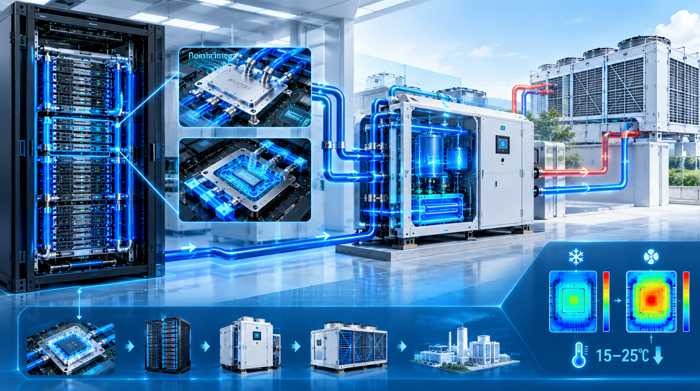


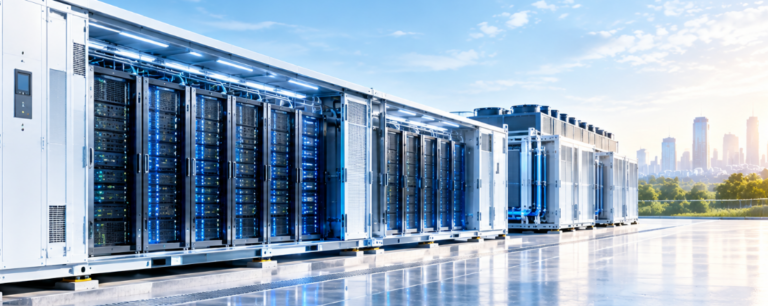
Modular data center cooling has reached a turning point: factory-built, liquid-ready modules now handle rack densities that air cooling cannot touch. Once a rack crosses roughly 20 kW, air systems stop being cost-effective; above 50 kW they become physically impractical. The industry answer is direct-to-chip liquid cooling inside prefabricated pods, reaching PUE 1.10–1.25 while compressing deployment from months to weeks. Liquid-ready modular data center cooling dominates new AI infrastructure, and operators must size, deploy, and run it without mistakes.
Why Does Modular Data Center Cooling Fail Above 20 kW per Rack?
Air cooling moves heat through large volumes of conditioned air, fan power, and aisle containment. That model worked when mainstream racks ran below 10 kW. The limits are now measurable: Uptime Institute reports that 81% of operators place the point where air cooling becomes too costly or inefficient at 20 kW per rack or higher. Cold-aisle containment and CRAC sizing hit diminishing returns beyond that line, so operators treat 20 kW as the practical ceiling for air-only pods.
AFCOM’s 2026 State of the Data Center Report shows AI-heavy average rack density jumping from 16 kW in 2025 to 27 kW in 2026, a 69% year-on-year increase.
Physics explains the wall. Water carries roughly three thousand times more heat than the same volume of air, so removing 30–60 kW from a dense AI rack with air demands enormous airflow, hot-spot risk, and thermal throttling. Uptime Institute notes air cooling becomes impractical above approximately 50 kW per rack.
NVIDIA’s GB300 NVL72 draws up to 142 kW per rack, while Vera Rubin NVL72 is estimated at 190–230 kW. Those loads push modular data center cooling toward liquid loops as a baseline, not an option.
What Makes Direct-to-Chip the Default in Liquid-Ready Modular Data Center Cooling?
Direct-to-chip cooling attaches cold plates to CPUs and GPUs and circulates coolant through a closed loop controlled by a coolant distribution unit. Schneider Electric estimates direct-to-chip liquid cooling held 55% of the market in 2026, handling 100–150 kW per rack. The IEA 4E EDNA report identifies direct-to-chip as the most mature advanced liquid cooling form, commanding 43% of market revenue in 2024. Its retrofit ease explains why modular data center cooling relies on it before immersion.
A factory-built pod integrates CDUs, manifolds, piping, and monitoring into one enclosure. Vertiv’s MegaMod HDX combines direct-to-chip with air cooling in prefabricated modules supporting 50 kW to over 100 kW per rack, scaling from 1.25 MW in 13 racks to 10 MW in 144 racks. Field work shrinks to skid placement, coolant hookup, and network cabling, which removes most scheduling risk from the critical path.
LiquidStack’s modular CDU architecture adds capacity in phases without redesign. That repeatability explains why AFCOM reported in May 2025 that 83% of operators plan to deploy prefabricated cooling modules, the fastest-growing slice of modular data center cooling.
How Do Factory-Built Cooling Modules Slash Deployment Timelines?
Prefabrication moves pressure testing, thermal validation, and commissioning from the job site to the factory, compressing every stage of modular data center cooling delivery. ZTE’s AIDC container solution, launched in July 2025, fits an 8 kW air-cooled general cabinet or a 40 kW liquid-cooled AI cabinet in one module.
The ZTE system reaches PUE as low as 1.15 and delivers projects in about seven months, nearly 40% faster than traditional builds. That speed directly attacks time-to-revenue, a decisive factor while GPU supply still lags demand. Vertiv says its SmartRun overhead system installs up to 85% faster on-site than stick-built methods, enabling more than 1 MW of IT capacity per day.
Speed matters because AI capacity demand outpaces construction. Standard modular designs cut timelines from 18–24 months to 6–9 months while preserving Tier III redundancy. Replacing slow stick-built construction with repeatable factory assembly also cuts cost overruns and commissioning defects. Containerized liquid-cooled AI server pods averaged about USD 0.95 million per unit in 2025, with shipments near 1,090 units, and the category is forecast to grow from USD 1.06 billion to USD 4.28 billion by 2032.
That momentum confirms modular data center cooling is a deployment strategy, not a niche product.
Which Modular Data Center Cooling Metrics Actually Matter for AI Workloads?
PUE remains the headline metric for modular data center cooling, but averages hide distribution. Uptime Institute’s 2025 Global Data Center Survey found legacy air-cooled facilities stuck at PUE 1.55–1.67, wasting 30–40% of electricity on cooling, while direct-to-chip systems commonly reach 1.10–1.25. Adoption sits near 22% of data centers, with 48% of users applying liquid cooling to fewer than 10% of racks. Facility size matters too: adoption reaches 20% above 20 MW but drops to 13% below 5 MW.
Key metrics beyond PUE include water usage, chip temperature, and usable compute:
- Coolant supply temperature: 45 °C return water enables chillerless operation across more climates.
- Water usage effectiveness: closed loops cut draw versus evaporative systems; NVIDIA’s design avoids over 125 million liters of water per site annually.
- Rack density: 100–150 kW supported by direct-to-chip versus roughly 50 kW ceiling for air.
The decisive number for modular data center cooling is power delivered to IT per rack. Lower cooling overhead converts fixed grid capacity into additional compute. Google DeepMind’s collaboration with Google data center operations achieved a 40% reduction in cooling energy through machine learning optimization, now embedded in modular control platforms.
Even one percent of PUE gain on a 10 MW module frees about 100 kW for revenue-generating GPUs. Measure the whole loop, from chip to dry cooler, before signing off.
How to Size CDUs and Redundancy Without Overpaying?
Sizing starts with the chipset roadmap, not today’s workload, the first rule of modular data center cooling planning. Each GPU generation raises thermal design power; Dell’Oro projects leading-edge GPU TDP will exceed 4,000 W by 2029. Design coolant loops for the next validated platform, then add CDU capacity in factory-tested increments. Row-based modules such as Vertiv’s configurations and LiquidStack’s CDU-1MW service a dozen or more high-density GPU racks while retaining standard rack footprints.
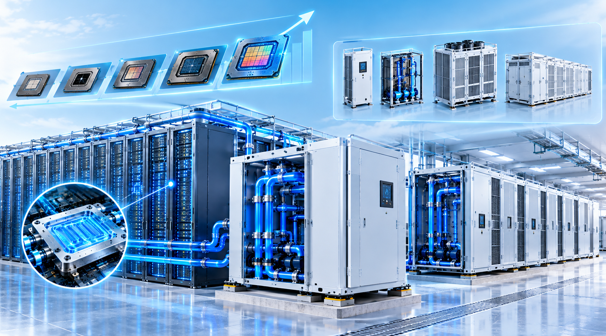
Redundancy deserves explicit planning because a pump failure stops cooling within minutes. Specify N+1 pumps and backup cooling modes. Uptime Institute finds ease of retrofit (46%) and running costs (39%) dominate liquid cooling decisions, with maintenance (35%) and redundancy (35%) close behind. Modular pods integrate distributed redundant power and buffer-tank thermal backup, a signature benefit of modular data center cooling. Budget redundancy first, since retrofitting it later costs far more.
What Are the Hidden Costs of Retrofitting Modular Data Center Cooling?
Retrofits remain the costliest path in modular data center cooling. Adding liquid loops means installing industrial-grade piping, CDUs, leak detection, and fluid-quality management inside existing halls. Floor loading, ceiling clearance, and pathway space often fail inspection once pipes and manifolds are mapped onto old layouts. Analysts estimate liquid cooling adds 15–30% to the mechanical budget of new builds, and significantly more when structural changes are required.
Partial liquid integration in air-cooled facilities has been estimated at USD 5–8 million per MW, versus USD 12–15 million for greenfield liquid designs. Retrofits therefore demand the most rigorous business case before approval.
The hidden cost is often power delivery, not cooling hardware. Legacy 54 VDC distribution hits practical limits above roughly 200 kW per rack due to copper cabling, so high-voltage DC and disaggregated power become necessary companions. Operators also underbudget fluid maintenance: IEA 4E notes ease of maintenance ranks among top selection factors, yet few teams staff coolant chemistry and leak response. Build these costs into modular data center cooling business cases from day one.
Is Immersion Worth It, or Is Hybrid Enough for a Modular Data Center Cooling Plan?
Hybrid air-plus-direct-to-chip is the pragmatic path for most modular data center cooling projects. It preserves compatibility with standard racks, eases retrofit, and reaches 100 kW per rack with PUE near 1.15. For greenfield pods, choosing liquid-ready from day one avoids later crane work and capacity loss. Immersion cooling pushes further, supporting 150–200+ kW per rack with PUE as low as 1.10.
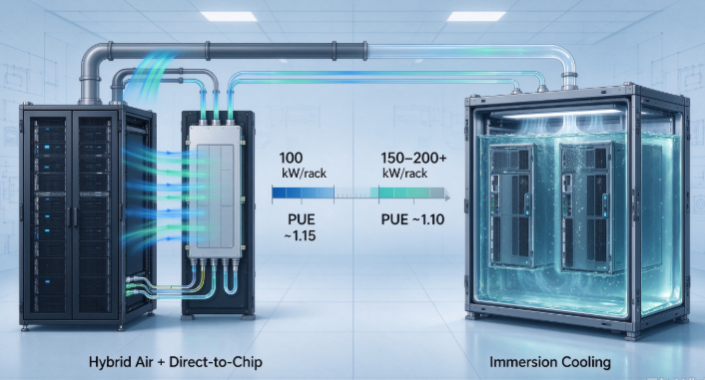
Immersion demands tank deployment, dielectric fluid management, and more operational oversight. That complexity pays off mainly where land and power are scarce and density per square meter becomes the binding constraint. Uptime Institute data shows water-cooled cold plates lead at 64% of liquid-cooling users, while single-phase immersion trails at 26%.
Choose by workload and site constraints. AI training clusters above 150 kW per rack justify immersion; inference and enterprise GPU work usually do not. Hyperscalers demonstrate both paths: Google deployed liquid cooling across thousands of TPU pods, while Meta built Grand Rapids around liquid cooling from day one.
Your decision should match density targets, retrofit reality, and ESG goals. Immersion wins extreme density; hybrid wins flexibility and speed for most modular data center cooling roadmaps.
What Does the Roadmap Look Like for Modular Data Center Cooling in 2026–2030?
Market forecasts confirm acceleration in modular data center cooling. Grand View Research values the global data center liquid cooling market at USD 6.7 billion in 2025, rising to USD 29.5 billion by 2033 at a 20.1% CAGR. Dell’Oro expects liquid-cooling manufacturer revenue to grow from USD 3 billion in 2025 to USD 7 billion by 2029. Buyers are also shifting from bespoke builds to standardized, orderable modules, which compresses procurement cycles and stabilizes unit economics.
For modular-specific systems, the data center modular cooling market is projected to grow from USD 10.5 billion in 2025 to USD 48.4 billion by 2034.
Uptime Institute’s 2025 survey shows 61% of operators considering liquid cooling even as adoption sits near 22%, confirming an inflection point. Tax incentives and grid-connection queues in several regions further reward facilities that can start generating revenue quickly. Regulation accelerates the shift: the EU requires data centers above 500 kW to report energy and water performance, and China’s East-Data-West-Computing program mandates PUE below 1.25 for new builds.
Operators who standardize liquid-ready modular designs now capture density, efficiency, and compliance advantages before the next GPU wave. Modular data center cooling is becoming the default architecture for AI infrastructure, and the planning window is closing.