



An aisle modular data center can handle AI-grade heat, but only if the right containment topology is selected. Below 10-15 kW per rack, cold aisle containment delivers 20-30% cooling energy savings at retrofit-friendly cost. Above 20 kW per rack, hot aisle containment or liquid-assisted designs become necessary, with documented savings of 30-43%.
The right aisle modular data center choice depends on three variables: rack density, the available return-air path, and whether the hall is a new build or a retrofit. Get this wrong, and GPU inlet temperatures exceed 35°C, triggering throttling that stretches training jobs by 20-50%. This guide walks through the thresholds, costs, and failure modes with measured data.
What Is an Aisle Modular Data Center and Why Does Containment Matter?
An aisle modular data center is a prefabricated, self-contained IT room. Power, cooling, monitoring, and racks are integrated into one factory-tested unit, so deployment avoids most on-site construction. Vendor data illustrates the speed advantage: Vertiv reports 80% faster deployment and up to 30% lower deployment cost for its SmartAisle platform, with PUE as low as 1.21.
Containment is the thermal heart of the aisle modular data center. Sealing the cold aisle or the hot aisle forces supply air through IT intakes exactly once and returns exhaust to the cooling units without mixing. Without that physical barrier, cold air bypasses racks and hot air recirculates, forcing CRAC units to overcool the entire hall. The Uptime Institute estimates that containment lowers cooling-system energy use by 15-30% in typical facilities.
Vendors position the aisle modular data center as the fastest path to AI-ready capacity. SOETECK, for example, publishes PUE figures as low as 1.3 with support for 15 kW or more per rack. Those numbers assume disciplined airflow management, and containment is the discipline that makes them real.
How Hot Do Modern AI Racks Actually Run?
Average rack density doubled from roughly 7 kW in 2021 to 16 kW in 2025 and reached about 27 kW by 2026, according to industry tracking cited by Obelinf. AI training racks routinely draw 100 kW or more. GPU clusters in NVL72 configurations exceed 40 kW per rack, with local exhaust hot spots above 50°C reported by Leviathan Systems field engineers. NVIDIA’s GB200 NVL72 systems run at 120-132 kW per rack.
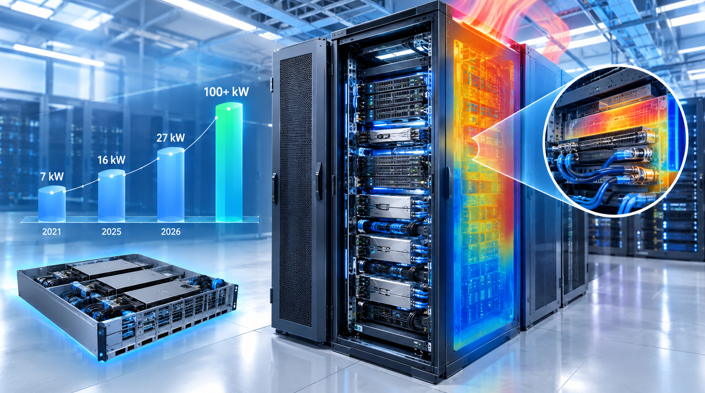
This heat has hard consequences. ASHRAE TC 9.9 recommends 18-27°C supply air, but GPU clusters often need supply below 22°C to keep accelerator inlets under 35°C. Above that threshold, nvidia-smi shows clock reductions, and distributed training jobs stretch by 20-50%. Standard open-aisle layouts simply cannot hold inlet temperatures stable at these densities.
The density trend is reshaping the entire cooling industry. Choosing an aisle modular data center without density data is guesswork. Air cooling with good containment handles roughly 25-40 kW per rack; above that, the airflow volumes and fan power become physically and economically absurd. Containment remains the foundation that every higher-density strategy builds on.
Cold Aisle Containment: When Does It Work in an Aisle Modular Data Center?
Cold aisle containment encloses the supply side. Sealed doors, roof panels, and blanking panels direct chilled air straight into server fronts. It is the retrofit-friendly option, especially in raised-floor halls without a ceiling return plenum. EziBlank reports typical cooling savings of 20-30% for CAC retrofits, with payback usually under three years.
Most aisle modular data center operators start with cold aisle containment because it needs only aisle caps, end doors, and a roof structure. No ceiling plenum or return ducting is required, which keeps both cost and downtime low. The room itself acts as the return path, equalizing pressure differences that would otherwise build up.
At GPU density, CAC works only under strict conditions. Standard perforated tiles at 25% open area deliver roughly 8-10 kW of cooling at typical underfloor static pressure. Leviathan Systems recommends high-flow tiles at 56% open area and underfloor pressure above 50 Pa. A 40 kW rack with a 25°C delta-T needs about 4,000 CFM, which requires at least two high-open-area tiles per rack.
When those conditions fail, the failure is dramatic. Supply air drifts toward 25°C, GPU inlets hit 38°C within minutes, and throttling begins. For greenfield builds, CAC can still work inside an aisle modular data center if cooling capacity is oversized by 20-30% and row-based cooling units handle 45°C return air. Measured retrofits prove that an aisle modular data center can absorb the upgrade without a full hall rebuild.
Hot Aisle Containment: The Stronger Choice for AI-Grade Density?
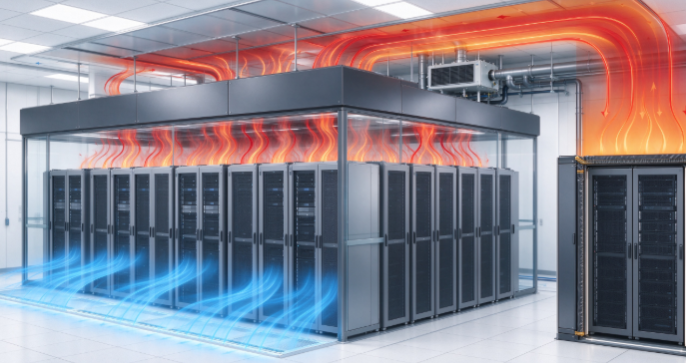
Hot aisle containment seals the exhaust side instead. Racks face rear-to-rear, and hot air is ducted into a ceiling plenum or directly back to cooling units. EziBlank documents 30-43% cooling savings for HAC, with the highest gains in new builds designed around overhead return paths. Return temperatures can reach 45°C, which improves chiller efficiency and extends economizer hours.
HAC also keeps the working environment livable. The room outside the contained hot aisles stays near supply temperature, while a contained cold aisle turns the hall into a hot zone at exhaust temperatures. AMD’s data center design guidance states that hot aisle isolation supports rack densities exceeding 30-50 kW per rack, making it the preferred topology for high-density environments.
The trade-off is structural. HAC requires a return-air path, ceiling plenum, or rack-level chimneys, and it costs more to build. Fire suppression integration is more complex under NFPA 75. For AI workloads above 20 kW per rack, these costs are usually justified by the efficiency and thermal-stability returns.
What Do the Numbers Say About Aisle Modular Data Center Efficiency?
Measured comparisons from Cool-Shield’s testing show the density ceiling of each topology. With room-based cooling, an open layout maxes out near 5 kW per rack, while HAC reaches 20 kW and CAC reaches 16 kW. Cooling-unit efficiency follows the same pattern: roughly 0.92 kW of cooling energy per kW of heat in an open room, 0.42 kW with HAC, and 0.50 kW with CAC.
These gains compound across the whole aisle modular data center. The Uptime Institute reports containment-driven cooling reductions of 15-30%. Schneider Electric’s white paper shows PUE dropping from 1.8 to below 1.4, and to about 1.25 in high-density deployments. Adoption is accelerating: Data Center Strategy projects the global containment market will grow at 12.7% CAGR to $4.6 billion by 2030.
Key metrics to track when evaluating any aisle modular data center design:
- Rack density ceiling: open layout 5 kW, CAC 16-25 kW, HAC 20-30+ kW per rack.
- Cooling energy per kW of heat: 0.92 kW open, 0.50 kW CAC, 0.42 kW HAC.
- Typical cooling savings: 20-30% for CAC, 30-43% for HAC.
- Retrofit cost: roughly $5,000-50,000 per aisle, with 6-18 month payback.
Where Does Liquid Cooling Fit in an Aisle Modular Data Center?
A well-executed aisle modular data center hits PUE below 1.3 in temperate climates, but air cooling has a hard ceiling. AMD’s design guide puts the practical limit at roughly 45 kW per rack before other strategies become necessary. Rear-door heat exchangers extend air-based designs to 50-80 kW per rack, making them a natural retrofit step.
Direct-to-chip liquid cooling handles 40-100 kW per rack and removes 60-80% of the heat at the source, according to AMD guidance. The remaining heat still needs airflow management, so containment does not disappear; it shrinks to a supporting role. A hybrid aisle modular data center pairs cold plates for accelerators with hot aisle containment for the residual air-cooled load.
The transition is staged, not binary. RDHx first, then cold plates, then immersion for 100 kW and beyond. Every stage assumes that the aisle modular data center’s airflow is already contained and predictable. In practice, an aisle modular data center with row cooling handles up to 40 kW per rack before liquid takes over, which is why the topology decision comes first.
How Do You Retrofit an Aisle Modular Data Center Into an Existing Hall?
Retrofit containment works in stages. Start with end-of-aisle doors, which create a “bathtub” of cold air and support 5-8 kW per rack. Add an 18-36 inch containment collar to lift the range to 10-12 kW. A complete cold aisle with a two-tile layout supports 20-25 kW per rack; a three-tile aisle reaches 30 kW or more, according to Technoguard’s high-density report.
Cost evidence favors staged deployment. Agriculture and Agri-Food Canada contained roughly 70% of its racks for under $100,000, versus about $300,000 for one additional air conditioner, and absorbed a 60% IT load increase without new cooling infrastructure. Seal every gap: field experience from Leviathan Systems shows leakage above 1 cm cuts containment effectiveness by 15-20%.
Validate before scaling. Measure rack inlet temperatures, delta-T values, and hot-spot maps. Use CFD modeling for complex geometries or high-density rows, then expand row by row once results match the specification.
What Mistakes Most Often Ruin Aisle Modular Data Center Performance?
Incomplete sealing is the most common failure. Gaps at aisle-end doors, open rack units, and unsealed cable cutouts all let hot exhaust recirculate into intakes. Blanking panels are the highest-return item in the cooling budget: every open rack unit is a recirculation path between hot and cold sides.

Miscalibrated controls are the second trap. CRAC units tuned for an open layout keep delivering air at temperatures designed for mixed environments, erasing the savings containment should produce. Reset setpoints and fan speeds after installation, using sensor data rather than assumptions.
Density averaging is the third mistake. Designing for the average rack ignores that GPU rows run far hotter than the hall mean. AMD guidance and field reports agree: design for the worst-case rack, not the average, and plan each density zone’s airflow, containment, and cooling separately. An aisle modular data center planned around averages will fail at the extremes.
How to Validate Aisle Modular Data Center Performance After Commissioning
Monitoring separates real gains from imagined ones. Return Temperature Index (RTI) quantifies bypass and recirculation: 100% means balanced airflow, below 100% indicates cold air returning unused, above 100% shows hot air mixing into supply. RTI needs only inlet and return temperatures already available in most monitoring systems.
Pressure testing and thermal imaging confirm seal integrity after installation. Temperature sensors inside and outside the aisle track inlet stability under load. For high-density aisles, continuous PUE monitoring tied to cooling loads catches drift early. Verify the results, document the baseline, and adjust controls before declaring the project complete.
The Decision Rule for Your Next Aisle Modular Data Center
The right aisle modular data center design follows density, not fashion. Below 15 kW per rack, cold aisle containment delivers fast, affordable savings in retrofits. Above 20 kW per rack, hot aisle containment or liquid-assisted hybrid designs protect GPU performance and unlock 30-43% cooling savings.
Match the topology to the load, seal every gap, and validate with measurements. If you are unsure about future density, leave room for staged upgrades. The aisle modular data center is built to grow: end doors now, collars later, and a return-air path activated when AI territory arrives.