

Data center thermal management has reached a tipping point. Global average PUE has stalled at 1.54 for six consecutive years, according to Uptime Institute’s 2025 survey, while AI training racks now exceed 100 kW per cabinet. Bigger chillers alone are no longer the answer; intelligence is.
AI-driven predictive data center thermal management, built on sensor telemetry, digital twins, and machine learning, has cut cooling energy by 30-40% in documented deployments. This article explains how predictive control works, what data it requires, and how operators deploy it safely, with real numbers from live facilities.
Why Has Data Center Thermal Management Become an AI Problem?
Rack density is the trigger. Thermal density jumped from 8-12 kW per rack in 2023 to 28-45 kW in 2025, according to Nodestream’s HPC analysis, and AI cabinets now draw up to 120 kW each. Airflow alone cannot absorb that heat reliably, and hotspot risk climbs with every kilowatt added.
Legacy controls fail for a second reason: load volatility. Cloud, machine learning, and container workloads shift demand continuously, creating thermal profiles that static thresholds were never designed to track. Conventional cooling reacts after a hotspot forms, wasting energy, raising failure risk, and leaving operators blind to what happens next.
The scale of waste is enormous. Cooling accounts for 30-40% of total facility electricity, as Italtel and Compute Forecast both report, while Uptime Institute finds hyperscale operators hit 1.10-1.15 PUE and enterprise sites linger at 1.58-1.80. That gap is exactly where predictive data center thermal management creates measurable value.
How Do Predictive Models Outperform Legacy Thermal Management Controls?
Traditional rule-based systems keep a fixed setpoint and respond to alarms. Predictive models invert that logic: they forecast heat before it appears and adjust fans, pumps, and chilled-water valves in advance. The shift from reaction to anticipation is the core of modern data center thermal management.
Google DeepMind proved the concept. Its neural network controls cooling directly, predicting conditions every five minutes and cutting cooling energy by up to 40%, with a 15% improvement in overall PUE overhead, as reported by Sustainability Directory. Later iterations stabilized at roughly 30% average savings.
Commercial systems replicate the result. Airedale by Modine’s Cooling AI uses a hybrid deep learning model with digital twins and claims up to 40% energy reduction. An LSTM-driven proactive controller tested in a live facility cut cooling energy 37.5%, lowered PUE from 1.48 to 1.30, and reduced cumulative hotspot duration by nearly 96%, from 48 to 2 hours.
Speed matters as much as accuracy. A predictive controller that needs hours to recompute a heat map cannot guide real-time decisions, which is why the newest thermal management platforms embed fast surrogate models alongside physics-based solvers. Operators increasingly treat this speed advantage as a prerequisite for autonomous data center thermal management.
What Data Does an AI Thermal Management System Actually Need?
Predictive data center thermal management begins with granular telemetry, not algorithms. Operators install dense mesh networks of wireless IoT sensors across rack intake and exhaust paths, capturing temperature, humidity, airflow, and power draw at high resolution. Without this foundation, no model can learn the facility’s true thermal behavior.
That raw stream feeds a unified data lake alongside weather feeds and building management system metrics. The Northern Virginia facility that cut cooling costs by 35% built exactly this baseline across its entire 50 MW footprint before any model went live.
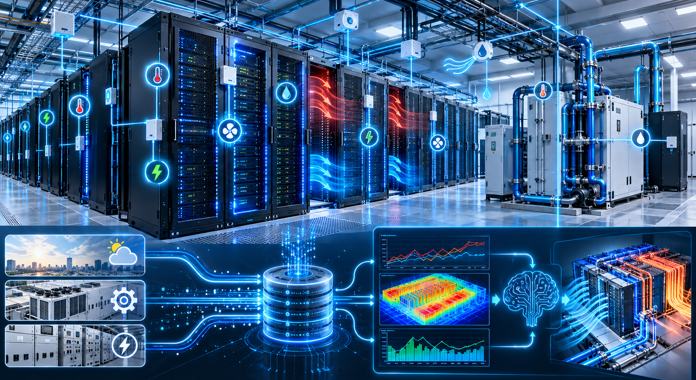
The model itself is usually hybrid. NTT’s Rhine-Ruhr 1 pilot in Germany combines data-driven learning with physical thermodynamic equations, allowing the digital twin to extrapolate behavior beyond observed ranges, such as predicting pump performance at 80% capacity when it had only run at 100%.
Sensor placement follows a simple rule: measure the extremes, not just the averages. Intake and exhaust temperatures, aisle-level humidity, and GPU cluster loads reveal the transient hotspots that whole-room sensors miss. Well-instrumented data center thermal management catches these microclimates early, which is why telemetry quality, not model complexity, drives most project outcomes.
How Accurate Are Temperature Predictions in Data Center Thermal Management?
Accuracy defines whether predictive control is safe to automate. The 50 MW case study predicts temperature changes up to two hours ahead with over 98% accuracy, enabling confident closed-loop action without sacrificing thermal safety.
Research models reach similar precision. Purdue University scientists built vision-based surrogate models, published in Nature Communications, that map server workloads to 3D heat maps up to 20,000 times faster than CFD solvers, cutting prediction time from hours to hundreds of milliseconds and trimming cooling energy by 7% in controlled tests.
A 2025 CNN-LSTM framework from IIUM Engineering Journal reports 85-95% prediction accuracy with reliability of 0.97-0.99, while AI-managed systems hold temperature stability within 0.7 degrees Celsius even during sharp load swings. High fidelity is what separates proactive data center thermal management from guesswork.
Prediction horizons also matter. Short-horizon models optimize minute-to-minute fan and pump settings, while longer forecasts inform chiller staging and free-cooling windows hours ahead. Mature platforms combine both, and the best data center thermal management strategies balance horizon length against model uncertainty rather than chasing perfect forecasts.
Case Study: How Did a 50 MW Facility Cut Cooling Costs by 35%?
A legacy Ashburn, Virginia data center demonstrates the full playbook for modern data center thermal management. Engineers first deployed a sensor blanket and trained a digital twin in pure recommendation mode for several weeks, validating predictions against real operations.
Once validated, the AI received closed-loop authority over CRAH fan speeds, airflow dampers, and chiller setpoints, operating within strict safety boundaries and making micro-adjustments every 30 seconds. Within 90 days, cooling power consumption fell 35%.
The operational results are striking. Facility PUE dropped from 1.54 to 1.19, temperature excursion incidents fell from 14 per month to zero, and chilled-water setpoints rose from 44 to 52 degrees Fahrenheit. Engineers also reported roughly 25% longer mechanical equipment life and full payback in under twelve months, without replacing core hardware.
The case shows that predictive data center thermal management does not require a new cooling plant. The facility kept its existing CRAH units, chillers, and raised-floor design, adding only a software layer and sensors. That retrofit path matters for the thousands of enterprise sites that cannot justify capital-intensive liquid cooling upgrades.
Scale-up follows the same blueprint. After the Ashburn pilot proved stable, engineers extended the controller to additional data halls and refined setpoint boundaries quarterly. Each expansion reused the trained digital twin, cutting rollout time from months to weeks. This repeatability is why operators now treat predictive data center thermal management as a software asset rather than a one-off project.
What Are the Risks of Autonomous Thermal Management and How Can Operators Mitigate Them?
Autonomous cooling touches mission-critical infrastructure, so safeguards are non-negotiable. NTT’s deployment rejects optimizer suggestions whenever the system runs in manual mode, communication fails, or setpoint ranges are exceeded, and operators can switch back to conventional control at any time. Safety boundaries define the trust envelope of any autonomous data center thermal management system.
Telehouse Germany ran the same discipline. Its AI-assisted optimization at a Frankfurt facility cut cooling electricity by 10.4% on one unit, projected to save 497 MWh and 180 tonnes of CO2 annually across five units, with no incidents or limit violations. The pilot also exposed cooling-tower filter fouling early, showing how predictive data center thermal management improves maintenance planning.
The proven deployment path is staged: sensor baseline, then recommendation-only mode, then closed-loop control. During the recommendation phase, your engineering team compares every AI suggestion against actual thermal behavior, building trust before autonomy expands across the data hall.
How Much Can AI Save Across Different Cooling Architectures?
Savings depend on the control surface being automated. Industry data from Compute Forecast and multiple vendor deployments shows a clear range:
- Air cooling optimization: 15-25% energy reduction through real-time fan speed and containment control
- Direct liquid cooling: 10-20% reduction via flow rate tracking of dynamic IT load
- AI-driven autonomous cooling: 30-40% reduction using deep neural networks that predict weather and workload needs
Live deployments confirm the pattern. NTT’s Rhine-Ruhr 1 recorded 19.1% chiller savings, Telefonica Germany expects 15-20% from its EkkoSense digital twins, and Italtel reports up to 30% cooling cost reduction with results visible in 90 days. Even a mature facility like Iron Mountain’s SIN-1 improved PUE by 3.5% within three weeks. The spread proves that data center thermal management gains depend more on execution discipline than on the underlying architecture.
How to Start with Predictive Data Center Thermal Management?
Begin small and measure relentlessly. The sequence below reflects the steps that successful operators actually follow:

- Audit existing sensors and BMS data; add wireless IoT thermal sensors to close blind spots
- Build a unified data lake that merges thermal telemetry, weather, and load curves
- Train a digital twin in recommendation-only mode until predictions exceed 95% accuracy
- Define hard safety boundaries for setpoints, fan speeds, and valve positions
- Grant closed-loop control gradually, then monitor excursion counts and PUE monthly
Retrofits matter more than new builds. Most legacy facilities can run predictive software on existing mechanical plant, and vendors such as Airedale, etalytics, and EkkoSense offer retrofittable platforms. Expect visible savings within the first quarter after deployment, and remember that model retraining is continuous: data center thermal management improves as the digital twin accumulates more operating history.
Measurement discipline completes the loop. Track PUE, cooling energy per megawatt of IT load, excursion counts, and chiller efficiency monthly, and compare against pre-deployment baselines. Vendors such as etalytics provide auditable dashboards that simplify regulatory reporting. Clear metrics also justify expansion budgets, since finance teams respond to documented kilowatt-hour savings rather than abstract descriptions of data center thermal management value.
Is Predictive Thermal Management the Endgame for Data Center Cooling?
Predictive control is becoming the operational standard rather than an experiment. LBNL projects U.S. data center electricity use rising from 176 TWh in 2023 to 325-580 TWh by 2028, while cooling’s share of facility power remains near 30%, so efficiency gains compound at massive scale.
The trend points toward convergence: AI-driven data center thermal management layered on liquid cooling, with digital twins simulating failures before they occur and waste heat recovery added as the next control loop. NTT and etalytics are already extending AI optimization to heat reuse.
Operators who adopt predictive thermal management today capture lower PUE, longer equipment life, and regulatory-ready energy reporting. The evidence is unambiguous: facilities that forecast heat instead of reacting to it consistently outperform those that do not, and the gap widens as rack densities climb. Proactive data center thermal management is no longer optional for competitive operation.