


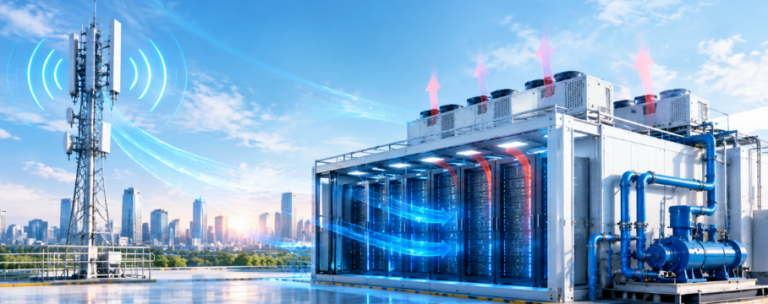
5G data center cooling has become a strategic priority as telecom operators push compute to the edge. Edge sites, cell towers, and central offices generate heat densities that air-based systems cannot handle efficiently. Immersion and direct-to-chip liquid cooling now deliver PUE values below 1.1, versus roughly 1.6 for conventional facilities, while cutting energy use by 20-45%.
The global data center cooling market will grow from USD 9.1 billion in 2024 to USD 17.1 billion by 2031, with telecom driving a large share. This guide explains the challenges, technologies, and cost strategies behind effective 5G data center cooling. Operators must balance density, environment, and budget when selecting a thermal approach for every site.
Why Does 5G Data Center Cooling Matter More Than Ever?
5G network rollout has changed where and how compute is deployed. Mobile operators now run data processing at base stations, street cabinets, and central offices rather than only in centralized facilities. These distributed locations must support low-latency services such as autonomous driving and augmented reality. Gartner estimates that 75% of enterprise data will be generated and processed at the edge by 2025, up from 10% in 2018. That shift multiplies the number of sites requiring reliable thermal management.
Cooling consumes a visible share of telecom operating costs. Traditional air conditioning accounts for a large portion of facility energy use, and data centers are expected to consume about 2% of global electricity in 2025, roughly 536 TWh, according to Deloitte research. Without efficient thermal systems, heat becomes the limiting factor for 5G capacity and equipment lifespan. Reliable 5G data center cooling therefore directly affects network uptime, service quality, and profitability.
What Thermal Challenges Do 5G Edge Sites Create for Data Center Cooling?
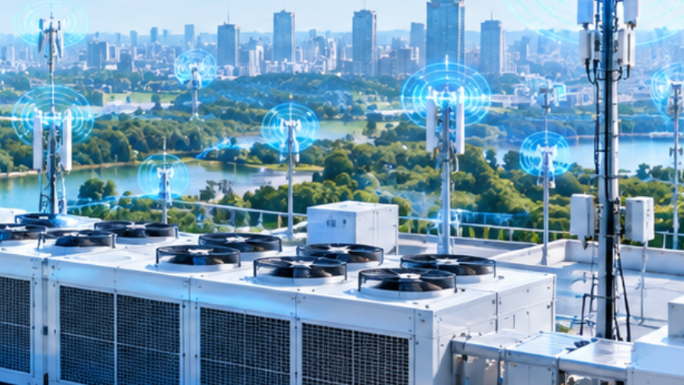
5G edge sites face conditions that differ sharply from traditional data centers. Many are located outdoors, on rooftops, or inside street-level cabinets with no dedicated mechanical rooms. Ambient temperatures can exceed 50°C in some regions, while dust, humidity, and salt air threaten sensitive electronics. Space is tight, power supply is limited, and water access is often unavailable. These constraints make conventional 5G data center cooling impractical for distributed infrastructure.
Density is the second major challenge. A single 5G radio unit combines power amplifiers, baseband processors, and AI acceleration in compact enclosures. Heat loads per rack keep rising as operators add edge AI and network slicing capabilities. The number of active 5G-connected sites globally surpassed 2.5 million by the end of 2025, according to market research. Every one of those sites requires some form of precision environmental control, creating a vast new cooling workload.
How Does 5G Data Center Cooling Differ from Traditional Air-Cooled Designs?
Traditional air cooling relies on CRAC units, raised floors, and cold-aisle containment. These designs work well in large, controlled facilities but scale poorly in compact edge environments. Air has limited heat capacity, so dense 5G hardware quickly exceeds the practical limits of fan-based cooling. Operators must also maintain filters, humidifiers, and compressors across thousands of remote sites. That maintenance burden becomes a serious operational constraint as networks expand.
Liquid-based systems change the thermal equation. Liquids carry heat far more efficiently than air, allowing higher rack densities without oversized HVAC infrastructure. Direct-to-chip cooling places cold plates on the hottest components, while rear-door heat exchangers capture heat at the rack boundary. Immersion cooling submerges entire servers in dielectric fluid, eliminating fans and airflow management altogether. These approaches define modern 5G data center cooling and enable deployment where air cooling cannot work.
| Technology | Best Fit | Typical PUE | Maintenance |
|---|
| Air-based CRAC | Centralized facilities | ~1.6 | High (filters, compressors) |
| Direct-to-chip liquid | High-density racks | 1.2-1.3 | Moderate |
| Rear-door heat exchanger | Hybrid retrofits | 1.3-1.4 | Moderate |
| Single-phase immersion | Edge and harsh sites | Below 1.1 | Low |
Which Cooling Technologies Are Best for 5G Data Center Cooling?
Direct-to-chip cooling suits existing facilities upgrading to high-density 5G compute. Cold plates attach directly to processors and GPUs, removing heat before it enters the room air. This approach requires a coolant distribution unit and a secondary heat rejection loop. It delivers strong efficiency with moderate retrofit cost. Operators with standard racks can adopt direct-to-chip without rebuilding the entire facility, making it a pragmatic first step in 5G data center cooling.
Immersion cooling offers the highest density and lowest PUE for new edge deployments. Servers are sealed in tanks filled with dielectric fluid, which absorbs heat across the entire surface area. Single-phase systems keep the fluid in liquid state, while two-phase designs use boiling and condensation for extreme heat transfer. Immersion tanks protect hardware from dust and humidity, and they operate quietly in urban locations. For demanding 5G workloads, immersion is becoming the preferred form of 5G data center cooling.
What Are the Real-World Efficiency Gains of Liquid Cooling for 5G Networks?
Field results demonstrate meaningful gains. ITRI and KDDI developed an immersion-cooled edge data center that achieves an average PUE of 1.07, compared with about 1.6 for traditional computer rooms. Their design cuts single-rack power consumption by 43% and reduces floor space by 60%. The containerized unit deploys in about three months. These figures show how 5G data center cooling can improve both energy efficiency and deployment speed.
Valeo and 2CRSi tested an outdoor immersion system operating in ambient temperatures above 50°C. The unit holds chip temperatures at 75°C max while running 1 kW-plus loads, achieving a PUE below 1.1. Versus conventional edge sites, it reduces infrastructure energy by 30-35% and cuts water consumption by 91%. A 1.5 kW IT load in Bengaluru saves 6-8 MWh per year. These outcomes make liquid cooling compelling for 5G data center cooling in harsh environments.
How Can Operators Cut Costs Without Sacrificing 5G Data Center Cooling Performance?
Operators can control costs through modular deployment and predictive monitoring. Modular container units allow rapid scaling of cooling capacity at 5G sites. AI-driven systems adjust set points in real time based on workload and weather, preventing overcooling. Cloud-based cooling management is growing at a 12.8% CAGR through 2034, reducing energy waste. Combining hardware with software optimization cuts cooling energy consumption by 18-28%.
Equipment longevity adds a second cost lever. Immersion cooling lowers component operating temperatures by 25-35°C compared with air cooling in 5G base stations, according to PatSnap analysis of Huawei designs. Lower temperatures can double the expected lifespan of critical RF components and power electronics. Fewer replacements mean lower spare-part spending and fewer truck rolls. Over a ten-year lifecycle, these savings offset the higher upfront cost of liquid 5G data center cooling systems.
What Is the Future of 5G Data Center Cooling?
Market forecasts point to sustained growth in liquid-based cooling. Grand View Research values the liquid cooling segment at USD 6.7 billion in 2025, rising to USD 29.5 billion by 2033. Kings Research projects liquid cooling will grow from USD 4.9 billion in 2025 to USD 24.9 billion by 2032. Edge deployments, AI inference, and 5G network expansion drive this growth. The future of 5G data center cooling is tied to edge AI and distributed compute.
Heat reuse will become a standard feature rather than an option. Immersion tanks produce waste heat above 60°C, suitable for district heating and industrial processes. Operators in Europe and Asia are pairing cooling systems with energy-recovery networks. Standardization of dielectric fluids will lower adoption barriers for smaller sites. As 5G evolves toward 6G, thermal management remains a core discipline for 5G data center cooling. Waste heat becomes a revenue stream rather than a disposal problem.
How Should You Plan 5G Data Center Cooling for Your Network?
Start with a thermal audit of each site type. Measure peak heat loads, ambient conditions, and available power at base stations, central offices, and edge cabinets. Classify sites by density and environmental stress, then match technology to each class. Retrofits should prioritize direct-to-chip or rear-door solutions, while new builds can adopt immersion from day one. This structured approach keeps 5G data center cooling capacity aligned with actual demand and avoids overspending on unused capacity.
Build operations around remote monitoring and maintenance. Edge sites are often unmanned, so sensors and AI should detect anomalies before failures occur. Fluid quality tracking, leak detection, and predictive maintenance extend system life in field conditions. Standardize spare parts and training across vendors to simplify service. By treating 5G data center cooling as a managed lifecycle, operators reduce downtime and keep total cost of ownership predictable.
5G data center cooling has moved from a facility detail to a strategic investment. Air-based systems remain viable for centralized facilities, but edge and high-density workloads increasingly demand liquid solutions. Immersion and direct-to-chip technologies deliver PUE below 1.1, energy savings of 20-45%, and longer equipment life. With the cooling market set to exceed USD 17 billion by 2031, early adopters gain both cost and reliability advantages. Operators should evaluate thermal strategy now to prepare for the next network generation.