

Modern AI data center infrastructure is a power problem, not a building problem. Racks now draw 80 to 140 kilowatts, and U.S. data centers use about 4% of national electricity in 2026, up from 2% in 2020 (GPUnex). Air cooling cannot cope. The answer is converged design: containerized modules, direct-to-chip liquid cooling, and grid-interactive battery storage, cutting delivery from 18–24 months to six months or less.
Why is AI data center infrastructure shifting from bricks to prefabricated modules?
Traditional facilities take 12 to 24 months to design, permit, and build, with serial dependencies: power before cooling, cooling before racks (ASDV Consultant, 2026). AI demand outpaces that calendar. KAYTUS compresses an 18- to 24-month construction cycle into 6 to 8 months using factory-built cubes (Interesting Engineering, 2026). Alibaba Cloud delivers large AI facilities in 100 days with a 90% modularization rate and 10% lower cost (GMT Eight, 2026). Modularity turns construction into an assembly line.
Containerized AI data center infrastructure moves integration risk to the factory. ZTE reports prefabricated modules install 40% faster than traditional builds, cutting timelines from over a year to about seven months (RCR Wireless, 2025). Delta claims a 60% faster deployment with PUE below 1.19 (The Data Center Engineer, 2026). For operators, the choice is simple: build slowly or assemble quickly. Speed is a competitive weapon, and modular design is the fastest legal way to get GPUs online.
How much power does AI data center infrastructure actually consume?
The numbers are staggering. A single H100 GPU draws 700 watts at full load; an 8-GPU node pulls 10 to 12 kilowatts; a full rack reaches 80 to 140 kilowatts (GPUnex, 2026). A 10,000-GPU training cluster consumes 10 to 15 megawatts, the load of a small town. U.S. data centers used about 4% of national electricity in 2026, up from 2% in 2020, with projections at 260 terawatt-hours by late 2026 (GPUnex, 2026).
This power hunger reshapes AI data center infrastructure economics. Rack densities are climbing from 132 kilowatts toward 1 megawatt (ET Datacenters, 2026). Individual accelerators already exceed 1,400 watts, with future processors potentially surpassing 2,000 watts (Business Research Insights, 2026). Grid connection cannot keep up: the U.K. queue holds over 700 gigawatts of requests against 81 gigawatts of available capacity (ET Datacenters, 2026). Power availability, not chip supply, is now the industry’s top constraint.
Why does liquid cooling become mandatory for AI data center infrastructure?
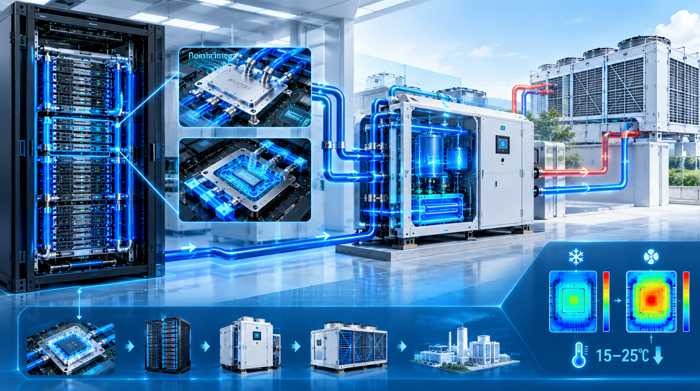
Air cooling fails above roughly 40 kilowatts per rack, which is why liquid cooling is now central to AI data center infrastructure. ZTE states liquid-cooled scenarios reach a PUE as low as 1.15, about 30% more efficient than conventional designs (RCR Wireless, 2025). Alibaba achieves 1.10 PUE with liquid cooling versus 1.15 with air (GMT Eight, 2026).
Immersion cooling can cut energy consumption by more than 50% and approach a PUE of 1.02 (Business Research Insights, 2026). Advanced accelerators already exceed 1,400 watts each, so liquid cooling is no longer optional; it is structural to AI data center infrastructure. Every serious operator now plans for it today.
Direct-to-chip cold plates dominate the technology choice. Single-phase cold plates captured 78% of the direct-to-chip liquid cooling market in 2025 (IDTechEx via PW Consulting, 2025). Vendors now ship complete coolant distribution units (CDUs). Delta offers a 2.4-megawatt liquid-to-liquid CDU with N+1 redundancy and 800-volt DC pumps moving up to 1,440 liters per minute (The Data Center Engineer, 2026). Liquid-cooled solutions already represent 45% of prefabricated container shipments (Grand Research Store, 2026).
In containerized AI data center infrastructure, cooling is engineered before arrival. KAYTUS’s Cooling Cube pairs a 4,200-kilowatt liquid-cooling source with a 3,300-kilowatt chilled-water plant, backed by a 10-minute thermal buffer tank and a 72-hour emergency water reserve (Interesting Engineering, 2026). These systems guarantee thermal ride-through during power transfers. When rack density exceeds 100 kilowatts, the question is not cost but survival. Liquid cooling is the difference between uptime and failure.
What role does energy storage play inside AI data center infrastructure?
Batteries have evolved from backup-only to strategic assets in AI data center infrastructure. AI pushes rack power from 132 kilowatts toward 1 megawatt, so uninterrupted power must now protect cooling pumps, CDUs, and controls, not just IT loads (ET Datacenters, 2026). Battery energy storage systems support peak shaving, grid services, and seamless generator transitions. Emerging chemistries such as sodium-ion and second-life electric-vehicle batteries are entering consideration for these roles (ET Datacenters, 2026).
Storage is now bundled directly into modular systems. Schneider Electric formed a USD 1.9 billion joint venture to deploy containerized data centers across 12 U.S. metros, explicitly pairing battery storage with demand-response participation (PW Consulting, 2026). PowerX and Internet Initiative Japan are designing battery-integrated containers for AI workloads (PW Consulting, 2026). Eaton’s xStorage couples lithium-ion batteries with UPS switchgear in a single block (Mordor Intelligence, 2026). Storage converts a grid constraint into an operating advantage.
How do containerized power cubes scale AI data center infrastructure from megawatts to gigawatts?
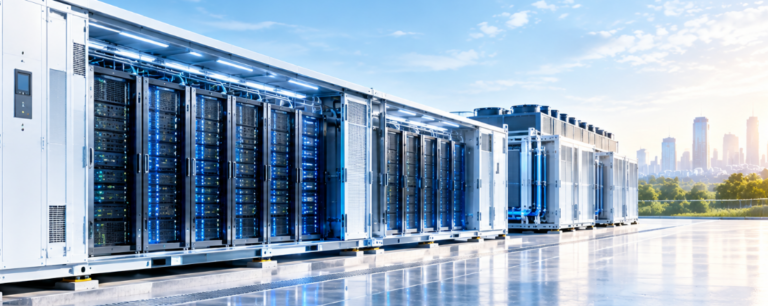
The building block is the cube. KAYTUS standardizes infrastructure into three units: an IT Cube, a Power Cube, and a Cooling Cube (Interesting Engineering, 2026). A 3-megawatt IT Cube holds 18 liquid-cooled racks at up to 227 kilowatts each, with integrated spine-leaf networking. The Power Cube provides independently prefabricated 2,500-kVA power transfer units and diesel generators in a 2+1 redundant, Tier III-compliant arrangement. Operators can start at 3 megawatts and expand progressively to gigawatt class.
High-voltage direct current is tightening the chain. Delta’s 800-volt DC in-row power delivers up to 660 kilowatts with 98.5% efficiency, while its modular UPS handles GPU load slew rates up to 6,000% of rated capacity per second (The Data Center Engineer, 2026). LG CNS’s “AI Box” packs 1.2 megawatts of IT load and 576 GPUs into one container, deploying in six months (LG CNS via Memorys, 2026). These modules convert AI data center infrastructure into replicable, factory-validated capacity blocks.
What does a turnkey modular deployment include?
A complete AI data center infrastructure deployment stacks five subsystems in standardized containers, each factory-integrated and pre-tested. Standardization is what makes the model repeatable: the same validated blocks ship to any site, removing the variability of on-site construction. The table below maps each cube to its typical capability and source.
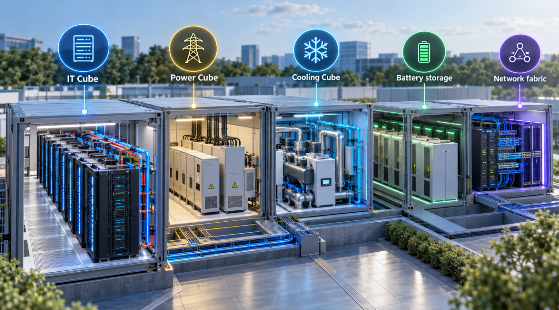
The factory integrates power, cooling, fire protection, security, and monitoring before shipment (Congruence Market Insights, 2026). On-site work shrinks to foundation preparation, module placement, and utility connection. Alibaba reports computing density per unit area reaching 5–10 times the previous generation, with transformer counts nearly halved (GMT Eight, 2026). Interconnection via dark fiber at up to 800G links distributed containers into a single virtual campus (Datalok, 2026). Modular AI data center infrastructure behaves like a network of interchangeable blocks.
What are the real costs and hidden pitfalls of modular AI data center infrastructure?
Costs fall, but not automatically. Modular systems cost up to one-third less than conventional builds, according to Exascale Labs (2026). The global containerized data center market reached USD 12 billion in 2025 and is projected to grow at a 13.9% CAGR to USD 38.8 billion by 2033 (Congruence Market Insights, 2026).
Yet high-density AI data center infrastructure requires heavier electrical systems, specialized cooling, water availability, and permitting decisions. Many jurisdictions classify containers as temporary, enabling sub-12-month permits, while fixed modules face zoning and environmental reviews (Mordor Intelligence, 2026). These variables often decide whether advertised economics hold in the field, so verify each one locally.
Integration risk simply moves from the jobsite to the factory in modular AI data center infrastructure. Late changes become expensive once interfaces are frozen, so power and cooling specifications must be locked early (The Data Center Engineer, 2026). Factory pre-integration shifts schedule risk to the plant, where quality is controllable.
Outdoor units face UV, sand, and humidity; filter swaps double and security hardening adds 10–15% to bill-of-materials cost (Mordor Intelligence, 2026). Ignore these variables and a promised six-month deployment becomes twelve months. Careful site surveys and factory testing prevent most surprises. Plan for water, power, transport, and acoustics before ordering.
What should you verify before committing to an AI data center infrastructure?
Before you sign, verify five things against your actual workload, not vendor slides. Each checkpoint in the list below targets a failure point that has already delayed real AI data center infrastructure projects in 2025 and 2026. Run them in order and document the evidence. This discipline prevents stranded capacity before it becomes a balance-sheet item.
- Confirm the power source: grid capacity, interconnection queue position, and backup strategy.
- Validate cooling architecture against real rack density, including CDU redundancy and water supply.
- Inspect battery storage sizing for peak shaving and ride-through, not just UPS runtime.
- Check modularity: can capacity grow without disruptive maintenance windows?
- Review compliance with UL 2755:2025 for prefabricated modular systems (UL, 2025).
Each item maps to a cost center in AI data center infrastructure, so skipping verification risks stranded capacity. Power failures, thermal events, and permit delays are the top causes of budget overrun in this sector. A disciplined checklist converts a risky bet into a controlled deployment. Treat every data point as a contract term, not a marketing claim.
The new standard for AI data center infrastructure
The era of building AI data center infrastructure like an office tower is over. Factory-built containers, mandatory liquid cooling, and grid-interactive batteries have replaced concrete and guesswork. Racks at 227 kilowatts, PUE near 1.02, delivery in months, and storage that earns revenue from grid services define the new standard. Hyperscalers from Microsoft to Alibaba already scale this model. The winners in the AI race will treat power, cooling, and energy storage as one integrated engineering problem.