


Every conversation about high-density data centers eventually hits the same bottleneck: heat. Traditional air cooling just isn’t cutting it anymore. That’s where CDUs for liquid cooling systems step in. But what exactly do these units do, and why are they suddenly everywhere in AI and HPC facilities?
Let me break down the five core roles a Coolant Distribution Unit (CDU) plays in a modern liquid-cooled data center—without the marketing fluff.
How CDUs Protect IT Hardware from Facility Water
Back in the early days of liquid cooling experiments, some engineers tried running facility water straight into server racks. It didn’t go well. Facility cooling loops often carry contaminants, particulates, scaling agents, and inconsistent water chemistry that can wreak havoc on delicate cold plates and microchannels.
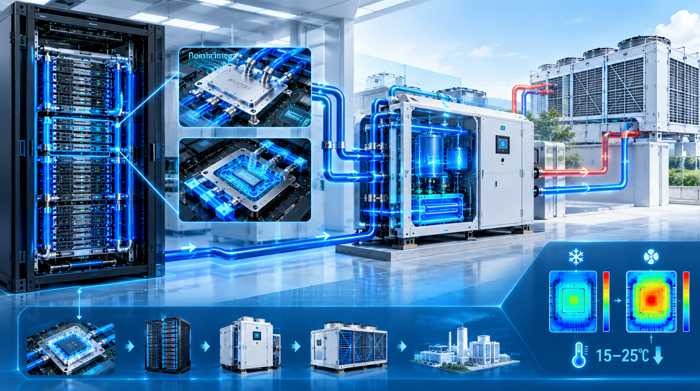
A CDU completely isolates the facility water system (FWS) from the technology cooling system (TCS). These two hydraulic circuits stay completely separate, connected only through a plate heat exchanger that transfers heat without mixing fluids. The TCS loop circulates clean, engineered coolant—often a water-glycol mixture with corrosion inhibitors—directly through your server cold plates. Meanwhile, the FWS loop can carry whatever the building supplies, from chilled water to condenser water, without putting your expensive IT gear at risk.
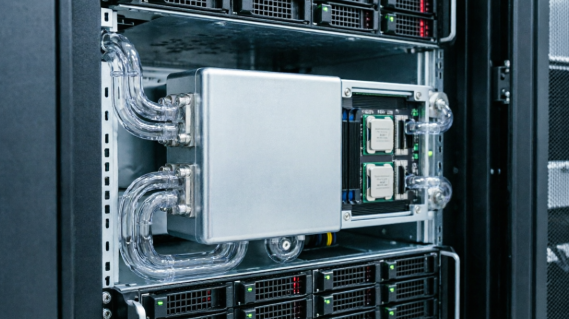
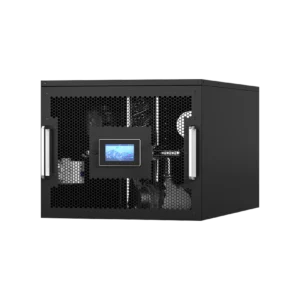
Some manufacturers take this isolation seriously. Mitsubishi Electric’s ME-CDU, for example, builds its hydraulic structure entirely with 304/316 stainless‑steel piping to ensure fluid purity and long-term resistance to contaminants.
The Core Heat Exchange Job of a Coolant Distribution Unit
The physics here is pretty straightforward. As coolant circulates through cold plates attached to CPUs, GPUs, and accelerators, it absorbs thermal energy. That warmed fluid returns to the CDU, where a brazed plate heat exchanger transfers the heat from the TCS loop into the FWS loop. The facility loop then carries that heat to cooling towers, dry coolers, or chillers for final rejection.
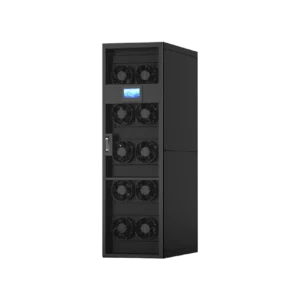
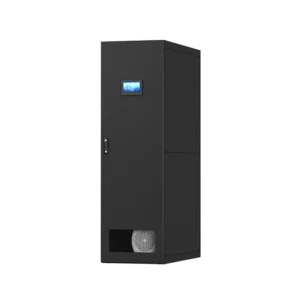
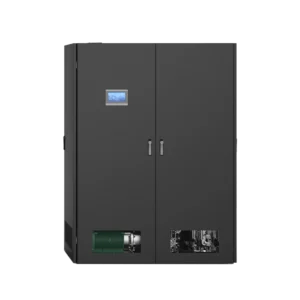
Modern AI chipsets drive the scale of this heat transfer. NVIDIA’s Blackwell GPU carries a thermal design power (TDP) of 2,000 watts. A single GB200 NVL72 rack server can reach 10kW TDP for its eight GPUs and two CPUs combined. At the facility level, CDUs now handle cooling capacities ranging from 345 kW up to 1,380 kW per unit, with some floor-standing models designed specifically for direct liquid-to-chip cooling and immersion cooling applications.
Newer architectures are pushing these capabilities further. In pumped two-phase direct-to-chip cooling, the coolant actually evaporates inside the cold plate, absorbing significantly more heat per unit mass than single-phase systems ever could.
Why CDUs for Liquid Cooling Systems Must Adapt in Real Time
This is the part that doesn’t get enough attention. A CDU isn’t just a passive heat exchanger—it actively manages the hydraulics of the entire secondary loop.
Integrated pumps—typically equipped with variable-speed drives and N+1 or triple-redundant architecture—circulate coolant through the TCS at precisely controlled flow rates. Motorized control valves adjust in real time based on sensor feedback from pressure transducers, flow meters, and temperature probes.
Why does this matter? Because thermal loads aren’t static. AI training workloads ramp up and down constantly. A well-configured CDU responds automatically, ramping pump speeds up during peak compute and dialing them back during idle periods to save energy while maintaining adequate cooling coverage across every cold plate in the rack.
For perspective, global CDU sales reached approximately 88,000 units in 2025, with an average market price of around US$15,000 per unit. Those units aren’t just sitting there—they’re actively thinking and adapting.
Preventing Degradation in Liquid-Cooled CDU Loops
This one’s subtle but critical. The channels inside plate heat exchangers can be incredibly narrow—anywhere from 2 to 8 millimeters. Even small particulates can cause fouling, reduce thermal transfer efficiency, and eventually lead to premature component failure.
CDUs include filtration on both the primary and secondary sides. The secondary (TCS) loop typically runs much finer filtration—25-micron in many designs—to maintain coolant purity. Some advanced units also monitor water chemistry parameters like conductivity, pH levels, and corrosion inhibitor concentrations.
The goal is keeping the TCS coolant clean enough for microchannel cold plates and sensitive IT hardware while allowing the FWS loop to operate under less stringent purity requirements. This two-tier approach balances performance needs with operational practicality.
Achieving Zero Downtime with Enterprise CDUs
Data centers hate downtime. Liquid cooling systems hate pump failures. The solution? Redundant everything.
Most enterprise-grade CDUs deploy N+1 or 2N pump configurations. When a primary pump fails—and at some point, one will—the backup seamlessly takes over. Subzero Engineering reports that modern CDUs achieve 99.999% system availability with triple-redundant architecture and failover times measured in milliseconds.
Even the control systems are fault-tolerant. Programmable logic controllers (PLCs) or embedded control modules manage all operations, and advanced units support remote monitoring via Modbus RTU, Modbus TCP/IP, BACnet IP, SNMP, and HTTP protocols, integrating directly into existing DCIM platforms.
Why the Role of CDUs in Liquid Cooling Matters More Than Ever
The data center liquid cooling market reached approximately 5.52billionin2025andisprojectedtohit15.75 billion by 2030, representing a compound annual growth rate of 23.31%. CDUs specifically are expected to grow from 720millionin2023to3.08 billion by 2030 at a 20.5% CAGR.
But the more interesting signal comes from chip design. NVIDIA’s upcoming Vera Rubin compute tray designs reportedly eliminate server fans entirely, requiring fully liquid‑cooled configurations at the rack level. Direct liquid cooling is forecast to surpass $8 billion annually by 2030, transitioning from an optional upgrade to foundational infrastructure for AI factories.
The Bottom Line
A Coolant Distribution Unit isn’t just a pump bolted to a heat exchanger. It’s the intelligent control layer that makes data center liquid cooling viable at scale. CDUs provide hydraulic isolation, thermal transfer, dynamic flow management, filtration, and operational redundancy—all in one coordinated package.
If you’re designing a new AI cluster, retrofitting an existing facility, or just trying to understand where your next major infrastructure investment should go, the CDU deserves a lot more attention than it usually gets. It’s not flashy. But it’s absolutely essential.
And as rack densities continue climbing past 100 kW per cabinet, the question won’t be whether you need CDUs for liquid cooling systems. It’ll be how many.