

Natural Cooling Solution is one of the core efficiency-driven solution for cutting data center operational costs and lowering their environmental footprint.
It is widely acknowledged that precise temperature control is critical for data centers, as excessive temperatures and unregulated humidity can cause permanent damage to IT hardware and degrade its operational performance. While Thermal Guidelines suggest an ideal temperature range of 18–20°C, most modern data centers operate with expanded temperature thresholds, often up to 27°C or higher.
Designing an optimized data center cooling system has therefore become a top priority, especially as public awareness and regulatory standards increasingly focus on curbing the environmental impact of data center operations.
Against this backdrop, natural cooling solution has emerged as a pivotal strategy to slash cooling energy consumption by making full use of available natural cooling resources. Thanks to innovative system design and the integration of high-efficiency chillers, natural cooling solution is now viable for a far wider range of geographic locations.
What Is Natural Cooling Solution?
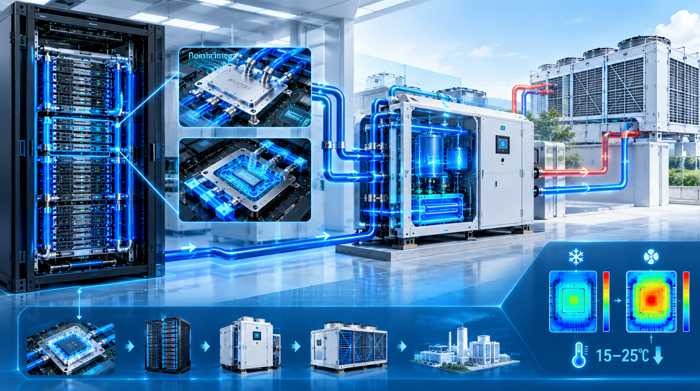
Natural cooling refers to a suite of cooling technologies that leverage naturally available resources—such as ambient outdoor air or water—to dissipate heat.
Its core objective is to reduce reliance on energy-intensive mechanical cooling methods like traditional air conditioning systems.
Though natural cooling systems come in various forms, their fundamental operating principle remains consistent: capturing natural air or water from the surrounding environment and circulating them through dedicated infrastructure to cool data center facilities.
This marks a significant departure from mechanical cooling systems, which rely on compressors and refrigerants to lower the temperature of air or liquids.
In contrast, natural cooling prioritizes operational simplicity, eliminating the need for complex mechanical components and energy-heavy refrigeration cycles.
Core Principles & Operational Conditions
First, it is essential to note that natural cooling is not universally applicable: its feasibility depends entirely on the availability of natural cooling resources at a data center’s physical site.
Second, natural cooling systems function as passive cooling solutions, as they depend on natural physical processes (such as air convection) to absorb and transfer heat. When outdoor air or water is cooler than the internal data center environment, it can be directed indoors to cool IT equipment passively.
That said, pure passive natural cooling is rarely implemented in practice. Most systems are paired with backup refrigeration equipment, such as high-efficiency chillers, which supply additional cooled air to maintain stable temperatures when natural resources are insufficient.
In hybrid cooling setups, natural cooling and mechanical chillers work in tandem to maintain optimal thermal conditions regardless of external weather or seasonal changes. This flexibility allows data center operators to maximize natural cooling during favorable periods of the day or year, while activating supplementary cooling during less ideal conditions.
In short, natural cooling typically acts as a complement to traditional cooling systems, working together to elevate the overall energy efficiency of the data center.
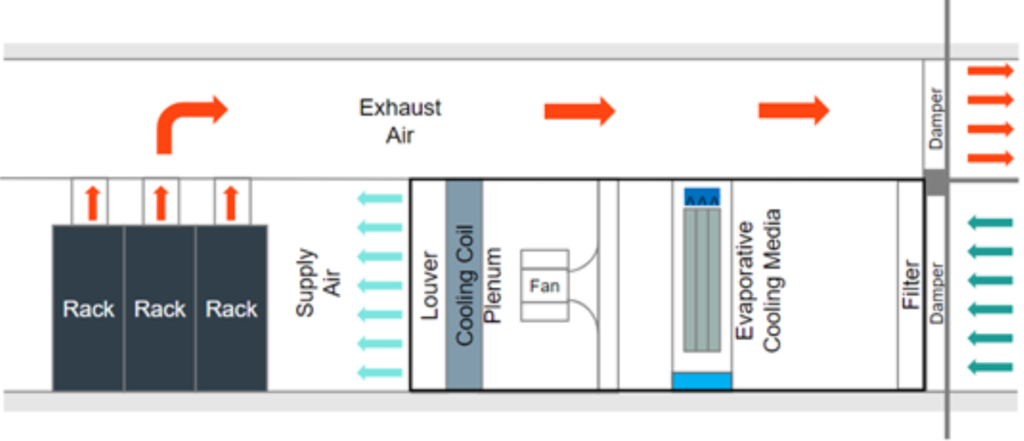
The key to success, as explored further below, lies in designing adaptable systems that activate chillers intermittently based on real-time outdoor temperatures.
Types of Natural Cooling
1. Direct Fresh Air Cooling
This approach directly draws in outdoor air to cool IT equipment when ambient temperatures are within optimal ranges. It requires supporting systems for air filtration and humidity regulation to protect sensitive hardware.
2. Water-Based Natural Cooling
This method uses cold water—sourced from natural water bodies or cooling towers—to absorb heat via heat exchangers, supported by electric chillers as needed.
3. Advanced Alternative Models
Additional specialized equipment can expand the capabilities of natural cooling systems. For instance, indirect natural cooling uses technologies like rotary heat wheels to transfer heat between indoor and outdoor air streams without direct mixing.
Heat pipe integration is another viable option. These passive heat transfer devices efficiently move heat away from server racks, enhancing overall heat dissipation performance.
The Growing Adoption of Natural Cooling
According to the Uptime Institute’s 2023 Global Data Center Report, 88% of data center operators rank “IT and data center power consumption” as their top concern. This widespread focus on energy usage has become the primary driving force behind the rapid adoption of a natural cooling solution.
As a leading player in the data center industry, Google’s shift toward natural cooling exemplifies industry-wide preference for this approach. To reduce power demand, the company notes that its most efficient data centers now utilize natural cooling techniques, operate at temperatures up to 27°C, and deploy custom energy-efficient hardware—delivering exceptional energy performance results.
Simultaneously, the rise of natural cooling is reshaping global data center site selection trends. Access to natural cooling resources has become a key factor when choosing new data center locations, paired with the availability of renewable energy. This has positioned Nordic countries, with Denmark’s data center market as a prime example, as top destinations for large-scale data center investments.
Key Benefits of Natural Cooling
- Delivers exceptional energy efficiency by replacing energy-intensive mechanical processes with low-power passive cooling structures.
- Enhances environmental sustainability: lower electricity use translates to reduced CO₂ emissions, while minimizing or eliminating refrigerant use delivers additional ecological benefits.
- Cuts down on energy-related operational expenses.
- Reduces upfront installation costs and simplifies operation and maintenance, as natural cooling systems minimize or eliminate moving parts (e.g., compressors, pumps) found in traditional cooling setups. This extends equipment lifespan and lowers long-term maintenance costs.
- Integrates seamlessly into hybrid systems, with chillers activating only when natural cooling resources are suboptimal.
Critical Design Considerations for Natural Cooling Systems
As previously highlighted, site selection is foundational to natural cooling implementation. Local climate conditions and access to cooling resources (such as cold water) directly determine whether a natural cooling system is practical.
Data center cooling design is a complex process governed by a range of core factors, including:
- Projected thermal load
- Expected IT demand and demand fluctuations
- Target energy efficiency metrics
- Feasibility of automated control systems to prioritize natural cooling during favorable conditions
- Integration of fully redundant hybrid cooling infrastructure
- Sustainability goals for resource conservation and green technology adoption
- Cost-benefit analysis and ROI projections for long-term energy savings
- Compliance with industry regulations and building codes
Beyond these general criteria, two factors stand out as especially vital for natural cooling system design:
Airflow Management
Effective airflow management is essential to maximize natural cooling efficiency and requires careful planning.
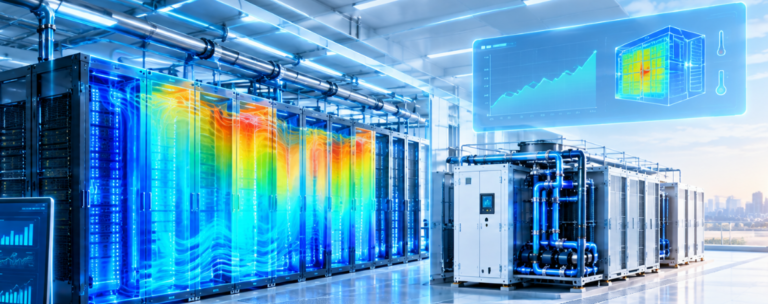
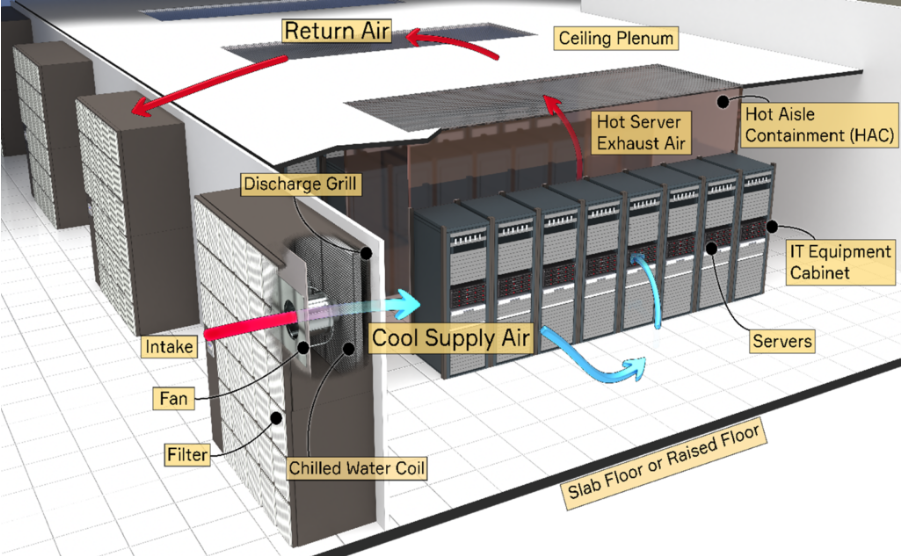
The hot-aisle/cold-aisle rack layout is the industry standard for optimized airflow, designed to prevent the mixing of cool and warm air streams. This setup ensures cold air reaches IT components directly, while warm exhaust air is expelled efficiently.
Various airflow patterns can be implemented within this layout, all focused on directing cool and warm air through racks and aisles in the most efficient way possible.
Well-designed airflow balancing optimizes natural cooling performance and reduces the need for costlier backup cooling methods, making it a cornerstone of effective system design.
Hybrid Operating Mode
Natural cooling systems almost always operate alongside high-efficiency chillers in hybrid configurations. Balancing optimal natural cooling temperatures with chiller activation thresholds is key to reliable performance.
For water-based natural cooling systems, three temperature-based operating scenarios maintain efficiency and equipment safety:
- Ambient temperature above 30°C: Chillers activate to support natural cooling, maintaining optimal thermal levels when natural resources are insufficient. Selecting a high-performance chiller is critical here; modern industrial chillers deliver exceptional efficiency at both partial and full loads.Chiller efficiency is measured by the ratio of cooling output to energy input: electric chillers use kilowatts per ton of cooling, while absorption chillers use fuel/gas/steam consumption per ton of cooling. The right chiller ensures seamless backup for natural cooling, delivering outstanding annual average efficiency.
- Ambient temperature 21–30°C: Natural cooling handles the majority of cooling demand to achieve the target 30°C water temperature, with minimal chiller support. While energy use rises slightly, it remains drastically lower than full mechanical cooling.
- Ambient temperature below 20°C: Natural cooling operates independently, with chillers inactive. Target 30°C cooling water is achieved solely via dry coolers, with fan energy consumption accounting for just 10% of the energy required by chillers. This scenario delivers maximum energy efficiency and cost savings, and is feasible for most of the year in many global regions.
SEOTECK: Your Partner for Next-Generation Data Center Cooling
Designing a high-performance cooling system is a multifaceted, complex process that demands expert thermal engineering.
On one hand, natural cooling solution must align with a data center’s thermal load, redundancy requirements, and overall operational needs. On the other, energy savings and responsible resource use are critical to addressing growing concerns over data centers’ environmental impact—especially as data center demand and power-hungry infrastructure continue to expand.
With energy efficiency and sustainability as core objectives, modern data centers have access to a diverse range of cooling strategies. Natural cooling can be paired with high-efficiency chillers, as well as AI-driven data center management systems that optimize cooling via dynamic adjustments, smart resource allocation, and full automation.
Partnering with an experienced thermal engineering specialist is essential to unlock a project’s full potential and deploy cutting-edge cooling technologies that maximize efficiency.
This is where SEOTECK steps in. We are dedicated to developing data center cooling solution centered on efficiency and sustainability. Leveraging our deep thermal engineering expertise, we design and implement tailored, state-of-the-art cooling systems—including advanced natural cooling solution—that align with each project’s unique needs and capabilities.