


If you run a data center, server room, or any space with sensitive electronic equipment, you know how important it is to keep the temperature and humidity steady. When it comes to choosing a cooling system, two options stand out: Direct Expansion (DX) and Chilled Water Precision AC. Both work to keep your equipment cool, but they’re very different in how they operate, how efficient they are, and which spaces they’re best for. In this guide, we’ll break down the differences in simple terms, so you can pick the right one for your needs.
How Each Cooling System Works
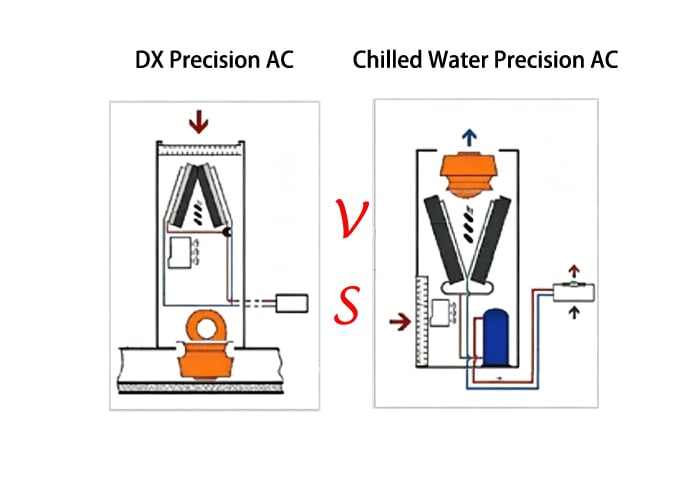
DX Precision AC
DX systems are a lot like the air conditioner you have at home—just built for bigger, more critical spaces. They’re self-contained units with all the parts they need (like compressors and coils) in one place. They use refrigerant to cool the air directly in the room. Here’s the basics:
- The refrigerant cools the air directly, no extra steps in between
- They can adjust how much cooling they provide to match how much you need
- Each unit works on its own—if one breaks, the others still run
- They focus more on cooling than removing moisture
- Each unit can cool between 5 and 100+ tons of space
Chilled Water Precision AC
Chilled Water Precision AC is a bit more complex, but it’s designed for larger spaces. It uses a central “chiller” unit that cools water, then sends that cold water through pipes to air handlers in your critical space. Here’s how it works in simple steps:
- The central chiller cools water to around 45°F (7°C)
- Insulated pipes carry the cold water to air handlers in your server room or data center
- Warm air from your equipment blows over the cold water coils, cooling down
- The now-warm water goes back to the chiller to be cooled again
- Pumps adjust their speed to make sure the water flows at the right rate
How They Compare: The Key Things You Care About
Energy Efficiency
Cooling runs 24/7 in critical spaces, so efficiency matters—a lot. It can make up 30-40% of your total energy bill. Here’s how the two stack up in real life:
| What to Measure | DX Precision AC | Chilled Water Precision AC |
|---|---|---|
| Efficiency Rating | 2.8-3.5 | 4.5-6.0 |
| Energy Used per Ton of Cooling | 0.8-1.2 kW per ton | 0.40-0.55 kW per ton |
| Saving Energy with Free Cooling | Hard to do | Easy to add |
| Efficiency When Cooling Less Than Full Capacity | Drops a lot when used less than 50% | Stays efficient even when used less |
For large spaces, Chilled Water Precision AC saves 20-30% on energy costs compared to DX. For example, a financial data center switched to chilled water cooling and cut its energy use from 1.6 to 1.28. That saved them over $2 million every year on electricity.
Costs: Upfront, Maintenance, and Long-Term
It’s not just about upfront cost—you need to think about how much you’ll spend over time. Here’s the breakdown:
| Cost Type | DX Precision AC | Chilled Water Precision AC |
|---|---|---|
| Initial Cost | $1,500-$2,500 per ton | $2,500-$4,000 per ton |
| How Long It Lasts | 10-15 years | 20-25 years for the main parts |
| Maintenance | More frequent service calls for the compressors, but each call is cheaper | Needs water treatment and more skilled technicians, so it’s more expensive |
| Total Cost Over Time | Higher for large facilities | Lower for spaces that run 24/7 with high cooling needs |
Scalability (Can It Grow With You?)
- DX systems: Great if you need to add cooling little by little. They’re perfect for small to medium spaces (like a small server room) or places where you don’t have much room for big mechanical equipment.
- Chilled Water Precision AC: Perfect for large spaces or multiple buildings. One central chiller can cool multiple floors or even different buildings with pipes. That’s why big data centers and campus-style facilities use it.
Will It Keep Running When You Need It?
| What to Consider | DX Precision AC | Chilled Water Precision AC |
|---|---|---|
| Risk of One Thing Breaking Everything | Low | Higher if you only have one chiller |
| What Happens During a Power Outage | Needs full backup power (UPS) to keep running | The air handlers can run on UPS using the cold water that’s already stored |
| Risk of Leaks | Refrigerant leaks | Water leaks |
| How Easy It Is to Fix | Easier | Harder |
When to Choose Each System
Choose DX Precision AC If:
- Your space is small to medium (under 5,000 square feet) and doesn’t need a lot of cooling
- You’re in a remote area without access to a central cooling system
- You need a temporary cooling solution (like a temporary server room)
- You can’t have water in the space
- You’re on a tight budget and need to spend less upfront
Choose Chilled Water Precision AC If:
- You have a large data center that runs 24/7 with high cooling needs
- You have multiple buildings or floors that need cooling
- Your space has high-density equipment
- You want to save money on energy bills long-term
- You plan to expand your space or add more equipment later
Example: Chilled Water Precision AC in Action
A big financial data center in Shanghai switched to Chilled Water Precision AC to cool its high-density servers. Here’s what happened:
- They cut their energy use (PUE) from 1.6 to 1.28 (a 20% improvement)
- Saved over $2 million every year on electricity
- Reduced the space taken up by cooling equipment by 60%
- Cut installation time from 3 months to 1 month
This shows how Chilled Water Precision AC not only saves money but also frees up space for more equipment that makes you money.
How to Make the Right Choice
When picking between DX and Chilled Water Precision AC, ask yourself these questions:
- How much will it cost over 10 years? (Include energy, maintenance, and replacement costs)
- Will I need more cooling in the future?
- What’s the climate like? (Can I use free cooling to save money?)
- How important is it that the system never fails? (Do I need backup?)
- Do I have sustainability goals (like reducing carbon emissions)?
The Future of Cooling
Both systems are getting better. Here’s what’s new:
- AI controls that adjust cooling based on how much you need in real time
- Better free cooling options to save more energy
- Smaller, scalable chilled water systems for medium-sized spaces
- Hybrid systems that combine chilled water with direct liquid cooling for super hot equipment
Final Verdict
DX systems are simple, independent, and good for small spaces or tight budgets. But for large, mission-critical spaces that run 24/7, Chilled Water Precision AC is the better choice. It’s more efficient, scales better, and saves you money in the long run. When paired with modern controls and free cooling, it can cut your energy use significantly—lowering costs and helping the environment.
If you’re still not sure, talk to a cooling expert who can look at your space and give you a personalized recommendation.