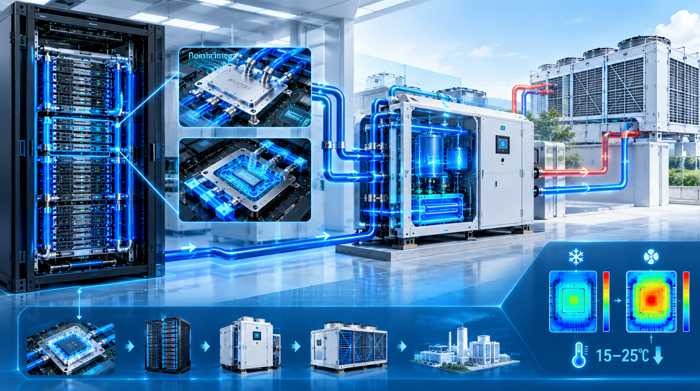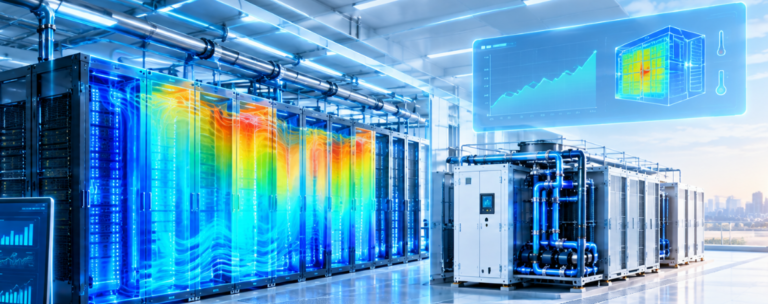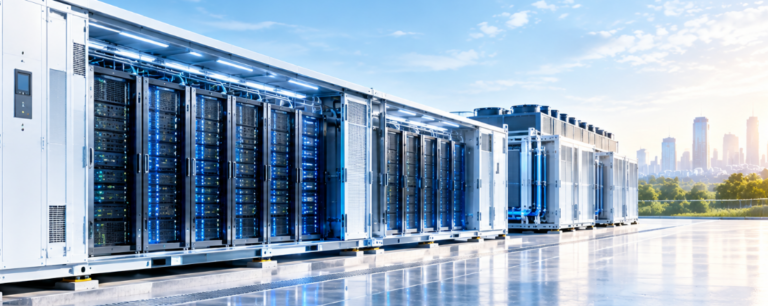


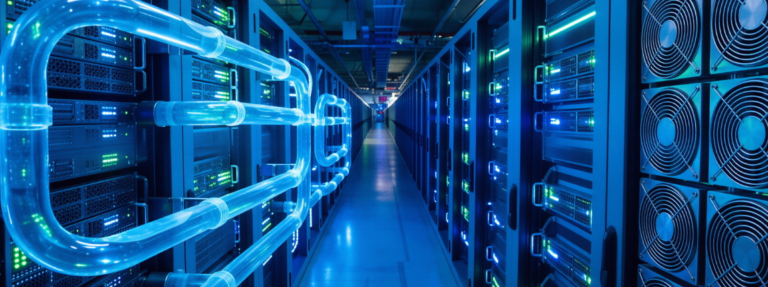
Let’s be honest: air cooling has reached its limit. If you’re running high‑density servers or AI clusters, you already know that. That’s why data centers everywhere are moving to a liquid cooling solution – better thermal efficiency, lower PUE, and a much faster path to cutting TCO.
Air cooling has been the standard for decades, but it is no longer sustainable. Conventional air conditioning (CRAC/CRAH) units struggle with racks exceeding 15–20 kW per rack. High-performance CPUs and GPUs now generate 300W–700W per chip, while AI accelerators like NVIDIA H100 or AMD Instinct can exceed 700W. Air’s low specific heat capacity and poor thermal conductivity require massive airflow, leading to loud fans, high parasitic power, and limited cooling capacity.
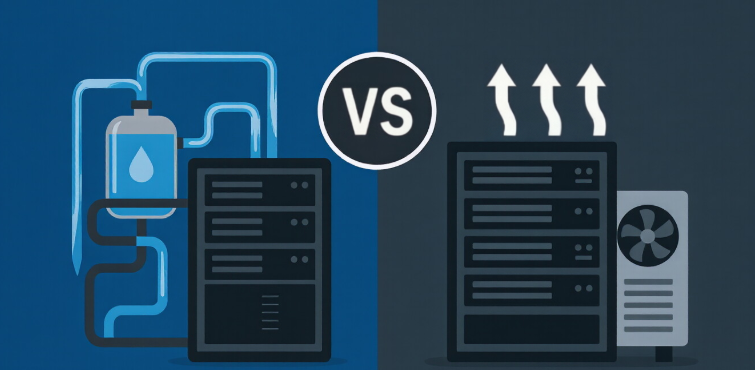
In contrast, a liquid cooling solution leverages water or dielectric fluids that are orders of magnitude more efficient at transferring heat. Liquid has 30–50 times higher thermal conductivity than air and a specific heat capacity roughly 4 times greater. This fundamental advantage makes liquid cooling the only viable path forward for high-density data centers.
Key Benefits of a Liquid Cooling Solution
Dramatically Lower Power Usage Effectiveness
The most compelling metric for any data center is PUE. Traditional air-cooled facilities typically achieve a PUE of 1.5–1.8, meaning 50–80% extra energy is spent on cooling. A well-designed liquid cooling solution can achieve PUE as low as 1.04–1.1, approaching theoretical unity. Direct-to-chip (cold plate) and immersion cooling eliminate most fans and reduce chiller load, slashing cooling energy by 50–80%.
Supporting Extreme Power Densities
While airflow management tops out at around 30kW per rack, a liquid cooling solution easily supports 50kW, 100kW, or even 200kW per rack. This capability is critical for AI training clusters, HPC simulations, and large-scale cloud computing. Hyperscalers like Google, Microsoft, and Meta are already deploying liquid-cooled racks to pack more compute per square foot, reducing overall facility footprint and infrastructure costs.
Enabling Free Cooling and Heat Reuse
Liquid cooling systems operate with higher coolant temperatures (40°C–65°C), unlike air cooling that requires chilled air (~22°C). This allows a liquid cooling solution to utilize free cooling via dry coolers or cooling towers for most of the year. Even better, the waste heat can be reused to warm buildings, greenhouses, or district heating networks – turning a cost center into a revenue stream.
Reduced Fan Noise, Maintenance, and Server Failure Rates
Air cooling demands high-speed fans inside servers, which consume power, create noise (often >85 dBA), and accumulate dust. Fans are among the most failure-prone components in a server. A liquid cooling solution eliminates most fans from the server itself (except for memory/VRMs in some designs), leading to quieter operation, lower vibration, and higher reliability. Studies show that liquid-cooled servers have 25–40% lower annualized failure rates compared to air-only cooled counterparts.
Types of Liquid Cooling Solution for Data Centers
Direct-to-Chip Liquid Cooling (Cold Plate)
A cold plate is attached directly to CPUs, GPUs, or memory, with liquid circulating through the plate. This closed-loop liquid cooling solution retains air cooling for other components (storage, networking). It is the most common retrofit option for existing data centers.
Single-Phase Immersion Cooling
Servers are submerged in a non-conductive dielectric fluid within a specially designed tank. Heat transfers directly from all components to the fluid, which is then pumped to a heat exchanger. This liquid cooling solution offers the highest density and eliminates fans entirely.
Two-Phase Immersion Cooling
Dielectric fluid boils at a low temperature; vapor rises, condenses on a cooled coil, and drips back. Two-phase immersion provides even greater heat removal per liter and passive circulation (no pumps needed for the fluid), though it requires careful handling of vapor.
Is Liquid Cooling Safe and Reliable?
Liquid and electronics don’t mix – what about leaks?
Modern liquid cooling solution designs use dielectric fluids (in immersion) or distilled water with corrosion inhibitors in sealed cold plate loops. Leak detection systems and anti-leak quick disconnects are standard. In immersion cooling, boards are designed to operate while submerged – short circuits are impossible because the fluid is non-conductive.
Retrofitting is expensive and complex
While upfront capital costs for liquid cooling infrastructure (tanks, CDUs, piping) can be higher than air, the total cost of ownership (TCO) over 3–5 years is almost always lower due to energy savings, density gains, and extended hardware life. Many providers offer modular liquid cooling solution kits that work with standard 19-inch racks.
What about maintenance and access?
Immersion tanks allow hot-swapping of servers – simply lift the server out, drain excess fluid, and perform maintenance. Fluid loss is minimal and can be topped up. Direct-to-chip loops use quick connectors that shut off automatically when disconnected.
Liquid Cooling is No Longer Optional – It’s Essential
The industry has reached a tipping point. Air cooling simply cannot handle the heat loads of modern AI accelerators, high-core-count processors, and dense storage arrays. A liquid cooling solution provides the thermal headroom, energy efficiency, and reliability needed for next-generation data centers.
Whether you choose direct-to-chip, single-phase immersion, or two-phase immersion, migrating from air to liquid is a strategic investment that pays off in lower operating costs, higher compute density, and improved sustainability metrics. As data centers race toward carbon neutrality and net-zero targets, liquid cooling is not just better than air cooling – it’s the only scalable path forward.