


According to Markets and Markets, the global data center liquid cooling market is projected to surge from $19.6 billion in 2024 to $211.4 billion by 2032, growing at a 33.2% compound annual rate. At the center of this transformation sits one piece of equipment you cannot afford to overlook: the liquid cooling CDU. Your choice of CDU determines whether your cooling infrastructure scales smoothly or becomes the bottleneck that caps your compute capacity.
What a Liquid Cooling CDU Does in Your Loop
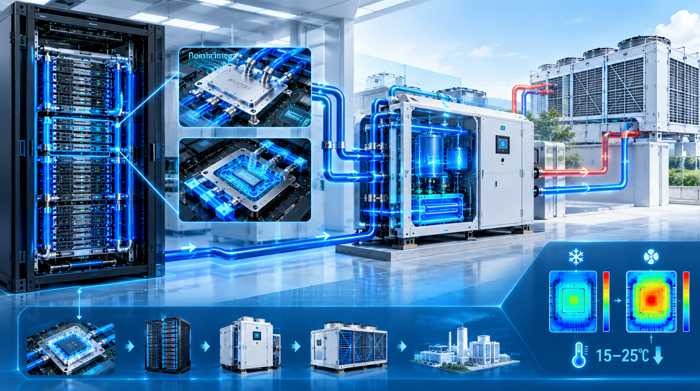
A coolant distribution unit is the bridge between your facility’s primary water loop and the secondary loop that runs through your servers. Think of it as a heat exchange gatekeeper: it isolates the two circuits, transfers thermal energy through plate heat exchangers with efficiency exceeding 95%, and ensures that no contaminants from your building’s water system ever touch your GPU clusters. Without a properly sized liquid cooling CDU, your entire liquid cooling investment becomes a liability rather than an asset.
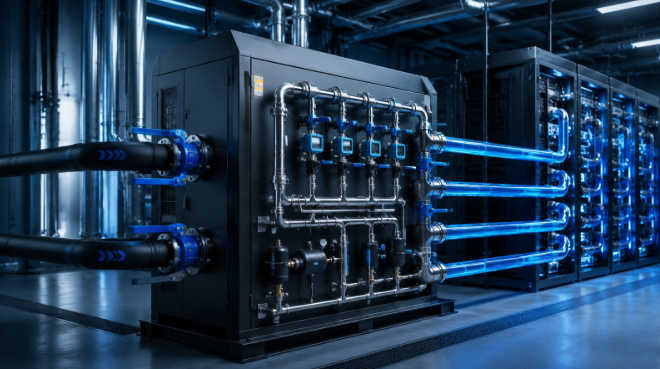
The CDU maintains precise control over coolant temperature, pressure, and flow rate. Modern units regulate these parameters within ±0.5°C accuracy, according to industry benchmarks from leading manufacturers. When your AI training cluster ramps up from idle to full load in seconds, your CDU must respond just as fast—adjusting pump speed and valve positions to prevent dangerous temperature spikes that could throttle or damage your processors.
Why Your Air Cooling Cannot Keep Up
If you are still relying on traditional air cooling, you already know the ceiling. Rack power densities have moved from 10kW just a few years ago to 30kW–50kW in modern AI deployments, with next-generation racks pushing past 100kW. IntelMarketResearch reports that liquid cooling delivers 40–50% greater efficiency compared to air cooling, and this gap widens every year as chip TDPs climb.
For a 500-rack data center, that PUE gap translates to roughly 140 million kWh saved annually, the equivalent of reducing carbon emissions by approximately 110,000 tons each year, according to the Science and Technology Daily. When you run the numbers for your own facility, the case for a liquid cooling CDU becomes difficult to ignore. A room-level liquid cooling CDU is not an optional upgrade anymore; it is the foundation that makes high-density AI deployment possible in the first place.
Heat Exchange Capacity: Your First Checkpoint
When you evaluate a liquid cooling CDU, the first specification you should look at is heat exchange capacity, measured in kilowatts. This number determines whether the unit can actually reject the thermal load your servers generate. You should calculate your total server peak power consumption and multiply by a safety factor of 1.2 to 1.3 before you start comparing models.
For context, Polaris Market Research data shows the 100–500kW segment held the dominant share of the CDU market in 2024. But if you are deploying more than 100 liquid-cooled cabinets—the threshold at which room-level CDUs become necessary—you need to look at units in the 800kW to 2,000kW range. A 1,000kW liquid cooling CDU can serve approximately 100 cabinets each drawing 10kW, or proportionally fewer cabinets at higher densities. You need to understand this sizing logic because undersizing means your cooling becomes the bottleneck that limits server performance, while oversizing wastes capital and floor space with no performance return.
N+1 Redundancy Keeps Your Liquid Cooling CDU Online
Downtime in an AI training cluster does not just cost you electricity—it costs you model convergence time that may take days or weeks to recover. This is why N+1 redundancy is non-negotiable in any serious liquid cooling CDU deployment. In an N+1 configuration, your system has one more pump than minimally required, so any single component failure does not interrupt coolant flow. Some enterprise-grade units extend this philosophy to heat exchangers, power supplies, and control processors, giving you full maintenance flexibility.
You should verify that your chosen liquid cooling CDU supports hot-swappable pumps and allows one heat exchanger circuit to be isolated for service while the other maintains full cooling capacity. The difference between N+1 and no redundancy can be the difference between a five-minute maintenance window and a five-hour emergency shutdown for your entire AI cluster.
Filtration and Leak Detection You Must Not Skip
Coolant quality is not a set-and-forget variable. Particulates, biological growth, and corrosion byproducts accumulate over time and can clog the microchannels in your cold plates. A properly designed liquid cooling CDU includes multi-stage filtration—typically 25–100μm on the secondary loop and 200–300μm on the primary side—plus online water quality monitoring that alerts you before fouling becomes a problem. You need to treat coolant chemistry as seriously as you treat power quality because a fouled cold plate removes heat just as poorly as a tripped circuit breaker delivers watts.
Leak detection is equally critical. According to industry analysis, leakage concerns remain one of the top barriers to liquid cooling adoption, especially in finance and healthcare sectors with strict uptime requirements. Your CDU should include independent leak sensors at multiple points, with response times measured in milliseconds, not seconds. When your cooling loop contains thousands of liters of fluid circulating near live electronics, even a small undetected drip can turn into a catastrophic failure that takes your entire deployment offline. A single point of leak detection failure in your liquid cooling CDU can mean the difference between a contained incident and a data hall evacuation.
Remote Monitoring: Protocols Your Liquid Cooling CDU Needs
If your data center operations team cannot see what your liquid cooling CDU is doing, you are flying blind. Modern CDUs should support at minimum Modbus TCP/IP and BACnet protocols, with SNMP and Redfish as valuable additions for integration with your existing building management and IT monitoring systems.
This is where equipment selection becomes particularly important. For example, if you are deploying a room-level system in a large AI intelligent computing center, you need a CDU that integrates these industrial communication protocols natively—not one that requires bolt-on gateways and custom scripting. Equipment vendors like Soeteck supply room-level CDUs with native Modbus and SNMP support, eliminating the integration headaches that delay commissioning. The right liquid cooling CDU gives your team the ability to monitor inlet/outlet temperatures, pump status, filter differential pressure, and coolant conductivity from a single dashboard—this unified visibility is what separates a manageable deployment from an operational headache. With the right monitoring stack, your team can identify a degrading pump bearing weeks before it fails, rather than discovering it at 3 AM when the alarms go off.
Sizing a Room-Level Liquid Cooling CDU for Scale
You reach the room-level CDU threshold when your deployment exceeds roughly 20 liquid-cooled racks, at which point rack-mounted or in-row units become impractical to coordinate at scale. A centralized room-level unit consolidates pumping, heat exchange, filtration, and control into a single system that feeds a secondary fluid network across your entire data hall.
The sizing math is straightforward: if each of your 100 racks draws 12kW, your total secondary-side thermal load is 1,200kW. Add your 1.2x safety factor and you need a minimum 1,440kW unit. You must also verify that the CDU can maintain your required approach temperature at your target flow rate. Flow rate itself is calculated via Q = cmΔT, where ΔT is your secondary-side temperature differential—typically 10–12K in well-designed loops. If your facility water enters at 25°C and you need 40°C supply to your cold plates, make sure your liquid cooling CDU is rated for continuous operation at those conditions, not just peak.
The Real Cost of Getting Your Liquid Cooling CDU Wrong
Upfront cost remains a barrier. Industry data suggests liquid cooling retrofits cost 2–3 times more per rack than air cooling. But this framing misses the point entirely because you simply cannot cool a 50kW rack with fans.Your alternative to a properly specified liquid cooling CDU is not a cheaper air handler—it is throttled performance, higher PUE, and servers that never run at full capacity. You are not choosing between spending and saving; you are choosing between a functioning AI data center and one that thermal-throttles under real workloads.
The investment calculus shifts sharply when you factor in energy savings. A facility running at PUE 1.15 versus 1.6 on a 1MW IT load saves approximately 280kW of overhead power continuously. At $0.10/kWh, that is over $245,000 per year. Your liquid cooling CDU pays for itself faster than almost any other infrastructure investment in your data center, and unlike GPU servers that depreciate in 3–4 years, a well-maintained CDU delivers value for a decade or more.
If you are evaluating equipment vendors, look for suppliers who provide detailed technical documentation and standardized communication protocols upfront—this transparency saves you weeks of integration engineering later in the project. Get your liquid cooling CDU selection right and you unlock the full performance of your AI infrastructure; get it wrong and your cooling system becomes the single constraint holding back every GPU in the building.