

AI infrastructure demand is exploding faster than anyone predicted. A container AI data center solution has shifted from an experimental concept to a mainstream deployment model because hyperscalers, telecom operators, and enterprises are racing to deploy GPU clusters — yet the traditional data center construction timeline of 18 to 24 months has become an impossible bottleneck.
The global containerized data center market, valued at $10.86 billion in 2024, is projected to reach $28.24 billion by 2032, growing at a CAGR of 15.0%, according to 24 Market Reports. Behind that number is a simple reality: when your AI roadmap demands capacity now, you cannot wait two years for concrete to cure.
Why Traditional Data Centers Cannot Keep Up
Building a conventional data center for AI workloads involves site acquisition, permits, civil engineering, power provisioning, and months of on-site integration. Even after construction, commissioning GPU clusters — with their extreme power densities and specialized cooling requirements — adds further delays. According to industry benchmarks, containerized solutions offer 40–60% faster deployment and 30% lower capital expenditure compared to traditional brick-and-mortar facilities.
Meanwhile, AI is not waiting. The U.S. Bureau of Economic Analysis reported that the real value added by the digital economy grew 6.3% in 2022, while total U.S. GDP grew only 1.9%. Every quarter of delay in deploying AI infrastructure represents missed revenue, slower model iteration, and competitive disadvantage for your organization.
What a Container AI Data Center Solution Delivers
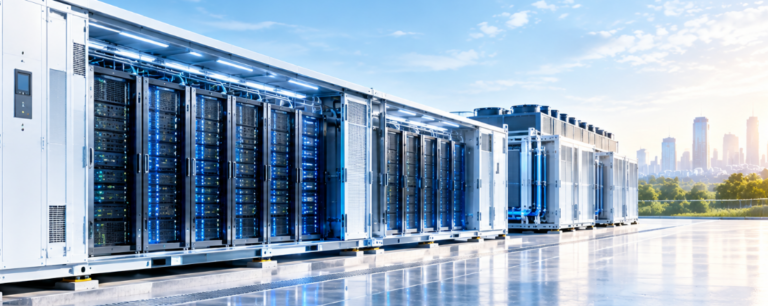
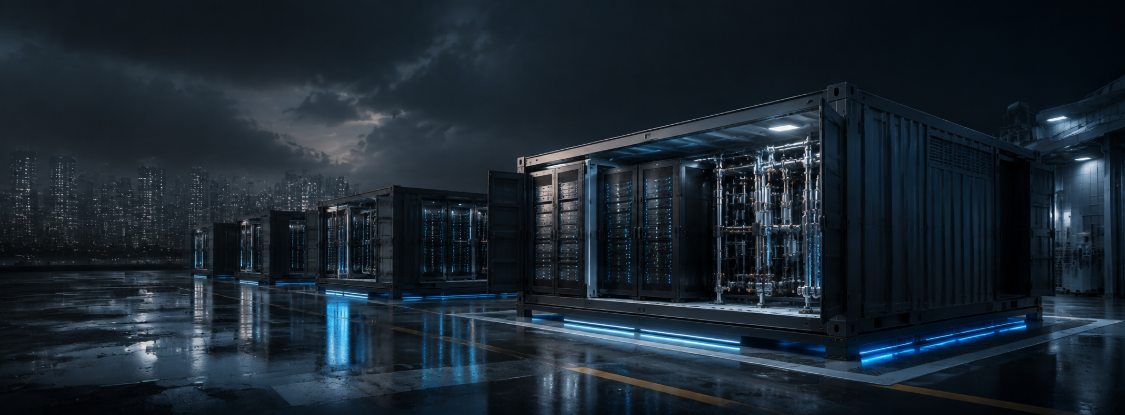
A container AI data center solution is a fully integrated, factory-tested computing facility housed in a standard ISO shipping container. It arrives at your site with servers, GPUs, power distribution, cooling, security, and remote monitoring already installed and validated. You commission it — you do not build it.
The 40-foot variant dominates the market, accounting for 45–52% of installations according to IMARC Group. These units typically support 400–800 kW of power capacity per container, making them viable for serious AI training and inference workloads. A 20-foot option exists for edge deployments, but the 40-foot form factor provides the compute-per-dollar economics that your AI projects demand.
This is not a stripped-down temporary solution. Major cloud providers now incorporate containerized modules as standard components in their expansion strategies, with roughly 25% of new capacity additions relying on prefabricated approaches, according to industry data from 24 Market Reports. When hyperscalers treat a container AI data center solution as core infrastructure rather than a stopgap measure, your confidence in the model should rise accordingly.
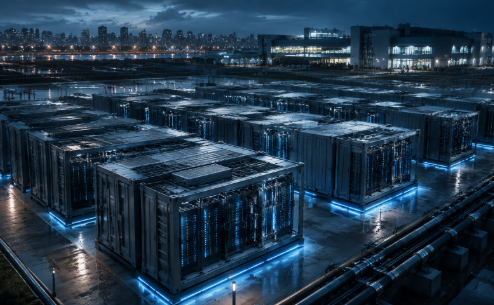
Speed: From Months to Weeks
Omdia tracked 486 containerized data center units shipped globally in 2023, up from 361 the year before — a 35% annual increase. The reason is straightforward: shipping-ready lead times average 42 days, versus the 24-month cycles typical for conventional facilities. Vertiv confirms that prefabricated modular solutions can save over 40% of deployment time, as manufacturing and testing happen off-site while the destination site is prepared in parallel.
For AI initiatives, this parallelization is transformative. Your procurement team orders a container AI data center solution while the site team prepares power and network connections. Eight to twelve weeks later, the unit arrives, and commissioning takes days — not months. This compressed timeline means your data science team can begin training models on real hardware within a quarter of placing the order.
Why AI Workloads Demand Container AI Data Center Solutions
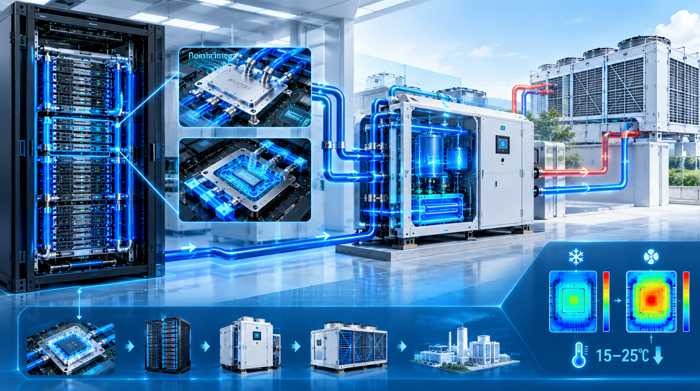
AI workloads are fundamentally different from traditional enterprise computing. GPU clusters for training large language models can demand 50 kW or more per rack. Direct-to-chip liquid cooling — once considered exotic — is becoming standard in any serious container AI data center solution. ZTE introduced its AIDC prefabricated container solution supporting 40 kW liquid-cooled AI racks at MWC Shanghai 2025, operating at a PUE of 1.15, according to IMARC Group. Schneider Electric launched the Galaxy PX-V module in Q2 2024, supporting 120 kW per rack through direct-to-chip liquid cooling, as reported by Astute Analytica.
These densities cannot be retrofitted easily into legacy data centers designed for 5–10 kW per rack. A container AI data center solution is purpose-built from the factory floor for these thermal and power realities. You define the workload profile; the manufacturer integrates the cooling architecture, power distribution, and rack layout to match — before the unit ever leaves the factory. This is the fundamental advantage: your infrastructure is engineered for AI from day zero, not adapted after the fact.
Cooling High-Density AI Racks Inside a Container
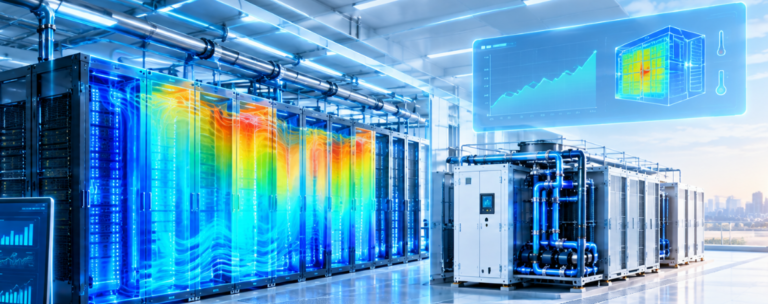
Thermal management is the single hardest problem in containerized AI infrastructure. Confined physical space limits airflow, and GPU clusters generate concentrated heat that air cooling alone struggles to dissipate. Hybrid approaches — combining rear-door heat exchangers, direct-to-chip liquid cooling, and immersion cooling — are now unlocking performance thresholds that were out of reach just two years ago.
Early adopters of liquid-cooled container solutions report 40% reductions in energy consumption compared to air-cooled equivalents, according to 24 Market Reports. A container AI data center solution with a PUE of 1.15–1.25 is competitive with the best traditional facilities, while offering deployment flexibility that no fixed building can match. For your AI roadmap, this means you can place high-density training infrastructure exactly where you need it — at a research campus, near a renewable energy source, or in a market with favorable energy pricing — without building a permanent facility.
Deploying AI Infrastructure Anywhere on Earth
The most overlooked advantage of a container AI data center solution is logistics. Standard ISO 668 containers are compatible with the entire global freight infrastructure: container ships, flatbed trucks, and cargo aircraft. A fully loaded 40-foot unit weighs 18–25 tons — within standard crane limits at any commercial port.
SOETECK demonstrates this model in practice, with containerized AI data centers deployed across Saudi Arabia, Qatar, Egypt, Nepal, Vanuatu, and France. Each unit undergoes full factory acceptance testing before leaving the facility, and remote monitoring is activated before shipment. When the container arrives at your site, an on-site commissioning team — traveling with or ahead of the unit — ensures it is operational within days.
This logistics capability matters because AI demand is not concentrated in a handful of major data center hubs. Edge AI applications — autonomous vehicles, smart manufacturing, precision agriculture, real-time language translation — require low-latency compute near the data source. A container AI data center solution lets you deploy GPU capacity in a Tier II city, a remote industrial site, or an emerging market where building a traditional data center would be economically unviable.
The Economics of Containerized AI Deployment
The financial case extends beyond deployment speed. A fully equipped 40-foot container AI data center solution typically requires an investment ranging from $500,000 to $2 million, depending on GPU configuration and cooling architecture, according to Stats Market Research. While this is a significant upfront cost, your total cost of ownership over 5–7 years compares favorably to traditional builds when you account for avoided construction delays, predictable factory-controlled quality, and the ability to relocate or repurpose the asset.
Traditional data centers tie capital to a fixed location for decades. A container AI data center solution preserves your optionality — if your AI strategy shifts, the hardware moves with it. In a field evolving as rapidly as artificial intelligence, that flexibility is worth real money.
Choosing a Container AI Data Center Solution
When evaluating providers, prioritize four criteria. First, factory acceptance testing: every unit should be fully validated under load before shipment, not assembled on-site. Second, cooling architecture: the solution must support your target rack density — 30 kW minimum for AI inference, 50 kW or higher for training workloads. Third, logistics track record: the provider should demonstrate successful deployments across multiple geographies and transport modes. Fourth, remote monitoring: the unit should be visible and manageable from the moment it leaves the factory, so your operations team has continuous insight into power, cooling, and compute health.
The container AI data center solution market is no longer a niche experiment. With deployment timelines compressed from years to weeks, cooling architectures that match AI’s thermal demands, and logistics networks that reach every continent, these modular systems are becoming the default answer to the hardest question in AI infrastructure: how do you scale compute capacity fast enough to keep up with the models you are trying to build?