

AI accelerators now push rack power past 100 kW, and a liquid cooling system data center is the only scalable way to handle that heat. Liquid-cooled facilities hit PUE between 1.02 and 1.15, while air-cooled halls stay near 1.4 to 1.6. Cooling eats up to 40% of facility power in conventional sites. Liquid cuts cooling energy by up to 90% and extends hardware life. This guide covers real costs, hidden risks, and a five-step migration plan.
What Is a Liquid Cooling System Data Center and How Does It Work?
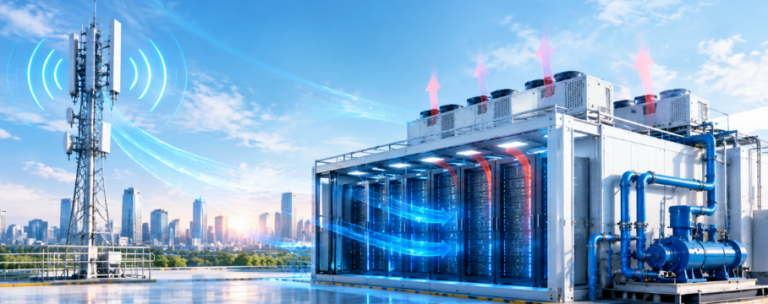
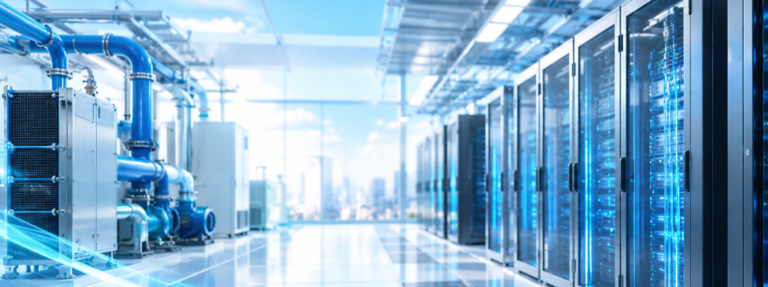
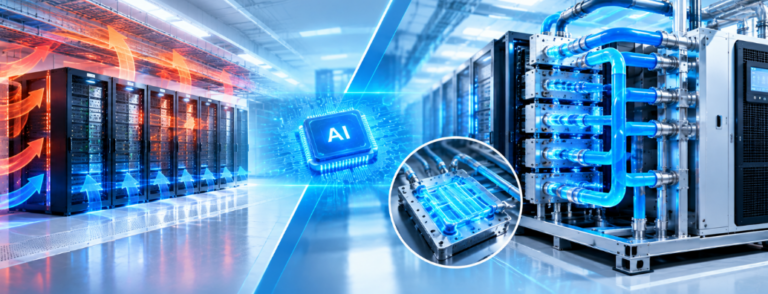
A liquid cooling system data center removes heat with water or dielectric fluid instead of chilled air. Water carries roughly 3,500 times more heat per unit volume than air, so thin pipes replace giant fan arrays. Direct-to-chip cold plates mount on processors and capture 60-80% of server heat. Coolant distribution units circulate fluid through sealed loops toward dry coolers or heat-reuse networks. Immersion tanks push density further by submerging whole servers in non-conductive fluid.
Three architectures dominate liquid cooling system data center deployments today. Direct-to-chip holds the largest commercial share at 40-45%, because it retrofits existing racks with minimal redesign. Rear-door heat exchangers intercept hot exhaust before it enters the room, a low-risk bridge for legacy halls at 20-50 kW. Immersion delivers the lowest PUE, down to 1.02, and supports racks above 200 kW, though it demands new tanks, fluids, and service skills. Choose by density, retrofit fit, and team readiness.
Why Is a Liquid Cooling System Data Center a Must-Have for AI Workloads?
Why did air cooling stop working? Chip thermal design power now exceeds 1,000W per accelerator, and a single NVIDIA GB200 NVL72 rack draws roughly 120 kW. Air cooling cannot move that heat without hurricane-force airflow. Fan power scales with the cube of fan speed, so doubling airflow costs eight times the energy. Air-cooled H100 clusters lose up to 17% of sustained training throughput to throttling. Physics, not marketing, now forces the shift toward a liquid cooling system data center.
Market data confirms the urgency. McKinsey projects AI-related data center electricity in the US could reach 11.7% of national consumption by 2030. The 2024 US Department of Energy report shows cooling consuming 38-40% of total facility load. Analysts value the global liquid cooling system data center market at roughly $4 billion in 2025, climbing to $21-27 billion by the early 2030s. Power scarcity, PUE mandates, and water limits are turning liquid from an option into a default.
Which Liquid Cooling System Data Center Technology Fits Your Density?
Air cooling remains viable below 20 kW and cheap to deploy. Rear-door heat exchangers cost less and bolt onto existing racks. Direct-to-chip balances retrofit friendliness with 50-100 kW density. Immersion wins on absolute performance but carries the highest capital cost. Most operators now run a hybrid, putting liquid on GPU pods while keeping air for general-purpose compute. The rack density profile should drive the final choice.
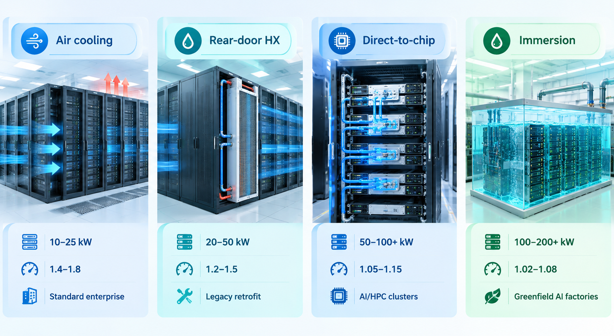
Direct-to-chip cooling captures 70-80% of server heat into the liquid loop, leaving drives, memory, and power supplies to modest fans. Immersion captures 90-95% of heat directly into dielectric fluid and removes fans entirely. Single-phase immersion is simpler to operate; two-phase offers higher heat transfer at extra cost. Coolant chemistry matters: water-glycol blends suit cold plates, while oils and engineered fluids serve tanks. Every liquid cooling system data center needs filtration, corrosion control, and leak monitoring built in.
What PUE Gains Can a Liquid Cooling System Data Center Deliver?
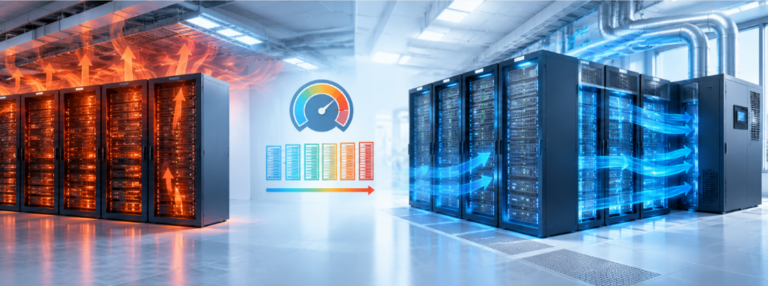
Power Usage Effectiveness divides total facility power by IT power, and the gap between methods is striking. The global average data center PUE stood at 1.58 in 2023, according to Uptime Institute. Air-cooled halls typically run 1.4 to 1.6, wasting a fifth of every watt on fans and chillers. A liquid cooling system data center with direct-to-chip plates reaches 1.05-1.15. Immersion plants report 1.02-1.08. Each 0.1 improvement on a 10 MW site saves hundreds of thousands of dollars a year.
Cooling consumes 25-40% of data center electricity, but liquid designs cut that share below 20%. Warm-water loops around 45°C reject heat through dry coolers, eliminating mechanical chillers entirely. Free cooling removes the largest parasitic load in the building. Water use falls 95-98% versus evaporative towers, easing pressure in drought-prone regions. Germany’s Energy Efficiency Act mandates PUE below 1.3 by 2027, and the EU directive pushes disclosure. A liquid cooling system data center turns regulatory pressure into an efficiency asset.
How Much Does a Liquid Cooling System Data Center Cost?
Capital cost is the biggest hesitation. Liquid builds run 20-40% higher than equivalent air-cooled projects, and retrofits cost $10,000-15,000 per rack versus $2,000-5,000 for advanced air systems. Coolant distribution units, piping, manifolds, and cold plates add up quickly. Immersion carries the highest upfront price, including dielectric fluid at $25-45 per liter. The premium narrows as density climbs, and hybrids spread cost across GPU and general-purpose zones. Budget the liquid cooling system data center build as core infrastructure.
Operating economics tip the balance. Server fans consume 10-20% of IT power under peak air-cooled loads, a cost that disappears with liquid. Analysts put payback at two to four years from energy savings, and as low as 1.6 years above 80 kW per rack with costly electricity. Higher density cuts floor space and distribution losses per compute unit. Extended hardware life adds another dividend. Over ten years, a liquid cooling system data center frequently wins on total cost of ownership.
What Risks Lurk Inside a Liquid Cooling System Data Center?
Liquid near electronics still makes operators nervous, and the risks are real. Leaks can damage servers, corrode connectors, and interrupt training jobs worth hundreds of thousands of dollars. Dielectric fluids degrade over five to eight years and need reconditioning. Immersion tanks complicate component swaps and hardware warranties. A liquid cooling system data center also lacks universal standards, so mixing vendors can create compatibility surprises. Most failures trace back to rushed installation and untrained staff rather than the technology itself.
Discipline turns those risks into manageable checklists. Install automated leak detection, dry-break connectors, and filtration from day one. Use corrosion-resistant materials matched to the coolant chemistry. Validate fluid levels, pressure, and temperature with monitoring software tied to the DCIM platform. Keep spare pumps and quick-connect fittings on site. Train facilities teams on hydraulics before go-live, and run staged pilots on non-critical nodes. With these controls, a liquid cooling system data center delivers reliability comparable to mature air-cooled halls.
How to Plan a Smooth Liquid Cooling System Data Center Transition?
Migration does not have to be a risky leap. A well-planned phased program reduces disruption dramatically, and five steps cover most successful rollouts. Start small, measure everything, and expand only after the first pods prove stable. The sequence below reflects lessons from operators who converted existing halls without ever losing uptime.
- Audit rack densities and tag workloads above 30 kW.
- Select direct-to-chip for retrofits or immersion for greenfield builds.
- Design 45°C coolant loops to maximize free cooling.
- Deploy leak detection, filtration, and monitoring early.
- Train staff and pilot on low-risk nodes before scale-out.
The checklist above turns a daunting conversion into a controlled rollout. Start with one GPU pod, measure PUE and uptime for 90 days, then expand. Rear-door heat exchangers can bridge legacy halls while new pods go liquid. Align the migration with hardware refresh cycles to avoid premature write-offs. Engage vendors early on piping, floor loading, and structural reinforcement. A well-sequenced liquid cooling system data center migration protects uptime while capturing efficiency gains.
Is a Liquid Cooling System Data Center the Right Call for Your Roadmap?
Three triggers signal readiness: rack density above 20-25 kW, AI or HPC workloads on the roadmap, and PUE or ESG targets the current plant cannot meet. Below 15 kW with stable workloads, air cooling still makes sense. In between, run hybrid designs and measure before committing. Colocation customers demand liquid-ready racks, which affects leasing decisions too. Regulatory deadlines, such as Germany’s 2027 PUE cap, can force the timeline. Test whether a liquid cooling system data center fits the strategy today.
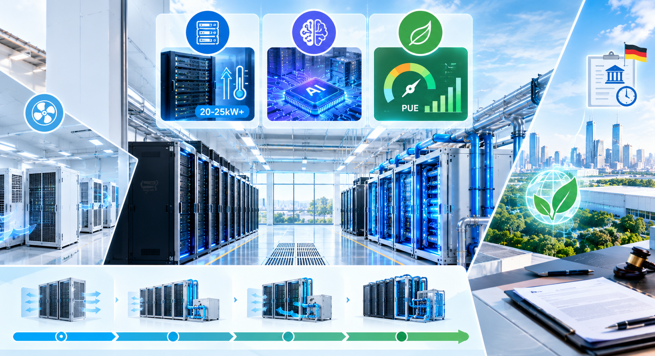
The outlook points one direction. GPU-accelerated server energy jumped from 2 TWh in 2017 to 40+ TWh in 2023, and AI server demand may reach 240-380 TWh by 2028. Rack densities will climb as Blackwell systems spread. Air cooling remains useful at the edge, but the center of gravity has moved. Operators who wait will retrofit under pressure. The strategic question for every liquid cooling system data center roadmap is when, not whether, to adopt liquid.
Conclusion: Adopt a Liquid Cooling System Data Center Before the Curve
The evidence is decisive. AI hardware has outgrown air cooling, and forecasts place the liquid cooling system data center market at $21-27 billion by the early 2030s. Cutting cooling energy by up to 90%, reaching PUE below 1.1, and doubling rack density justify the upfront premium. Water savings and waste-heat reuse add sustainability dividends. Start with audits, staged pilots, and phased deployment. Operators who act now convert thermal management from a cost center into a competitive advantage.