

A new GPU generation ships every 18 months. A traditional data center takes 36 months to build. AI training clusters now pull 50 to 250+ kilowatts per rack. Edge computing demands processing power in places where pouring a foundation isn’t an option. Hyperscale cloud providers need capacity in weeks, not years. The math hasn’t added up for a while.
That’s the gap modular data center solutions fill. Shift construction from the job site to the factory floor, and suddenly deployment timelines collapse, capital risk shrinks, and infrastructure can actually keep pace with technology.
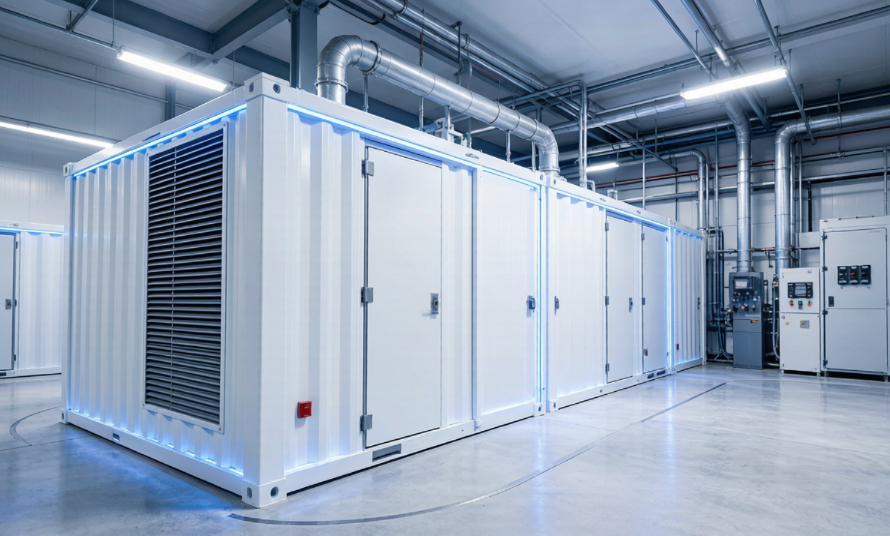
Here are the six advantages that make modular infrastructure the practical default—and increasingly, the only option where the numbers work.
Advantage 1: Deployment Speed — Months, Not Years
Speed is the reason most enterprises make the switch. When competitors are deploying in months and you’re still waiting on permits, no amount of strategic planning closes the gap.
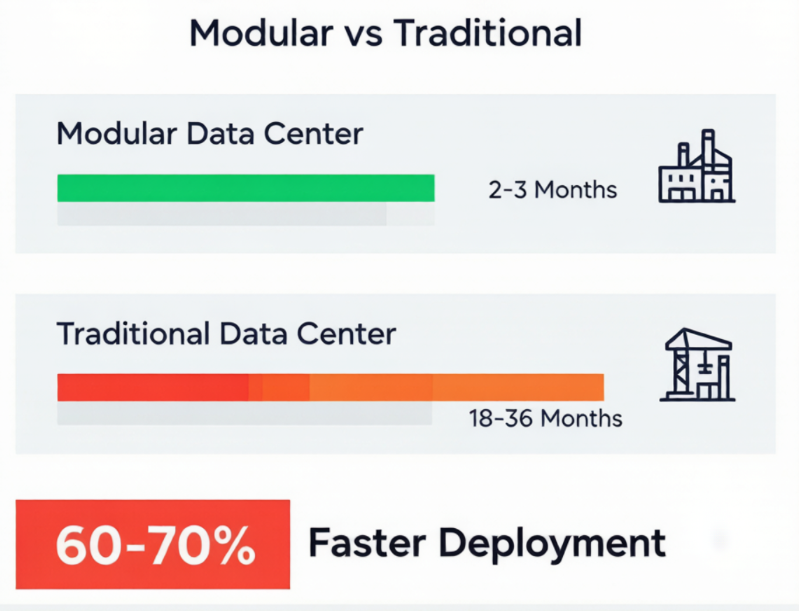
The traditional data center timeline runs 18 to 36 months from planning to commissioning. Each phase—permitting, foundation, structure, MEP, commissioning—waits for the previous one. Weather hits. Labor runs short. Supply chains hiccup. The result: 7 to 8 months in even the best-case enterprise scenario.
Modular data center solutions collapse this through parallel processing. While the site gets prepped, modules are manufactured, integrated, and tested simultaneously in a factory. Both tracks finish, the modules ship, utilities connect, and operations start. Total elapsed time: 2 to 3 months.
That’s a 60–70% reduction. The industry calls it “weeks-not-months” or “months-not-years” deployment—and the mechanics are straightforward:
- Parallel construction: Site prep and factory build happen simultaneously
- Pre-tested modules: Factory acceptance testing eliminates on-site commissioning delays
- Plug-and-play design: Standardized utility connections cut integration time
- Indoor manufacturing: No weather delays, no frozen concrete, no dust storms
For organizations rolling out edge compute across dozens of sites, this timeline decides who captures the market and who’s still waiting on concrete to cure.
Advantage 2: Scalability — Add 300 kW at a Time
Traditional data centers force a trade-off: overbuild today to cover growth you might not see for five years, or build too little and face expensive, disruptive expansions later.
Modular data centers sidestep this dilemma. Instead of betting on a five-year forecast, you add capacity in bite-sized increments—300 kW at a time, when you actually need it.
Deploy exactly the capacity your workloads demand today. Six months later, when a new AI initiative needs another 300 kW, add a third module. No demolition. No downtime. No stranded capital sitting idle and depreciating.
This pay-as-you-grow data center model rewrites the financial equation. Instead of sinking capital into capacity that sits idle for years, you spend when demand materializes. The result: better capital efficiency, lower carrying costs, and infrastructure that grows alongside the business—not years ahead of it.
The elasticity goes beyond simple linear growth:
- Seasonal scaling: Retail and e-commerce add capacity for peak shopping seasons, then scale back
- Project-based HPC: R&D teams spin up dedicated environments for specific research runs
- Geographic expansion: Identical modules, consistent configurations, any region
- Tech refresh cycles: Older modules handle lighter workloads while new modules take the dense compute
Modular data center doesn’t mean one-size-fits-all. What you standardize is the platform—power topology, cooling interface, management software. What goes inside stays flexible. One module might house GPU clusters with liquid cooling. Another runs general-purpose compute with traditional air cooling. The standardized interfaces ensure they work together without friction.
Advantage 3: Total Cost of Ownership — 30%+ Savings
Procurement teams tend to fixate on upfront cost. But the numbers that actually matter are in total cost of ownership—and they tell a different story.
| Cost Category | Traditional Build | Modular data center | Where Savings Come From |
|---|---|---|---|
| Construction | High (on-site labor, materials waste) | 30–40% lower | Factory efficiency, parallel timelines |
| Design & Engineering | Custom for every project | Amortized across deployments | Standardized, reusable platforms |
| Commissioning | 4–8 weeks on-site | Days (pre-tested at factory) | Factory acceptance testing |
| Ongoing Operations | Variable, hard to predict | Predictable, optimized | Integrated DCIM, standardized maintenance |
| Expansion | Disruptive, expensive retrofits | Incremental, plug-and-play | No downtime add-ons |
| Real Estate | Large permanent footprint | 30–50% smaller footprint | Higher density, no permanent structure |
Modular data center consistently cut total project cost by 30% or more versus equivalent traditional builds. Factor in avoided delays and fewer change orders, and some deployments report savings north of 40%.
Then there’s something traditional construction almost never delivers: a price that stays put. Factory-built modules come with fixed-price contracts and minimal change-order exposure. Weather, labor disputes, and site surprises—the three budget-killers in construction—largely disappear when 80% of the work happens indoors, on an assembly line.
For CFOs, this means budgets that hold. ROI that arrives faster. And infrastructure spending that fits inside quarterly planning instead of dominating it for years.
A growing number of providers now offer Modular Data Center as a Service (MDCaaS) models, converting upfront CapEx into operating expense. For organizations with constrained capital budgets, this opex-friendly path eliminates the single biggest barrier to infrastructure modernization.
Advantage 4: Energy Efficiency & Sustainability
Sustainability has moved from corporate virtue-signaling to a hard operational requirement. Regulations are tightening. Investors are scrutinizing ESG metrics. And energy costs are not getting cheaper.
The PUE Gap
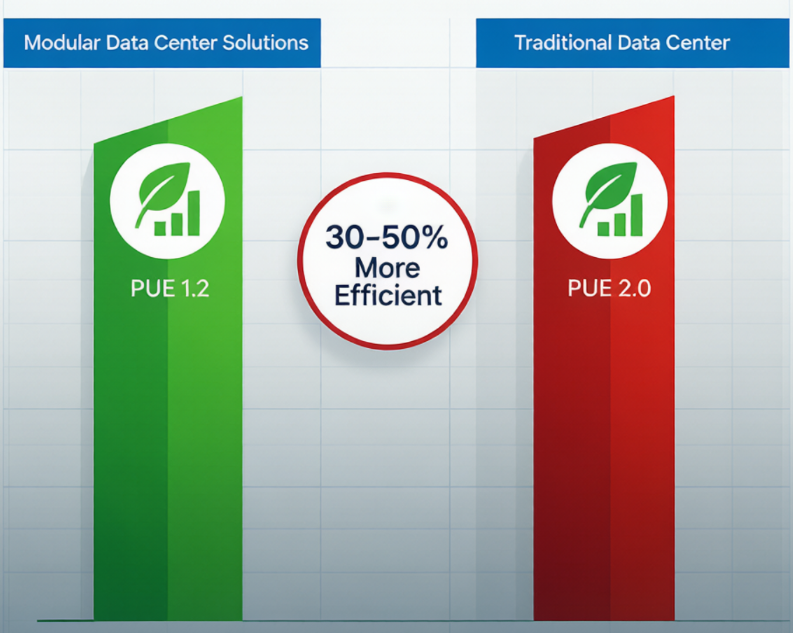
Power Usage Effectiveness (PUE)—the ratio of total facility energy to IT equipment energy—is the industry’s efficiency scorecard. A PUE of 1.0 means every watt goes to compute. A PUE of 2.0 means half the energy is wasted on cooling and overhead.
Traditional data centers typically operate at PUE of 1.8 to 2.0. Aging facilities with legacy cooling can exceed 2.5.
Factory-built modular data centers consistently hit PUE of 1.2 to 1.5. Leading designs push below 1.1.
A 30–50% reduction in non-compute energy. That’s the gap between a PUE of 2.0 and 1.2—not a rounding error.
What makes this possible?
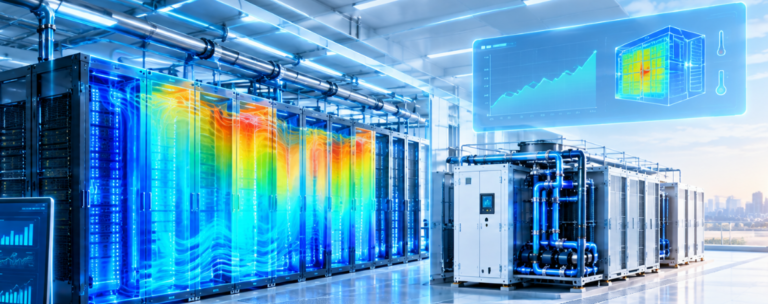
- Computationally designed airflow: Hot/cold aisle containment engineered in CAD, not improvised on-site
- Built-in high-efficiency cooling: In-row cooling, direct expansion, and chilled water systems integrated from day one
- Right-sized power infrastructure: No oversized transformers running at wasteful partial loads
- Integrated DCIM: Every module ships with monitoring that enables real-time energy optimization
I’ve walked through traditional data centers where you could feel the waste—cold air blasting into hot aisles because someone eyeballed the airflow design a decade ago and never revisited it. Modular data center designs eliminate that entire category of inefficiency at the source.
Construction Carbon: Less of It
Building a data center produces significant carbon—concrete, material transport, on-site equipment. Modular construction cuts this dramatically: 75% less construction waste through factory precision, far fewer site deliveries, and reduced concrete usage with steel-frame enclosures. One documented deployment showed a 94% reduction in NOx emissions and a 90% reduction in CO and total hydrocarbons when comparing a modular microgrid to traditional diesel-backed construction.
When environmental regulations tighten—and they will—modular facilities upgrade incrementally. Swap a cooling module. Add renewable integration. Upgrade power conditioning. No tearing down walls.
Advantage 5: Flexibility & Mobility
Data centers used to be permanent monuments—build once, use for 20 years, walk away. That model doesn’t fit how business works anymore. Workloads change. Markets shift. Mergers happen. Modular data center solutions give you infrastructure that can actually move.
Pick It Up and Go
Containerized data centers and prefabricated modules are built for transport. Business unit relocates? The data center moves with it. DR strategy evolves? Modules get repositioned. Lease expires? No need to abandon millions in infrastructure—relocate the modules.
This mobility stretches the useful life of your investment. If the business moves, the data center moves with it. Traditional buildings don’t give you that option.
From Urban Rooftops to Historic Sites
Modular data center solutions work in places where traditional construction is impossible:
- Urban infill where permanent building permits are a nightmare
- Remote edge locations—cell towers, rail junctions, offshore platforms
- Historically protected sites where you can’t touch the structure
- Temporary deployments for events, military ops, disaster response
- Brownfield industrial sites with no-build ground conditions
The Sagrada Familia basilica in Barcelona—a UNESCO World Heritage site—needed HPC for restoration work but couldn’t permit any structural alteration. A modular data center was deployed next to the site, delivering world-class capacity without disturbing a single stone. The same principle applies to any space-constrained or environmentally sensitive deployment.
The Lifecycle Nobody Talks About
There’s one flexibility advantage nobody talks about: lifecycle management. In a traditional facility, upgrading cooling or power is a major capital project with downtime and phased cutover. In a modular facility, you swap entire infrastructure modules during scheduled maintenance. A 5-year-old cooling module gets replaced with next-generation technology without touching the IT load or the other modules. Continuous modernization instead of once-per-decade disruption.
Advantage 6: AI & HPC Readiness
AI has left the hype phase and landed squarely in the data center. Training runs for large language models consume megawatts. Heat densities overwhelm conventional cooling. Inference workloads demand low-latency processing scattered across edge locations. Traditional data centers weren’t designed for any of this.
Modular infrastructure was.
Density Traditional Facilities Can’t Touch
A standard enterprise data center runs at 5–10 kW per rack. AI training clusters operate at 50–250+ kW per rack. The gap is an order of magnitude. You can’t retrofit your way across a 10x divide.
We’ve seen facilities try. Most end up with a Frankenstein’s monster of bolt-on cooling and re-cabled power distribution that nobody wants to operate, let alone scale.
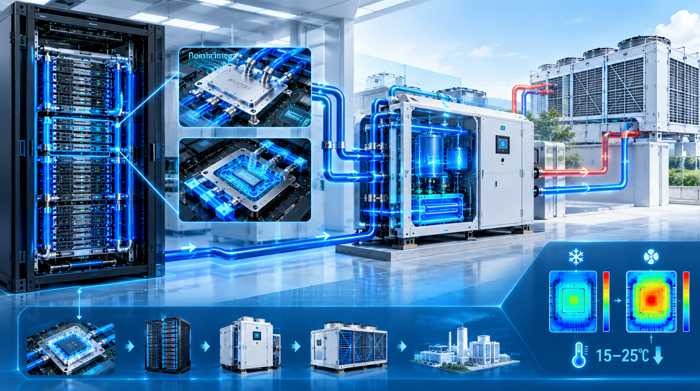
AI-ready modular infrastructure solves this from the ground up. Purpose-built modules integrate direct-to-chip liquid cooling, high-amperage power distribution for GPU-dense configurations, advanced thermal management (rear-door heat exchangers, immersion cooling), and structural engineering for the weight and vibration of dense GPU racks.
Two Platforms, Clear Separation
Leading modular data center manufacturers have split into two specialized platforms:
Training/Learning Platforms are multi-megawatt systems built for sustained, high-density compute. Liquid cooling, high-amperage power, GPU clusters running at full utilization for weeks. This is where the model gets built.
Inference Platforms are smaller, self-contained units for edge deployment. Low-latency AI processing where data is generated—factories, retail, healthcare, autonomous vehicle test tracks. Rapid deployment, minimal site requirements, reliable in non-data-center environments. This is where the model does the work.
Edge AI: Where Inference Hits the Real World
As AI moves from centralized training to distributed inference, the infrastructure math explodes. Autonomous vehicles need compute at the test track. Smart factories need AI on the plant floor. Healthcare needs local inference for medical imaging—data can’t leave the building.
Deploying traditional data centers at each of these locations is economically impossible. Modular data centers make it practical—a single standardized edge module, replicated across a hundred locations, with identical configuration and management.
Modular vs Traditional: The Side-by-Side
| Dimension | Traditional Data Center | Modular Data Center Solution |
|---|---|---|
| Deployment Timeline | 18–36 months | 2–3 months |
| Capital Outlay | Large upfront, fixed | Incremental, pay-as-you-grow |
| Scalability | Difficult, disruptive expansion | Seamless module addition |
| Energy Efficiency (PUE) | 1.8–2.5 | 1.2–1.5 (sub-1.1 achievable) |
| Construction Waste | High (on-site) | 75% less (factory precision) |
| Cost Predictability | Low (change orders, delays) | High (fixed-price factory build) |
| Mobility | Fixed, permanent | Relocatable, transportable |
| Power Density Support | 5–10 kW/rack typical | 50–250+ kW/rack with liquid cooling |
| Site Flexibility | Requires permanent foundation | Minimal site prep, no permanent structure |
| Technology Refresh | Major capital project | Module-level swap during maintenance |
| TCO (vs equivalent MW) | Baseline | 30–40% lower |
The comparison makes the case plainly. Modular solutions have moved from niche to default for a reason: every dimension—speed, cost, efficiency, flexibility—tilts in their favor. The harder question at this point isn’t whether to go modular. It’s what you lose by waiting.
I’m not saying traditional data centers are dead. But for new capacity, the comparison is starting to feel like evaluating a flip phone against a smartphone.