

You keep hearing about AI compute demands. But the real bottleneck isn’t the GPU—it’s the infrastructure surrounding it. AI training clusters require rack densities far exceeding what traditional air‑cooled data centers can support, often ranging from 50 kW to over 150 kW per rack. This is where a new class of infrastructure steps in: Container AIDC (Artificial Intelligence Data Center) —a prefabricated, modular data center engineered specifically for AI workloads.
What Is a Container AIDC? Definition and Core Concept
A Container AIDC is not a traditional data center. Unlike conventional facilities designed around “store and run” principles, an AI Data Center is built around data itself—focused on “use well and control well” rather than simply “store and run”. Think of it as an intelligent logistics hub where every piece of data is cleaned, labeled, and indexed the moment it arrives, ready for immediate use by AI models.
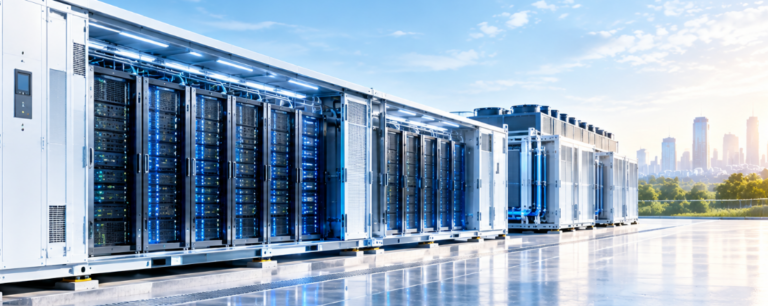
Housed inside standard ISO shipping containers, every functional subsystem—IT compute, power distribution, cooling, networking, and management—is factory‑assembled, pre‑tested, and shipped as an integrated unit. Upon delivery, you simply place it on a prepared concrete pad, connect external power and fiber, and power it up.
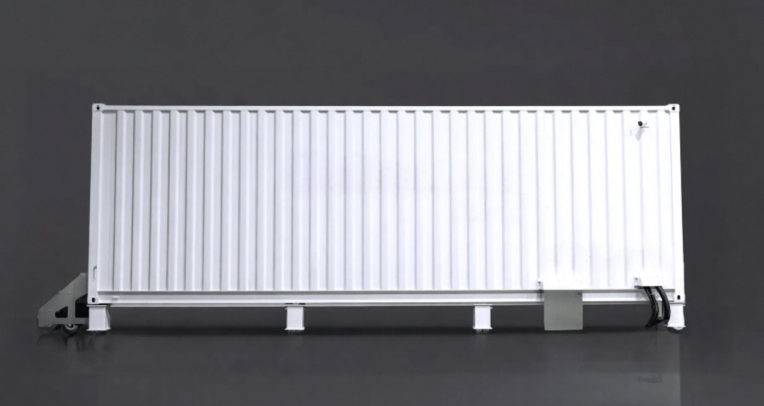
The “Factory‑to‑Field” Delivery Model
From Lego Blocks to Data Center: How the Architecture Works
You don’t build a Container AIDC—you assemble it. Each container functions as an independent building block, factory‑prefabricated for standardized transport and on‑site interconnection. The architecture follows a top‑down, system‑of‑systems design.
Layered Architecture: From Container to Cluster
Container‑Level Integration: Each 20ft or 40ft ISO container encloses a complete, operational subset of the data center. Your IT compute nodes, high‑speed networking fabric, power distribution units (PDUs), uninterruptible power supplies (UPS), battery cabinets, cooling distribution units (CDUs), and management controllers all reside inside the same sealed, climate‑controlled enclosure.
Module‑to‑Module Interconnection: Containers aren’t isolated. Pre‑routed power busways, fiber trunks, and liquid cooling manifolds equipped with blind‑mate couplers allow you to connect adjacent containers into a single logical cluster. This plug‑and‑play interconnect eliminates field cabling and plumbing, reducing deployment time to weeks.
Cluster Scaling: Need more compute? Add another container in parallel. Need to move? Unplug, lift onto a flatbed, and redeploy. This true modularity gives you a “pay‑as‑you‑grow” model, avoiding the over‑provisioning typical of traditional builds.
Functional Modules Within a Container
Each container AIDC is subdivided into purpose‑built functional modules, factory‑integrated and field‑interchangeable:
- IT Module – Racks of GPU/XPU servers (e.g., NVIDIA HGX), plus top‑of‑rack (ToR) switches and storage nodes.
- Power Module – High‑density UPS, lithium battery cabinets, and distribution panels. For ultra‑high density, manufacturers like Huawei offer single‑box 3.2MW Power PODs supporting 3.2 MW in a single shipping container.
- Cooling Module – Liquid cooling systems ranging from direct‑to‑chip cold plates to full immersion tanks.
- Network Module – High‑bandwidth spine/leaf switches with integrated optical transceivers.
- Management Module – DCIM controllers with remote monitoring, predictive maintenance, and AI‑driven optimization.
Breaking Down the Components of a Container AIDC
Now let’s open the container door and look inside.
High‑Density Compute Enclosure (The “Brain”)
The compute enclosure houses your AI processing power. Racks inside a container AIDC are configured for 60–100 kW per rack, with each rack capable of holding multiple 4U GPU servers or 2U XPU nodes. Traditional open‑frame racks with rear‑door fans won’t work here; instead, sealed chassis with front‑to‑rear airflow blocked and cold plates mounted directly to processors enable the extreme densities required for AI training and inference.
Power Distribution Unit (The “Heart”)
Because power density defines AI infrastructure, the entire electrical chain is engineered for high current at high efficiency. Starting from the utility feed, a container AIDC typically integrates:
- Medium‑voltage transformer skid (if external utility is MV).
- Low‑voltage main switchboard with automatic transfer switch (ATS) for generator failover.
- Modular UPS – For a 1 MW cluster, you might see dual 600 kVA UPS modules in parallel. Modern UPS designs achieve 99.1% efficiency in S‑ECO mode, drastically reducing energy loss.
- Lithium‑ion battery cabinets – Energy density 4× lead‑acid, lifespan 15+ years, with cloud‑based BMS for cell‑level monitoring and thermal runaway detection.
- Power distribution units (PDUs) – Intelligent PDUs per rack report per‑outlet kW, voltage, current, and power factor in real time.
Liquid Cooling System (The “Lungs”)
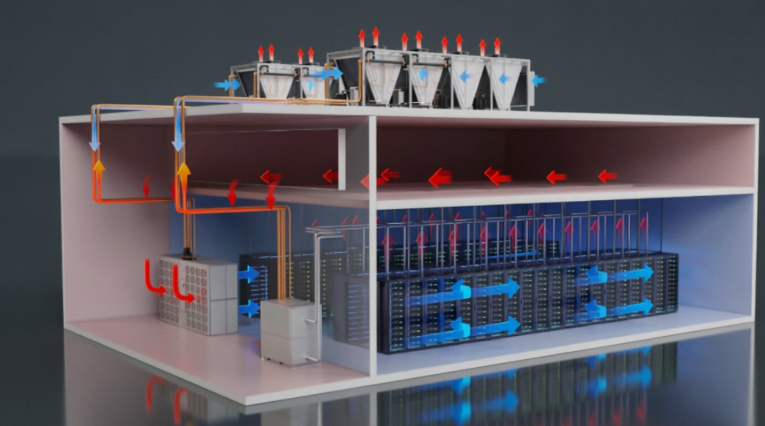
This is the most critical differentiator from conventional data centers. Air cooling caps out at 15–20 kW per rack; modern AI GPUs demand 50–150 kW. Liquid cooling is the mandatory answer.
Container AIDCs support multiple liquid cooling topologies:
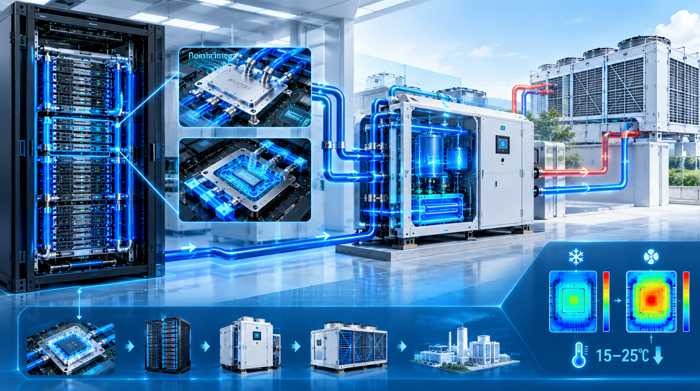
- Direct‑to‑chip (cold plate) – Coolant circulates through micro‑channels on a cold plate mounted directly to the processor die, removing 500–2000 W per chip. This is the mainstream choice for high‑density GPU clusters.
- Immersion cooling (single‑phase or two‑phase) – Entire servers are submerged in dielectric fluid. The fluid absorbs heat and circulates through an external heat exchanger. This approach eliminates fans entirely, enabling PUE as low as 1.05.
Both methods share the same closed‑loop architecture: a primary cooling distribution unit (CDU) circulates coolant through the racks, rejecting heat to an outdoor dry cooler, cooling tower, or facility chilled water system.
Environmental and Fire Suppression
Industrial‑grade seal ratings (IP55 or higher) ensure dust, salt, and humidity don’t intrude. Fire suppression uses pre‑action dry pipe or clean agent systems (Novec 1230 or FM‑200), with heat and smoke detectors in every sub‑compartment. Liquid immersion containers have the unique advantage of being fire‑suppressed by the dielectric fluid itself—no added chemical system required.
Smart Management and Observability
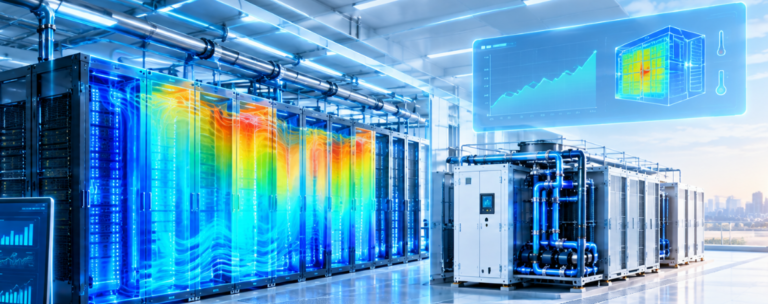
A container AIDC is not a “dumb box”—it’s a fully instrumented, AI‑managed facility. An embedded Data Center Infrastructure Management (DCIM) gateway aggregates sensor data from thousands of points: per‑GPU temperature, coolant flow rates, UPS load, PDU branch current, leak detection, door contacts, and more. From this data, AI algorithms run predictive analytics—alerting you to a failing UPS fan before it trips or rebalancing compute load to avoid thermal hotspots.
How a Container AIDC Is Deployed
Deploying a container AIDC follows a predictable, accelerated workflow enabled by factory prefabrication and parallel construction.
Step 1 – Site Preparation (Parallel to Factory Build). A level concrete pad or asphalt lot is prepared with utility stub‑ups: medium‑voltage or high‑voltage power feeders, fiber conduits, and water supply/drain lines (if using evaporative cooling). Because the containers will be craned into place, no building structure or overhead crane system is required.
Step 2 – Factory Integration and Testing. While site prep is underway, the manufacturer assembles each container in a controlled factory environment. IT racks are populated, cables are dressed, UPS batteries are installed and charged, coolant loops are filled and pressure‑tested, and full system integration tests run for 72+ hours.
Step 3 – Transport and On‑Site Placement. Completed containers are loaded onto flatbed trucks and delivered. A mobile crane lifts each container onto the prepared pad, stacking them side‑by‑side or up to four layers high for space‑constrained sites.
Step 4 – Interconnection and Burn‑In. Containers are mechanically bolted together. Pre‑routed power busways and fiber trunks are coupled, and liquid cooling manifolds are connected via blind‑mate couplings. The integrated DCIM gateway is powered up for remote monitoring, and a 48‑hour burn‑in test runs all subsystems under simulated load.
Total timeline from order to operation: 4–6 months for greenfield deployment, or as little as 15 days for cluster expansion within an existing AIDC footprint.
Factory Prefabrication: The Secret Behind Fast Delivery
Traditional data center construction is sequential: dig foundation, erect steel, pour floors, install electrical, install mechanical, bring in IT gear. Any delay cascades through the entire schedule. Container AIDC flips this model on its head.
Everything happens in parallel:
- Civil works prepares the pad at the customer site.
- The factory builds the containers.
- The supplier tests the integrated system.
Because the containers are built to standard ISO dimensions and interface specifications, they can be transported by any flatbed truck, railcar, or cargo ship. On‑site interconnection uses standardized busways, fiber trunks, and liquid manifolds with blind‑mate couplers—plug in, no field fabrication required.
This modular assembly dramatically compresses delivery: projects can be operational in less than half the time of traditional builds. Leading providers like Huawei have globally delivered over 130 AIDC projects using this methodology.
Container AIDC vs Traditional Data Center: A Feature Breakdown
The Productized Container Portfolio
Container AIDC providers offer a tiered product line to match different deployment scales. The table below illustrates a typical portfolio structure.
Each series ships as a fully integrated, pre‑tested unit—just connect external utilities and deploy. This productized approach turns AI data center capacity into a catalog item, ordered like enterprise IT equipment rather than custom‑engineered real estate.
Ready for Your AI Future
Container AIDC solutions fundamentally redefine what an AI data center can be: factory‑precise, liquid‑cooled, modularly scalable, and deployable in months rather than years. At SOETECK, the AICoolit™ containerized liquid cooling platform is engineered to deliver extreme density—up to 100 kW per rack, PUE as low as 1.15, from 200 kW edge pods to 1 MW supercomputing clusters. No construction delays. No power density ceilings. Just AI infrastructure that deploys as fast as your models train.