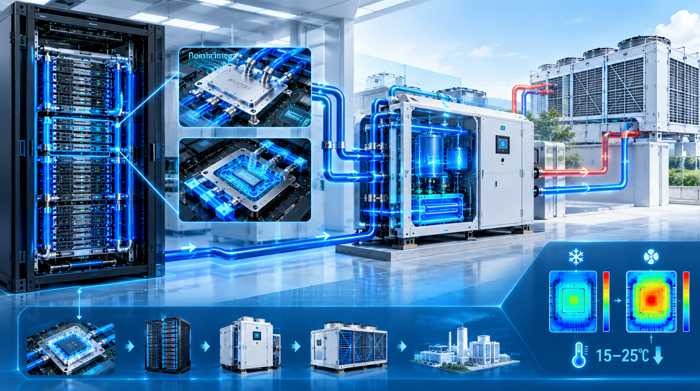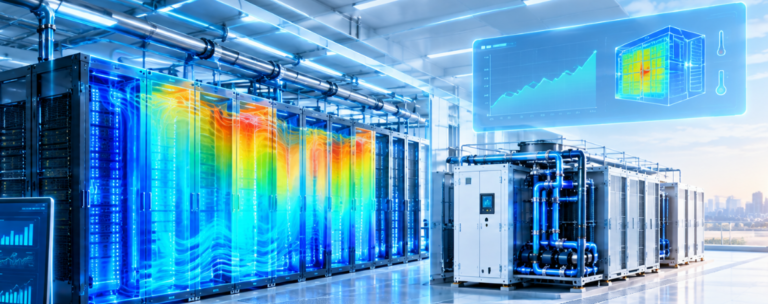



Data center Precision cooling is a thermal management approach built specifically for the unique heat profile of servers, storage, and networking gear — not for human occupancy. While a conventional office AC unit focuses on cooling air to a level comfortable for people, precision cooling is purpose-built for electronics that run continuously, generating high-density heat loads that require exacting environmental control.
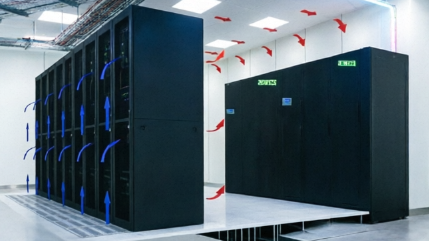
Traditional CRAC-centric designs rely on an indirect paradigm: CRAC units cool the entire room, and your servers pull air from that shared volume. Cold-aisle/hot-aisle containment, raised-floor delivery, multi-unit layouts — this architecture uses “space” as the thermal medium. At 5–15 kW per rack, this approach worked effectively for you. However, with 40–120 kW AI racks, the physics breaks down.
As your rack density increases, the cooling-to-IT power ratio deteriorates non-linearly. At 40–80 kW densities, the ratio can reach 0.55–0.80, pushing your PUE past 1.60–1.85. Direct-convection precision cooling avoids this problem by delivering cold air exactly where your components generate heat and removing hot air before it disperses. Because the air is never mixed with the whole room, thermodynamic irreversibility stays near its physical minimum — and your efficiency stays high.
Why PUE Matters More Than Ever for Your AI Workloads
PUE is the universal metric for your data center’s energy efficiency, defined as the ratio of total facility energy consumption to IT equipment energy consumption — with an ideal PUE approaching 1.0.
Cooling alone can account for 30–40% of your data center’s total electricity consumption, according to the U.S. National Renewable Energy Laboratory. With data centers currently consuming approximately 415 TWh of electricity annually — roughly 1.5% of global demand — and projections reaching 945 TWh by 2030 due to the growing needs of high-performance AI, improving your cooling efficiency through precision technologies has become an operational imperative for you.
In 2026, industry leaders are converging on three shared requirements that you should also target: stable delivery of PUE in the low 1.2 range, at least 30% cooling-power savings under field-guaranteed SLAs, and structural stability to host high-density AI racks. Meanwhile, hyperscale operators such as Google have reported trailing-twelve-month PUE as low as 1.09 across their global fleets, demonstrating that best-in-class levels are achievable even as AI drives rack densities upward.
The financial impact on your bottom line is substantial. Suppose your facility has a 500 kW IT load operating at PUE 1.80 — your total consumption is 900 kW. Improving to PUE 1.30 reduces your total consumption to 650 kW, a saving of 250 kW. At your commercial electricity rate, running 8,760 hours per year, that saving can exceed half a million currency units annually, with the capital cost of cooling upgrades typically recovered within 18 to 36 months.
Data Center Precision Cooling PUE Benchmarks
Precision cooling technologies span a spectrum of architectures, each offering distinctly different PUE outcomes. Here are the industry benchmarks you can use to evaluate your options:
| Cooling Approach | Achievable PUE Range | Key Characteristics for Your Consideration |
|---|---|---|
| Legacy CRAC (Computer Room Air Conditioner) | 1.80–2.20 | High cooling overhead, poor efficiency — avoid if possible |
| Modern CRAC | 1.50–1.70 | Industry average air-cooled baseline |
| CRAH + Chiller (Computer Room Air Handler) | 1.30–1.50 | Good efficiency, suitable for larger facilities |
| In-Row + Free Cooling | 1.20–1.35 | Efficient, scalable design for your growth |
| RDHx (Rear-Door Heat Exchanger) | 1.10–1.30 | Rack-level heat removal, reduces your room burden |
| Direct-to-Chip Liquid Cooling | 1.03–1.10 | Near-theoretical maximum efficiency for high-density loads |
Air Cooling PUE Limitations You Need to Know
If your current rack densities are in the conventional range of 5–15 kW per rack, air cooling remains viable and cost-effective. But as your densities increase for HPC and AI GPU workloads, air cooling reaches physical and acoustic limits. A typical air-cooled facility operates at an industry average PUE of approximately 1.55 — meaning you are likely leaving efficiency on the table.
The fundamental limitation is thermodynamic: air has a thermal conductivity of only approximately 0.026 W/(m·K), creating significant temperature gradients between your chips and heat sinks. Once your per-rack power density exceeds 15 kW, air cooling struggles to maintain chip junction temperatures within safe limits.
Liquid Cooling PUE Breakthroughs for Your High-Density Future
Liquid cooling fundamentally changes the efficiency equation for you. Whereas an air-cooled data center may require approximately 1 watt of cooling for every 1 watt of computing power, liquid cooling can support roughly 10 watts of computing with 1 watt of cooling. In PUE terms, air cooling typically achieves approximately 1.5, while advanced liquid cooling can drive your PUE down to 1.1, 1.04, or lower.
Precision liquid cooling delivers even more dramatic results for your facility. One benchmark study evaluating 16 HPE ProLiant DL380 servers found that precision cooling not only improved server performance by approximately 4% at elevated temperatures but also reduced rack-level IT power by 1 kW — representing 5% IT energy savings. In the air-cooled scenario, total rack power reached 27.4 kW (19.6 kW server + 7.8 kW cooling). Precision liquid cooling, by removing server fans and reducing cooling infrastructure demand, brought total rack power down to 19.3 kW — more than 8 kW less per rack, representing estimated 30% total energy savings for you.

Partial PUE (pPUE) values for advanced liquid cooling solutions can reach 1.03 or lower, meaning that for every 100 watts of your IT power, only 3 watts are consumed by the cooling system.
You Can Apply to Your Existing Data Center
Not every facility can immediately transition to liquid cooling. However, you can achieve meaningful PUE improvements in your existing air-cooled data center through precision retrofitting strategies.
Airflow Management Optimization You Can Start Today
Airflow optimization is the most accessible precision cooling upgrade for you. By implementing hot-aisle and cold-aisle containment, sealing cable cutouts, installing blanking panels, and adjusting your supply air temperatures, you can reduce cooling energy without capital-intensive equipment changes. One facility achieved a PUE reduction from 1.4 to 1.3 by implementing automated adjustments to free air cooling settings — a seasonal change sustained for over 12 months. You can replicate this approach.
Supply Temperature Optimization for Immediate Savings
Traditional data centers often operate chilled water temperatures at unnecessarily low set points (7°C or below). If you raise your chilled water supply temperature from 7°C to 15°C, you can reduce your chiller energy consumption by approximately 18%, directly improving your PUE. Every 1°C increase in your chilled water temperature typically yields 2–3% chiller energy savings.
Free Cooling Integration — Leverage Your Local Climate
free cooling use lower outside air temperatures to cool your facility without operating energy-intensive compressors. If you implement economization, you often improve PUE by 0.1 to 0.2 points. In cooler climates, extended use of free cooling can help you achieve significantly lower PUE values, while operations in warmer regions require you to invest more heavily in mechanical cooling efficiency improvements.
Hybrid Cooling Strategies as a Stepping Stone
For facilities like yours transitioning toward liquid cooling, hybrid strategies offer a practical intermediate step. One study of a dual-loop active-passive cooling system — combining vapor compression with gravity heat pipes — achieved an annual average PUE of 1.27, with winter PUE as low as 1.23, significantly outperforming traditional air conditioning systems. You can consider a similar approach.
Choosing the Right Precision Cooling System
Your selection of a precision cooling system is no longer primarily a technology preference — it is driven by your rack density. Understanding where your facility sits on the density spectrum and where it is heading is the first decision in your cooling strategy review.
| Your Rack Density | Recommended Cooling Approach for You | Expected PUE You Can Achieve |
|---|---|---|
| 5–15 kW/rack | Air cooling with containment | 1.40–1.55 |
| 15–30 kW/rack | In-row cooling, RDHx | 1.20–1.40 |
| 30–80 kW/rack | Direct-to-chip liquid cooling, hybrid | 1.10–1.20 |
| 80–120+ kW/rack | Immersion cooling, two-phase DTC | 1.03–1.10 |
Key Selection Criteria You Should Weigh
Your rack density remains the primary driver. If your maximum rack density is 15 kW or below, modern precision air cooling with containment will likely meet your needs. At densities between 15 kW and 30 kW, in-row cooling or rear-door heat exchangers become attractive. At 30–80 kW, direct-to-chip liquid cooling is strongly recommended for you. Above 80 kW per rack, immersion cooling or two-phase DTC is a practical necessity.
Your facility age matters. For new builds, you can design from the ground up for liquid cooling architectures, achieving optimal PUE outcomes. For retrofits, you need to carefully consider existing infrastructure, but DTC cooling can be deployed in retrofitted facilities without major structural changes.
Your climate conditions influence the feasibility and ROI of free cooling integration. If you are in a cooler climate, you can achieve lower PUE through extended economizer operation. If you are in a warmer region, you should depend more heavily on mechanical cooling efficiency and may benefit most from liquid cooling architectures.
Your water availability is increasingly a constraint. Traditional evaporative cooling consumes substantial water — large sites can consume up to 5 million gallons per day. Leading facilities like yours are implementing closed-loop systems and alternative cooling technologies that reduce water consumption by up to 90%.
The Future of Data Center Precision Cooling
Data center precision cooling has evolved from a facility management consideration to a strategic differentiator for you in the AI era. The PUE value delivered by precision cooling systems directly translates to your operational expense reduction, regulatory compliance, and competitive advantage.
The trajectory is clear for you: industry standard PUE targets below 1.2 are becoming baseline expectations for new facilities, with leading operators achieving 1.1 or better through liquid cooling and AI-driven optimization. The global shift away from air-only cooling toward hybrid and full-liquid architectures is accelerating, driven by rack densities that legacy CRAC systems simply cannot support for you.