

Port Vila runs 26°C at 70% to 83% relative humidity, which puts the ambient dew point near 22.3°C. ASHRAE’s 2021 recommended envelope stops at a 15°C dew point. That 7 K gap shaped the container data center solutions shipped to Vanuatu far more than any capacity figure in the enquiry, and working through it produced seven lessons worth carrying to the next island site.
Why the Dew Point Picks the Topology in Container Data Center Solutions
Vanuatu’s annual mean humidity runs 70% to 83%, and the wet season from November to April pushes higher. Port Vila records roughly 2,338 mm of rain across 153 wet days. ASHRAE caps recommended relative humidity at 70%, dropping to 50% where corrosion coupons show gaseous contamination, and a coral coast carrying salt aerosol qualifies on both counts.
The arithmetic that matters takes ten minutes. Plot the annual mean dry bulb against the annual mean relative humidity on a psychrometric chart rather than reading the two numbers separately. At 26°C and 80% the intersection sits far above the 15°C dew point line, and no supply air volume moves it. If your specification quotes a dry-bulb setpoint alone, it has skipped the figure that decides everything downstream.
The first consequence is that 7/12°C chilled water cannot enter the building. It would condense on the coil, the pipe insulation, the valve bodies and the floor within minutes of commissioning. ASHRAE’s liquid-cooling guidance requires facility water to sit at least 2 K above the room dew point, which at 22.3°C puts the minimum supply temperature at 24.3°C. Both figures are unusable, and most of the plant catalogue goes with them.
What survives is direct-expansion cooling, where the coil runs above the internal dew point of a sealed box. That is why these container data center solutions ship with DX air-cooled in-row units — SOETECK builds them from 5.6 kW to 90.1 kW — rather than a chilled-water coil lifted from a temperate catalogue and re-rated on the drawing. The trade is that DX capacity per unit is bounded by compressor and coil size inside one enclosure, so the practical ceiling on a 20ft platform lands near 54 kW across nine racks. Anyone sizing container data center solutions for the tropics should treat that figure as physics, not as a vendor limit.
What Sealing the Box Teaches About Container Data Center Solutions
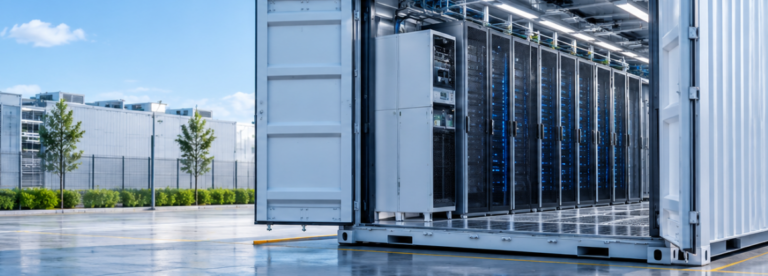
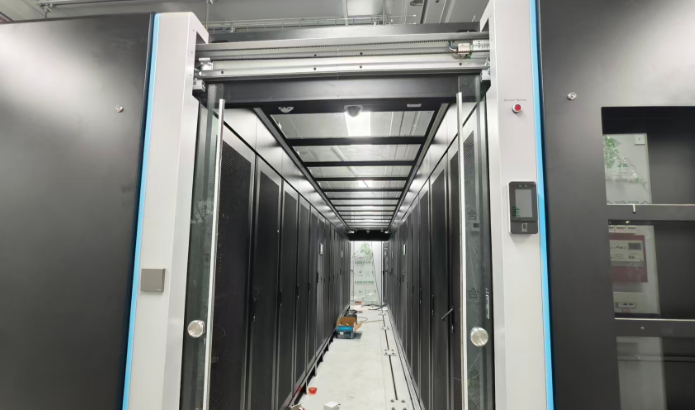
Once outside air is excluded, the problem turns closed-loop. The enclosure seals to IP55 or IP65, the coil carries sensible load only, and humidity control stops being a room-level function and becomes a property of the box. The humidifier, the enthalpy control and the mixing box all leave the design, and their failure modes leave with them. For container data center solutions, that is the largest single simplification available in a tropical climate.
The arithmetic is worth doing once on paper. A sealed 20ft unit carrying 54 kW with a 12 K rise returns air near 34°C. In a closed loop the internal dew point settles wherever the coil holds it, so a 24°C apparatus dew point stays dry — but only while the envelope holds. Open the door for an hour in February, admit 26°C at 80%, and the coil surface sits 1.7 K from ambient dew point.
That margin is why container data center solutions in the tropics specify door gaskets and cable-entry seals as thermal components rather than as weatherproofing. Every penetration is a path for moisture-laden air to reach a cold surface, and a sealed aisle only works if the seal runs continuously around doors, cable trays and condensate lines alike. A gap of a few millimetres at the bottom of a door is not a draught but a humid-air injection point aimed at the coil.
The condensate side deserves the same attention and rarely gets it. Every unit in a sealed enclosure produces water, and the drain runs to a pump and a line out through the wall. On a site where the box is the whole building, a blocked drain is a water path to the battery cabinet rather than a nuisance on a plant room floor.
Salt Settles the Coating Class Before Anyone Argues Rack Count
C5-M is the ISO 12944 class for coastal sites within 5 km of the shore, and it applies to both of Vanuatu’s national data center locations, on Efate and Santo. Verification runs to ISO 9227 neutral salt spray at a 720-hour minimum with 1,440 hours recommended, plus a scribe-creep limit of 2 mm and a 15-year coating service life. A coating bought on unit price rather than class tends to reappear as a line item in year two.
Marine corrosion rates run 5 to 10 times inland values, and airborne chloride ignores the fact that a cabinet passed a factory inspection. It settles on condenser fins, door seals and every fastener, and it begins with condensation forming on cold surfaces night after night rather than with visible spray. SOETECK builds to C5-M with anti-corrosion paint and heavier welded frame profiles for maritime work, and the fastener schedule is fixed at the steel yard, months before a container data center solutions procurement visit. The Telecom Fiji deployment is the clearest reference: C5-M units restored cooling at coastal stations whose pre-existing coils, supplied before the site was re-specified, had already been eaten by salt air.
Two details separate a C5-M specification from a paint order. The first is substrate preparation, because a coating reaches its rated life only on steel blasted to Sa 2.5 with a 40 to 70 μm profile. The second is the fastener schedule: bolts, hinges, gland plates and cable entries are where dissimilar metals meet, and a stainless bolt against a mild-steel frame corrodes faster than either metal alone.
The Build Sequence Decides What Can Still Be Tested
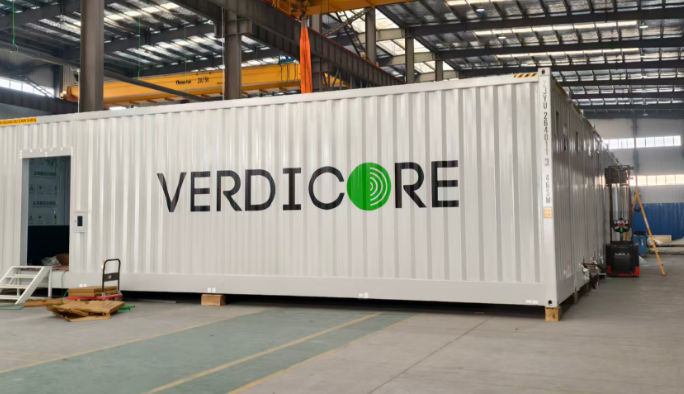
Frame assembly, precision AC installation, then internal wiring — in that order, photographed on SOETECK’s Hefei line before the box closes. Wiring pulled after the in-row units are set has to route around refrigerant lines and condensate drains, and in a 20ft footprint the clearance for that routing is measured in centimetres. Sequencing the loom first removes any reason for it to cross a drain pan, and that is the kind of ordering decision a container data center solutions buyer only sees the value of when the drawings are still open.
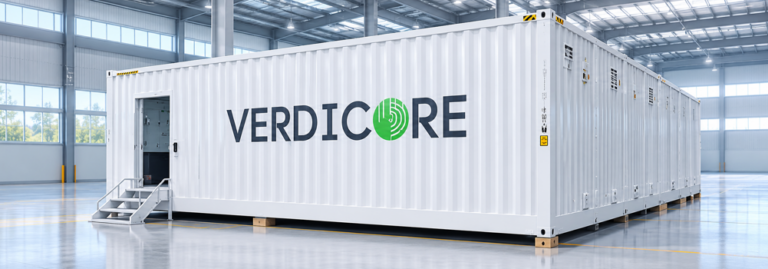
A unit leaves the line with nine rack positions, up to 54 kW of IT capacity at 6 kW per rack, a 90 kVA modular UPS at N+1, in-row cooling, fire suppression and a monitoring system already polling itself. Everything testable at 30°C in Hefei gets tested there, because the first time the unit meets 26°C at 83% RH should not also be the first time anyone confirms the condensate pump runs. That single rule is what makes tropical container data center solutions predictable.
Factory acceptance testing is where that discipline is proven. A full-load run at the project’s setpoint, witnessed by the client, confirms the coil margin and the compressor behaviour before the box is sealed for freight. For container data center solutions bound for the tropics, testing at the 34°C return the sealed box will actually produce is the run that predicts the first wet season.
The distinction is not academic. A unit proven at 24°C return has met a rating, while a unit proven at 34°C return has met the load, and the second test reproduces what a container data center solutions enclosure will see in service. Buyers comparing quotations rarely ask which of the two the FAT certificate documents.
Freight Is the Long Pole and Commissioning Is the Short One
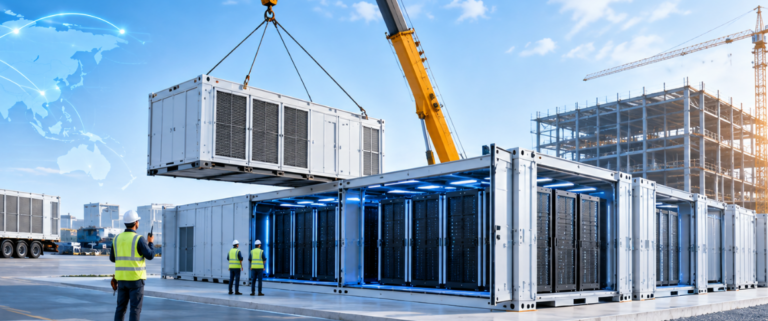
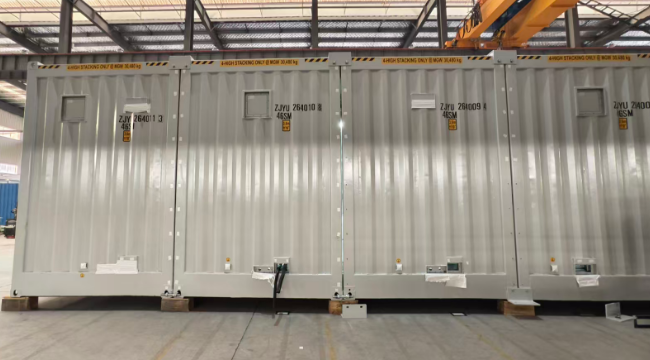
Delivery to Port Vila means a direct vessel or transshipment through Fiji or New Caledonia, then clearance on an island where the last mile may be a barge. The 8–12 week window in the datasheet covers production and FAT. It does not cover a cyclone holding a ship at anchor between December and March, which is why the sensible ordering window for an island site closes around September — a scheduling rule that applies to container data center solutions in every cyclone belt, not just this one.
The asymmetry is worth planning around, because commissioning a pre-integrated unit takes days: connect power, network and condensate, verify the coil, confirm the monitoring link. Everything else in the schedule is water, paperwork and weather. That imbalance is the most useful planning lesson from the project — weeks go into steel, coating and test while only days go into the site, and moving the engineering earlier separates container data center solutions that commission cleanly from those that commission twice.
Spares are the second half of that problem for container data center solutions. A condensate pump on Efate is not a next-day delivery, so the recommended kit for a Pacific site runs heavier than for a European one: a pump, a controller, filter media, door gaskets and a set of C5-rated fasteners. That kit costs a fraction of one unscheduled vessel booking.
Autonomy Is Sized Against the Local Outage Record
Vanuatu’s two national facilities have run on diesel generators reported at 1.2 million litres a year, and Cyclone Rey in 2022 left the main island without power for 47 hours. A UPS autonomy figure chosen against a European outage profile is the wrong instrument for that history, because fifteen minutes covers a generator start rather than a distribution repair.
This is where container data center solutions diverge from a brick hall. The UPS, the generator interface and the fuel plan behave as one system, and on an island the fuel plan carries a shipping lead time of its own. Sizing autonomy for container data center solutions without that constraint produces a number that looks adequate in a spreadsheet and short in the second week of a cyclone recovery.
A Local Partner Answers What Container Data Center Solutions Cannot Ship
The agreement signed at the Hefei headquarters pairs a Vanuatu partner holding local satellite and subsea cable channels with a manufacturer supplying customised equipment and efficiency engineering. That split suits the Pacific. ICN1 and ICN2 have connected the country since 2021 at roughly 60 ms to Australia, while the outer islands still depend on satellite links — a connectivity picture no single vendor serves alone, and one that changes what container data center solutions must deliver at each site class.
Maintenance is the constraint that makes the pairing structural rather than commercial. A service contract cannot be staffed across 83 islands from a factory, and a C5-M enclosure with a witnessed full-load test cannot be produced by a partner working from an office in Port Vila. One side holds the reach, the other holds the build, and the container data center solutions handover only closes when both are present at the same site on the same day.
What the Vanuatu project produced is an ordering of decisions rather than a market story. Dew point first, then coating class, then cooling topology, then capacity. Container data center solutions specified in that sequence arrive ordinary and stay ordinary; specified in the reverse sequence, they arrive looking correct and meet the wet season anyway.