


Four precision cooling families sit in one catalogue and quote capacity in the same unit, which is where the trouble starts. A data center temperature control decision that opens by comparing those kW figures is comparing numbers measured at four different return air temperatures, none of which match the air the unit will actually see. Sensible capacity at the real return condition is what decides a selection, and that figure can land 20% to 38% below the nameplate.
Why Four Ratings Cannot Be Sorted Into One Data Center Temperature Control Shortlist
Room units are commonly rated near 24°C return air. In-row units are rated at 37°C/24% RH or 40°C/18% RH. Rack-mounted units sit around 35°C. Those are not marketing choices — each family is rated where its manufacturer expects it to sit in the airflow path, and the ratings are honest within their own frame.
The problem is that the frames do not overlap. ASHRAE’s fifth edition Thermal Guidelines recommend 18–27°C at the server inlet for classes A1 through A4, with a tighter 18–22°C for the H1 high-density class. A server inlet at 24°C with a 12 K rise across the rack produces 36°C return air. So a room unit rated at 24°C return is being asked to work at 36°C, and an in-row unit rated at 37°C return is being asked to work at 36°C. Both drift, in opposite directions, from the number on the sheet.
Most data center temperature control mistakes we see at the quotation stage trace to this single step. A buyer collects four kW figures, sorts them, and picks the largest, without asking which return condition produced it. The remaining paragraphs work through what each family actually costs in space, redundancy and part-load behaviour once the ratings are put on a common basis.
The Same In-Row Unit Loses 38% Between Two Rating Points
Here is the arithmetic, taken from published performance data on a 300 mm wide chilled-water in-row unit moving 4,800 m³/h. At 45°C/12% RH return it delivers 47.1 kW. At 40°C/18% it delivers 41.0 kW. At 37°C/24% it delivers 38.8 kW. At 35°C/26% it drops to 35.9 kW, at 32°C/30% to 31.7 kW, and at 30°C/34% to 29.1 kW.
Nothing changed. Same coil, same fan, same 2,000 mm cabinet, same 190 kg. The 38% spread between the first and last row is entirely a function of what air came back to the coil, and it is why two quotations for the same hall can differ by half without either vendor lying.
The direction surprises people. Hotter return air gives a DX coil more capacity, not less. One long-running field example puts a single unit at 75 kW with 23.9°C return and 114 kW with 35°C return — 65% more from the same hardware. That is why a contained hot aisle raises achievable density without buying equipment, and why a data center temperature control comparison that ignores return temperature is not comparing anything.
Room Precision ACs Win on Scale and Lose on Air Path
SOETECK’s DataCool room units run from 7.5 kW to 265.8 kW with EER ≥ 3.0, available air-cooled, water-cooled or chilled-water, in single or dual system configurations. At that scale, nothing else in the catalogue competes on capacity or on cost per kW. A single perimeter unit covering 200 kW of hall load also centralises maintenance into one service point, which matters more on a remote site than on a campus.
What a room unit cannot do is follow the load. Air leaves a perimeter unit, crosses a floor plenum or a duct run, and arrives at the rack having picked up heat and leaked into the room. In an open aisle that mixing forces supply air down to 12°C to hold 24°C at the rack, and the plant manages full free cooling for roughly 1% of the year, per Airedale’s published comparison. Cold aisle containment lifts supply to 17°C and return to 27°C, and free cooling hours climb to about 6%.
In-Row Units Buy Rack Density With Row Space
DataRow in-row units cover 7.5 kW to 93.2 kW, in 300, 600 and 900 mm widths, moving 2,300 to 16,200 m³/h. Capacity modulates between 20% and 100%, which is what makes them viable in a hall that runs at 30% load on a Tuesday. SOETECK rates the efficiency gain over standard air-cooled units at 33.3% to 50%.
The price is paid in floor. A 600 mm in-row unit occupies a cabinet position, so a row of ten racks plus two units consumes twelve positions. In a row-modular hall that is a reasonable trade, and it is where most data center temperature control budgets in the 10 kW per rack range end up. In a 20ft container, where internal length yields nine 600 mm positions, the same trade can consume a quarter of the IT capacity.
Rack Precision ACs Answer a Different Data Center Temperature Control Question
DataRack units run 2.5 kW to 12.5 kW in a 6U to 12U chassis on R410A, mounted inside the server rack itself. They are not compact in-row units. They exist for the case where there is no row — a single cabinet at a substation, a telecom hut, one rack in a factory — and running refrigerant to that point is easier than building a room around it. For that site, the data center temperature control problem is a box with one heat source and no plenum.
The cost is rack units. A 12U unit in a 42U cabinet surrenders nearly 30% of the mounting height, and the unit draws its return air from the same enclosed space the servers exhaust into. It works at low density. A data center temperature control plan that specifies rack units for a 20 kW cabinet will find the unit rated for the return air it creates, not the load it serves.
Sealed Boxes Need a Different Data Center Temperature Control Unit
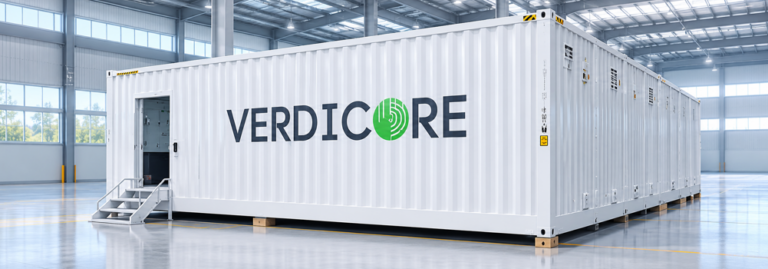
Wall-mounted and enclosure precision units share a 12.5 kW to 21.2 kW platform built around an inverter refrigerant pump and a dual-mode controller. They are the correct answer for prefabricated container data centers, where the enclosure is a steel box with no room to condition and the condenser sits outside the envelope.
The inverter pump matters more than the kW figure here. A container running at 15% IT load in its first year needs the compressor to turn down without cycling, and a fixed-speed unit will either short-cycle or hold a wide temperature band. For containerized data center temperature control, that part-load behaviour determines whether the first year of operation is stable.
Where Data Center Temperature Control Sits Between Air and Liquid
A published guidance puts air cooling at its practical limit around 20 kW per rack, with rear-door coils covering 20 to 80 kW. ASHRAE’s H1 class, for high-density air-cooled equipment, narrows the recommended inlet to 18–22°C — which is difficult to hold in a hall also serving A1 equipment at 27°C.
The data center temperature control table that follows from this is short. Below 5 kW per rack, a rack unit or a room unit both work; the choice is about access, not thermodynamics. From 5 to 15 kW, in-row units with containment. From 15 to 30 kW, multiple in-row units or rear-door heat exchangers. Above 30 kW, air stops being the right answer and the conversation moves to liquid.
End-of-Row Placement, the Middle Path
End-of-row placement is the middle path that catalogues rarely advertise. Instead of a perimeter unit or a full in-row column, one or two in-row units sit at the end of a contained cold aisle and discharge into it. The air path is shorter than a perimeter unit’s and the unit does not consume a cabinet position. For a 15-rack hall at 8 kW per rack, two 50 kW in-row units at the row end cover 120 kW of IT load with one unit spare.
What this arrangement gives up is uniformity. An end-of-row unit pushes air down a 9 m aisle, and the rack furthest from the discharge runs 2–4 K warmer than the nearest one unless the containment is properly sealed and the perforated tiles are balanced. That gradient is tolerable inside the ASHRAE band and intolerable if the floor is being run at the top of it, which is why end-of-row data center temperature control projects usually settle at 22–24°C supply rather than 27°C.
What a Data Center Temperature Control Comparison Leaves Out
Three items dominate the list. Coil fouling is the failure mode that never appears in a selection table. A unit that delivers its rated capacity on a clean coil in the factory loses it steadily once dust binds to the fins, and the loss is invisible until return air temperature starts climbing. GRD Qatar’s containerized installation runs in exactly that environment, which is why filter loading needs a pressure switch and not just a maintenance calendar. A data center temperature control plan that budgets capacity for a clean coil is budgeting for a state the unit reaches once.
Refrigerant pipe length is the second. Most air-cooled precision units work to a standard outdoor ambient limit and need a low-temperature kit below it — the units we build are specified at −15°C as standard and −35°C with the kit, and long pipe runs erode both figures further through suction-line pressure drop. A site that assumes the standard unit will run through a Mongolian or northern-China winter is buying a service call in the first January.
The third is condensate. Every unit in this comparison produces it, and a failed pump inside a sealed enclosure with IP55 walls has nowhere to send it. On a container site the usual result is water tracking along the floor to the battery cabinet, which is the most expensive place it can end up.