

Data center liquid cooling solutions have moved from experimental technology to essential infrastructure as AI workloads push rack densities past 100 kW. Grand View Research pegs the global market at $6.7 billion in 2025, climbing toward $29.5 billion by 2033. With industry-wide PUE stagnant at 1.54 for six straight years, liquid-cooled facilities consistently achieve 1.03 to 1.20 PUE, making these systems the most reliable route to thermal stability and energy savings.
Why Are Data Center Liquid Cooling Solutions Becoming Essential?
Data center liquid cooling solutions have become essential because air cooling hits a physical ceiling near 20 kW per rack. AFCOM’s 2026 State of the Data Centre Report shows AI-heavy facilities jumping from 16 kW average rack density in 2025 to 27 kW in 2026, up 69 percent year on year. NVIDIA GB200 NVL72 racks draw up to 120 kW; a single B200 GPU generates roughly 47,900 BTU per hour at peak load.
Uptime Institute’s Cooling Systems Survey 2025 found only 22 percent of operators use direct liquid cooling, while 75 percent still rely on perimeter air cooling. Yet 61 percent say they would consider adopting data center liquid cooling solutions in the future. The gap between current adoption and future intent explains why these systems are moving from niche specialty to standard specification for new AI facilities.
What Are the Main Types of Data Center Liquid Cooling Solutions?
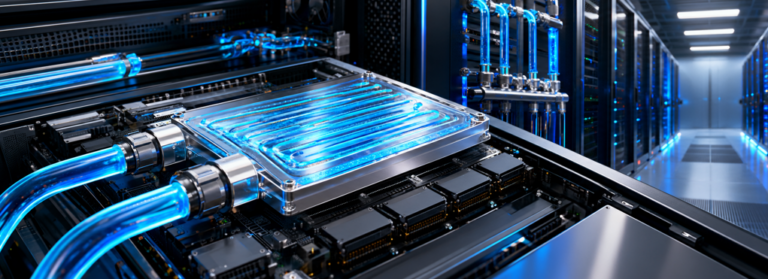
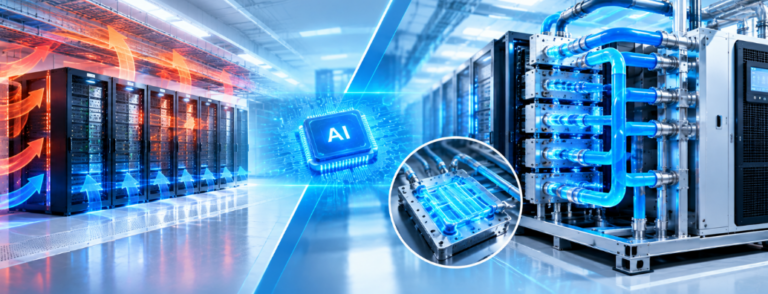
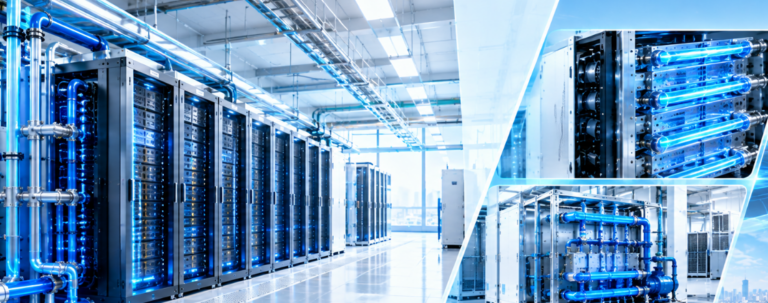
Three architectures dominate the market. Direct-to-chip cooling mounts cold plates on CPUs and GPUs, capturing heat at the source through a closed coolant loop. Immersion cooling submerges entire servers in dielectric fluid, either single-phase or two-phase. Rear-door heat exchangers add liquid loops behind racks to supplement air systems. Among data center liquid cooling solutions, direct-to-chip held roughly 60 percent of solution revenue in 2025, while immersion grows fastest for AI training clusters.
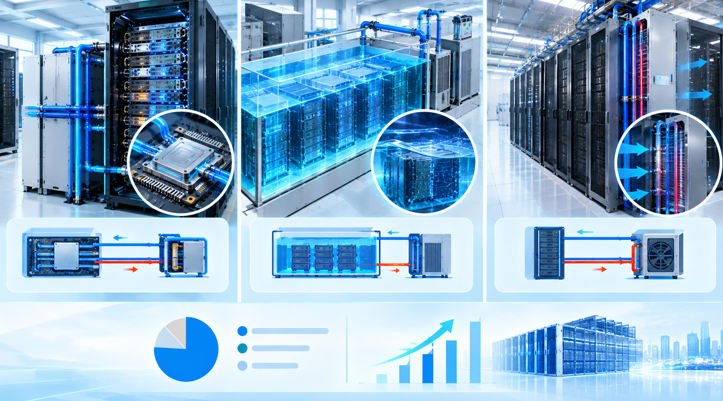
Component choices matter as much as architecture. A standard direct-to-chip system combines cold plates, thermal interface materials, manifolds, quick disconnects, a circulation pump, and a coolant distribution unit. Water-based loops account for 64 percent of direct cooling deployments, while dielectric fluids cover 30 percent, according to Uptime Institute. These data center liquid cooling solutions vary mainly in how they manage flow, redundancy, and leak containment.
Direct-to-Chip or Immersion: Which Liquid Cooling Solution Fits Your Workload?
Direct-to-chip suits most enterprise and colocation environments because it retrofits into existing racks without full facility rebuilds, extending capacity from 60 to 120 kW per rack. Immersion targets greenfield hyperscale campuses, where single-phase systems reach PUE values around 1.05 and two-phase designs approach 1.03. When comparing data center liquid cooling solutions, remember that immersion removes server fans entirely, cutting acoustic noise and failure points but demanding new facility plumbing.
Immersion wins when density and efficiency outrank retrofit convenience. Single-phase immersion keeps coolant in liquid form and simplifies fluid handling, while two-phase immersion boils and condenses fluid for higher heat rejection but adds pressure control complexity. For extreme thermal design power beyond 1,000 W per chip, immersion offers headroom that cold plates cannot match, making it the choice for next-generation AI training clusters.
Use this selection checklist:
- Retrofit constraint: Choose direct-to-chip when adding 40 to 100 kW to existing racks with minimal disruption.
- Density target: Pick immersion when racks must exceed 100 kW or PUE below 1.10 is mandatory.
- Capital profile: Direct-to-chip carries lower upfront cost; immersion rewards long-running AI training campuses.
- Service maturity: Most data center liquid cooling solutions rely on certified installers, so verify local support before committing.
How Much Can Data Center Liquid Cooling Solutions Reduce Energy Costs?
Cooling can consume up to 40 percent of a data center’s total energy draw, and air systems waste much of that moving air instead of removing heat. Direct-to-chip cooling can cut cooling subsystem energy use by up to 90 percent and deliver facility-wide savings of 20 to 30 percent, according to Dober’s 2025 technical analysis. These data center liquid cooling solutions typically report PUE between 1.03 and 1.20, versus 1.50 to 2.00 for air-cooled sites.
Global averages underline the opportunity. Uptime Institute’s 2025 survey shows industry-wide PUE holding at 1.54 for six consecutive years, while hyperscale operators reach 1.10 to 1.15. Lawrence Berkeley National Laboratory projects data center electricity consumption rising from 176 TWh in 2023 to between 325 and 580 TWh by 2028. Closing that gap depends on deploying data center liquid cooling solutions at scale rather than optimizing legacy air systems.
What Are the Real Challenges of Deploying Liquid Cooling?
Initial capital remains the largest barrier. Liquid cooling adds roughly 50 to 100 percent to per-rack cooling investment compared with air systems, according to CCID Consulting’s 2025 market report. Retrofitting legacy raised-floor facilities requires careful heat-path redesign, controls integration, and safety procedures. Supply chains for cold plates, quick disconnects, and coolant chemistries still lag hyperscaler deployment schedules, creating lead-time risk for any data center liquid cooling solutions project.
Skills and standardization also lag. Many operators lack in-house expertise for monitoring coolant flow, pressure, and leak integrity, which differ fundamentally from air handling. Industry groups such as the Open Compute Project and ASHRAE TC 9.9 are publishing open designs and updated guidelines, but proprietary interfaces still raise integration costs. Adoption of data center liquid cooling solutions demands disciplined commissioning and leak testing before production loads are connected.
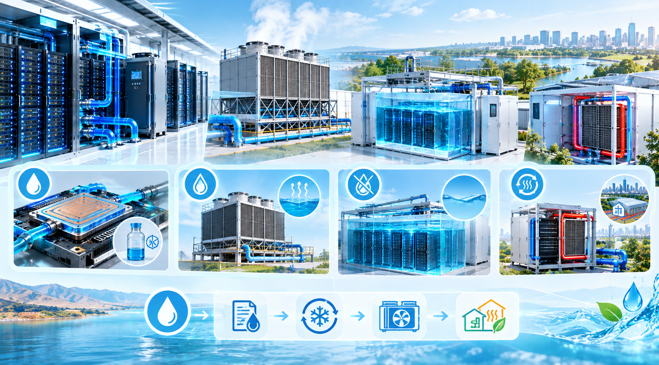
Water consumption raises another consideration. Direct-to-chip loops typically use water-glycol mixtures, and evaporative towers consume significant volumes in warm climates. Dielectric immersion fluids eliminate evaporation losses but carry higher procurement and replacement costs. Operators in water-stressed regions should model total water usage, compare closed-loop dry cooling options, and evaluate heat-recovery integration before selecting a final design.
How Do Operators Deploy Liquid Cooling Without Disrupting Uptime?
Successful deployments follow a phased path that protects availability. Google reports 99.999 percent uptime across roughly 2,000 liquid-cooled TPU pods, representing about 1 GW of capacity and half its global footprint. Meta’s air-assisted liquid cooling retrofit in Prineville improved PUE while raising compute density. These data center liquid cooling solutions prove that both greenfield builds and legacy transitions can proceed without full rebuilds or downtime windows.
Phased rollout requires honest capacity planning. Begin with one pilot row, instrument it with flow and pressure sensors, and collect at least four weeks of telemetry before expanding. Pair the pilot with a redundant cooling distribution unit so a single failure cannot take down production. Document baseline temperatures, coolant delta-T, and pump energy so later phases can be benchmarked against measured data rather than assumptions.
Follow this deployment sequence to minimize risk:
- Conduct a thermal audit to map hot spots and quantify per-rack kW.
- Pilot one row with a 2 MW-class cooling distribution unit before scaling.
- Validate coolant quality, flow rates, and leak detection with dry-run testing.
- Train facility staff on CDU maintenance and redundancy switching.
- Monitor pressure signals, which typically warn 2 to 5 minutes before temperature alarms.
- Track performance metrics so future data center liquid cooling solutions scale predictably.
What Does the Future Hold for Data Center Liquid Cooling Solutions?
The market trajectory is steep. Grand View Research forecasts demand for data center liquid cooling solutions growing from $8.2 billion in 2026 to $29.5 billion by 2033 at a 20.1 percent CAGR, with Asia Pacific the fastest-growing region. Dell’Oro Group estimates liquid cooling penetration in AI data centers rising from 14 percent in 2024 to roughly 33 percent in 2025. Mega-deals such as Eaton’s $9.5 billion acquisition of Boyd Thermal signal deepening consolidation across the supply chain.
Technology standards are opening up. Google contributed its Project Deschutes CDU design to the Open Compute Project, and 2 MW-class CDUs are becoming the industry norm, with Schneider Electric and Motivair already shipping a 2.5 MW unit. Two-phase immersion, embedded microfluidic channels, and waste-heat reuse systems are advancing rapidly. These developments will make data center liquid cooling solutions more interoperable, easier to service, and cheaper to own over the next decade.
How to Choose the Right Data Center Liquid Cooling Solution?
Match the solution to your density trajectory, not to vendor marketing. If racks stay below 20 kW, high-efficiency air cooling with containment remains cost-effective. Between 20 and 40 kW, hybrid approaches such as rear-door heat exchangers make sense. Above 40 kW, direct-to-chip cooling is the practical default, and immersion becomes attractive beyond 100 kW or when PUE targets fall below 1.10. Budget for services, the fastest-growing segment in data center liquid cooling solutions.
Vendor selection deserves equal rigor. Evaluate total cost of ownership across a five-year horizon, including coolant replacement, filter changes, and service contracts. Ask for reference deployments with similar rack densities and verify measured PUE outcomes rather than marketing claims. Prioritize vendors with open-standard interfaces, local service capacity, and documented leak-containment procedures, because operational reliability depends on the ecosystem around the hardware as much as the hardware itself.
How Do Data Center Liquid Cooling Solutions Support Sustainability Goals?
Data center liquid cooling solutions support sustainability in three measurable ways: lower cooling energy, higher compute density per square meter, and recoverable waste heat. Facilities replacing air systems report facility-wide energy savings of 20 to 30 percent, directly reducing scope-two emissions. Higher density means more compute per megawatt of power and per unit of floor space, shrinking the embodied carbon footprint of new construction.
Waste-heat recovery turns cooling from a cost center into a resource. German regulations now require new data centers opening between 2026 and 2028 to reuse 10 to 20 percent of waste heat, according to the German Energy Efficiency Act. Liquid loops capture heat at higher temperatures than air exhaust, making district heating and building reuse practical. Operators planning liquid infrastructure should position heat exchangers and piping for future recovery connections.
Data center liquid cooling solutions face a clear verdict: they are the most energy-efficient path for AI-era facilities, but they reward disciplined planning. Start with a thermal audit, pilot before scaling, standardize on open designs, and budget for services and training. Operators who follow that sequence will reach PUE below 1.20, cut cooling energy by up to 90 percent, and unlock rack densities beyond 100 kW while competitors remain constrained by air cooling physics.